



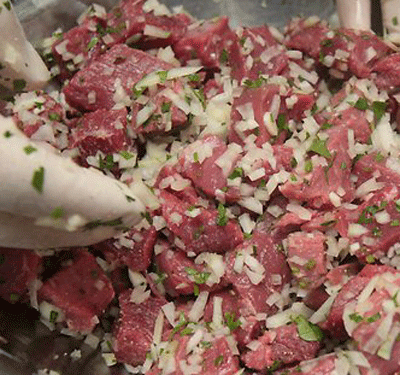
 VANCOUVER: The world's first "test-tube" meat, a hamburger made from a cow's stem cells, will be produced this fall, Dutch scientist Mark Post told a major science conference on Sunday.
Post's aim is to invent an efficient way to produce skeletal muscle tissue in a laboratory that exactly mimics meat, and eventually replace the entire meat-animal industry.
The ingredients for his first burger are "still in a laboratory phase," he said, but by fall "we have committed ourselves to make a couple of thousand of small tissues, and then assemble them into a hamburger."
Post, chair of physiology at Maastricht University in the Netherlands, said his project is funded with 250,000 euros from an anonymous private investor motivated by "care for the environment, food for the world, and interest in life-transforming technologies."
Post spoke at a symposium titled "The Next Agricultural Revolution" at the annual meeting of the American Association for the Advancement of Science in Vancouver.
Speakers said they aim to develop such "meat" products for mass consumption to reduce the environmental and health costs of conventional food production.
Conventional meat and dairy production requires more land, water, plants and disposal of waste products than almost all other human foods, they said.
The global demand for meat is expected to rise by 60 percent by 2050, said American scientist Nicholas Genovese, who organized the symposium.
"But the majority of earth's pasture lands are already in use," he said, so conventional livestock producers can only meet the booming demand by further expansion into nature.
The result would be lost biodiversity, more greenhouse and other gases, and an increase in disease, he said.
In 2010 a report by the United Nations Environment Program called for a global vegetarian diet.
"Animal farming is by far the biggest ongoing global catastrophe," Patrick Brown of the Stanford University School of Medicine told reporters.
"More to the point, it's incredibly ready to topple, it's inefficient technology that hasn't changed fundamentally for millennia," he said.
"There's been a blind spot in the science and technology community (of livestock production) as an easy target."
Brown, who said he is funded by an American venture capital firm and has two start-ups in California, said he will devote the rest of his life to develop products that mimic meat but are made entirely from vegetable sources.
He is working "to develop and commercialize a product that can compete head on with meat and dairy products based on taste and value for the mainstream consumer, for people who are hard-core meat and cheese lovers who can't imagine ever giving that up, but could be persuaded if they had a product with all taste and value."
Brown said developing meat from animal cells in a laboratory will still have a high environmental cost, and so he said he will rely only on plant sources. Both scientists said no companies in the existing meat industry have expressed interest.





















Comments
Comments are closed for this article.