



 NICOSIA: On the resort island of Cyprus, whose stricken economy is closely linked to Greece, residents and politicians are nervously watching the crisis unfolding in Athens but hoping that a giant offshore gas discovery will save them.
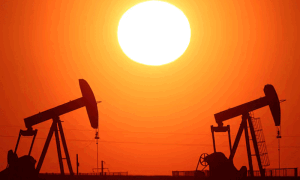
In December, US firm Noble Energy said it had discovered gas reserves of up to eight trillion cubic feet (225 billion cubic metres) beneath the seabed south of Cyprus, which has an estimated value of 100 billion euros ($131 billion).
"And it is just the beginning," said hydrocarbons expert Pierre Godec.
The reservoir, named Aphrodite after the Greek goddess, born according to legend in Cyprus waters, is situated some 40 kilometres (24 miles) from Israel's Leviathan and Tamar fields, also discovered by Noble and Israel's Delek Energy.
On Monday, Cyprus launched a new licensing round for its 12 remaining offshore exploration blocks, which it hopes to award by the end of the year, despite the strong objections of Turkey.
Noble's announcement was a ray of hope for Cypriots, who experienced their first recession in 30 years in 2009.
The economy, already hit by the euro-zone debt crisis, was sent deeper into turmoil by a deadly munitions blast last July that destroyed the island's main power plant.
The Greek crisis has aggravated the difficulties facing Cyprus, which, apart from the breakaway Turkish state-let in the north, has strong cultural and economic ties to Greece.
Cypriot banks are heavily exposed to Greek sovereign debt and have already had to write-off two billion euros the country owed them, economists say, a hefty sum for a country with less than 900,000 inhabitants.
The top three rating agencies have all downgraded Cyprus, restricting its access to international debt markets, with Fitch warning that the country would need a Greek-style European bailout.
But in a boost to the eurozone country, and aided by the expectation of future gas earnings, Cyprus managed to secure late last year a 2.5-billion-euro Russian loan to help cover its financial requirements for 2012.
"The situation in Cyprus is not as bad as Greece, far from it," said economist Costas Apostolides, stressing that Cypriot banks had deposits of around 60 billion euros, and that measures had already been taken to reduce the country's debt.
As an example, Cypriot public debt, which stands at around 61 percent of GDP, compares with a figure of 160 percent in Greece. And the unemployment rate is only seven percent, in contrast with 20 percent in Greece.
But the International Monetary Fund estimated Cyprus's public deficit at some 7.0 percent of GDP in 2011, way above the 3.0 percent limit set by the European Union.
So the fund and the European Commission ordered the island nation, which joined the eurozone in 2008, to adopt a debt reduction plan. Cyprus has already raised taxes and frozen public sector salaries in a bid to avoid a bailout.
But few Cypriots are willing to accept the kind of tough austerity measures imposed on Greece, and local newspapers regularly publish articles raising hopes about the potential benefits of the newly found gas reserves.
"The gas will change our quality of life, not straightaway, but over the next ten years we could become like the oil-rich kingdoms in the Gulf, countries where life is good," said Cleonthios Adamou, a computer teacher.
Economist Apostolides estimated that, with a bit of luck, the government would get one billion euros per year in gas revenues, "which amounts to a third of our budget."
But others caution against betting on a future hydrocarbons windfall.
"Some are already taking the future revenues into account in their behaviour, and politicians fear that will make the electorate resist any (austerity) efforts, as the gas will not be sold for another eight to ten years," said Godec, the energy expert.
Economist Zenon Kontolemis agreed, warning of the "strong temptation to spend the money even before it comes in."

















Comments
Comments are closed for this article.