


Industrial competitiveness with technological breakthrough is imperative to successfully survive in the fast changing global environment and in this connection workable and result-oriented Industry-Academia linkages could play a major role, said Engr Ahmed Hassan, Chairman FCCI standing Committee on R&D.
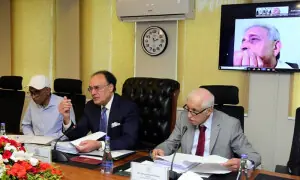
The chairman R&D met with Brigadier Tariq Javed, Commandant NUST (National University of Science & Technology) College of Electrical and Mechanical Engineering and Dr Abdul Ghafoor Principal/Dean NUST School of Mechanical and Manufacturing Engineering to discuss the modalities to ink a Memorandum of Understanding (MOU) between the two organizations.
Both the sides emphasized the importance of industry-academia linkages for the national economy and agreed in principle to encourage cooperation between the NUST and FCCI. Representing FCCI, Chairman R&D mentioned that Faisalabad is one of the largest industrial hubs of Pakistan, contributing around 20 per cent to the national GDP and 35 per cent to the national exports. He said that FCCI is the premier association of the business community of this important economic city.
He also informed NUST officials that keeping in view the importance of research and development, FCCI has established a full-fledge Research and Development (R&D) Center to serve its members. "A key objective behind the establishment of this department is to promote industry-academia linkages by providing a bridge between the industry and leading academic and research institutions through the R&D center", he added.
He pointed out that the Pakistan was facing a major problem in the area of foreign trade as the country's exports have seen a continuous declining trend over the past few years while imports have been on the rise. "Despite low cost of labour in Pakistan, our industry has seen a decrease in competitiveness, and we have already lost a large chunk of our global market share in many products, including textiles", he said and added that the primary reason for this is low productivity and efficiency coupled with lack of emphasis on new ideas and innovation.
He said, "We have to adopt current trends of technological advancement in the world, if we want to achieve sustainable economic growth and this could be achieved only through the collaboration of industry and key academic institutions".



















Comments
Comments are closed for this article.