


Remittance: What’s driving the surge?
Pakistan's home remittances surged 14% in 4MFY27, reaching $14.8 billion, driven by factors like shifts from informal channels, SBP incentives, and better exchange rates, significantly aiding the current account.
- Reasons for the unexpected surge in remittance inflows.
- Dubai's outlier performance in remittance contributions.
- Shift of informal money flows to formal banking channels.
- SBP incentives and favorable exchange rates influencing inflows.

The upbeat momentum in home remittances continues to surprise market participants. Inflows in 4MFY27 are up by 14 percent to USD14.8 billion. The October tally is exceptionally strong, up by 14 percent YoY to nearly USD3.9 billion in a non-seasonal month. The numbers are encouraging and should help keep the current account deficit in check.
The question is what is driving these higher flows. There is a visible upward trend, especially from Dubai, which has been an outlier ever since the war broke out in the region. Flows from Dubai are up by 21 percent during March–October 2026 compared to the same period last year, while overall remittances grew by 9 percent during the same period.
This is counterintuitive, as more than half of the country’s remittances come from GCC countries, where there is a visible economic slowdown and employment opportunities are thinning, especially in Dubai. Hence, there is more to explain.
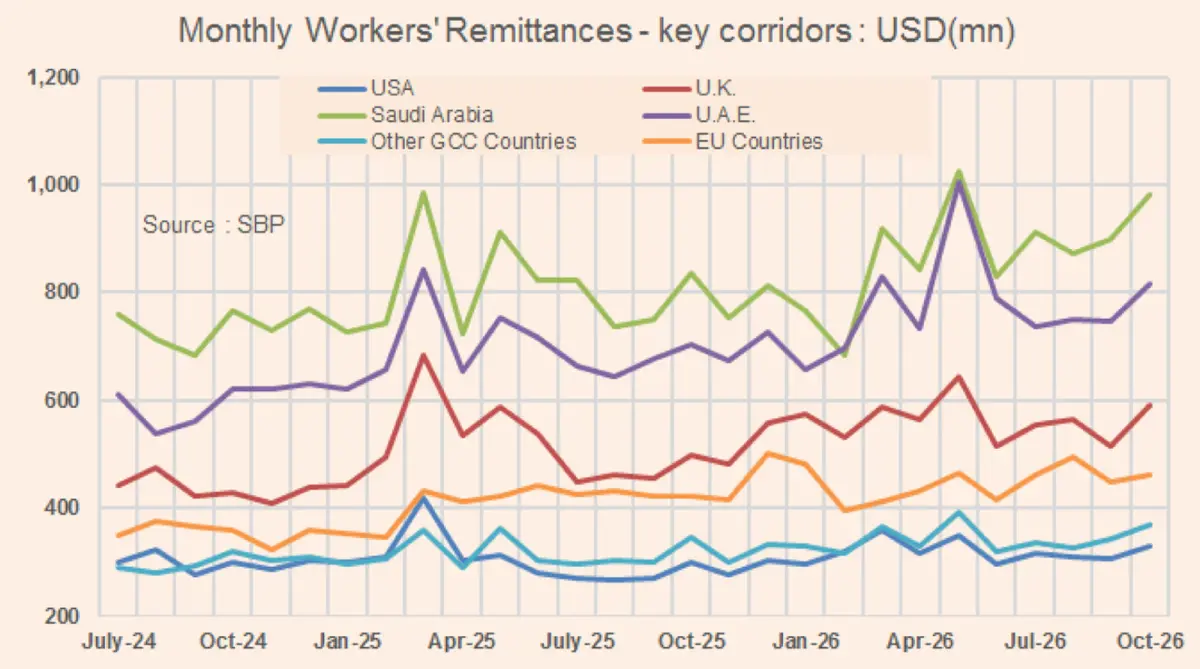
One possible reason is that people are bringing back their parked savings, as Pakistanis are among the leading investors in UAE real estate and other businesses. Then there are cases of workers returning home and bringing their savings with them. These two factors were more visible in the early months, from March to May 2026.
Another, perhaps more plausible, explanation is the stoppage or slowdown of money flowing out of Pakistan to other jurisdictions, mainly Dubai. These outflows are usually netted off against inward flows through the hundi-hawala system. With fewer outflows through the informal market, some inward remittances are shifting to formal banking channels.
Then there is the SBP’s recently introduced remittance incentive scheme for banks, under which cash prizes are offered to remitters through a balloting process, with the cost borne by banks. Some remitters may shift to formal channels for a chance to win a prize.
Another reason for higher remittance inflows is the better exchange rate offered by banks to remitters compared to exporters, especially in months when import payment pressures are higher. When banks have more payments to make, they offer a higher premium to attract remittances. Seeing the better rates, some small export proceeds, such as freelance income, may be routed and reported as remittances. Higher rates also encourage informal flows to move into the formal market.
It is difficult to determine which of these factors is contributing the most to formal remittance inflows. A better assessment could be made by examining trends in the average ticket size of remittance transactions. A significant increase could indicate reverse capital flight. If the average ticket size remains largely unchanged, it would suggest that more flows are shifting from the grey market to the formal banking system.
BR Research asked several banks whether they had observed any changes in their own remittance transactions. According to one large bank, the average ticket size has increased by 10–12 percent. Another bank reported an increase from USD300 to USD400. However, both pointed to a possible explanation: the change in the minimum transaction value eligible for rebates, which has been raised from USD100 to USD200 per transaction.
The SBP Governor recently stated that there has been no meaningful change in the average ticket size. He is also hopeful that higher remittance inflows will continue. The SBP has revised its FY27 remittance projection upward by USD1 billion to USD45 billion.
Given the current trend, the upbeat momentum in remittances is likely to continue, with inflows potentially surprising on the upside and increasingly becoming an anchor of Pakistan’s balance-of-payments stability.


















Comments