


A senior Pakistani industrialist and exporter whom I regard as a mentor sent me the other day Tresmark’s commentary on exports and the rupee. Its device was an imaginary fifth panelist responding to a Harvard discussion.
The questions, however, were painfully real. Behind my mentor’s message was the frustration of a man who has spent his life producing in Pakistan and selling to the world. How long can a country demand more export dollars while making them progressively harder to earn?
Tresmark identifies the central failure with admirable clarity: “Pakistan’s problem isn’t excessive remittances. It’s actually insufficient exports.” Overseas Pakistanis deserve our gratitude. Their earnings support households and sustain the external account. But the breathing space they provide must be used to build productive capacity at home. Governments cannot keep treating money earned abroad by our people as an excuse for neglecting what our businesses could earn from the world.
The latest figures sharpen the warning. The World Bank’s October 2026 update records approximately USD 40.8 billion in goods and services exports in FY2026, against USD 41.6 billion in remittances. Pakistan earned less than a dollar through exports for every dollar remitted. Total exports were virtually unchanged from FY2025; growing services exports offset a decline in goods exports. This is an inadequate foundation for the ambitions of a country of Pakistan’s size.
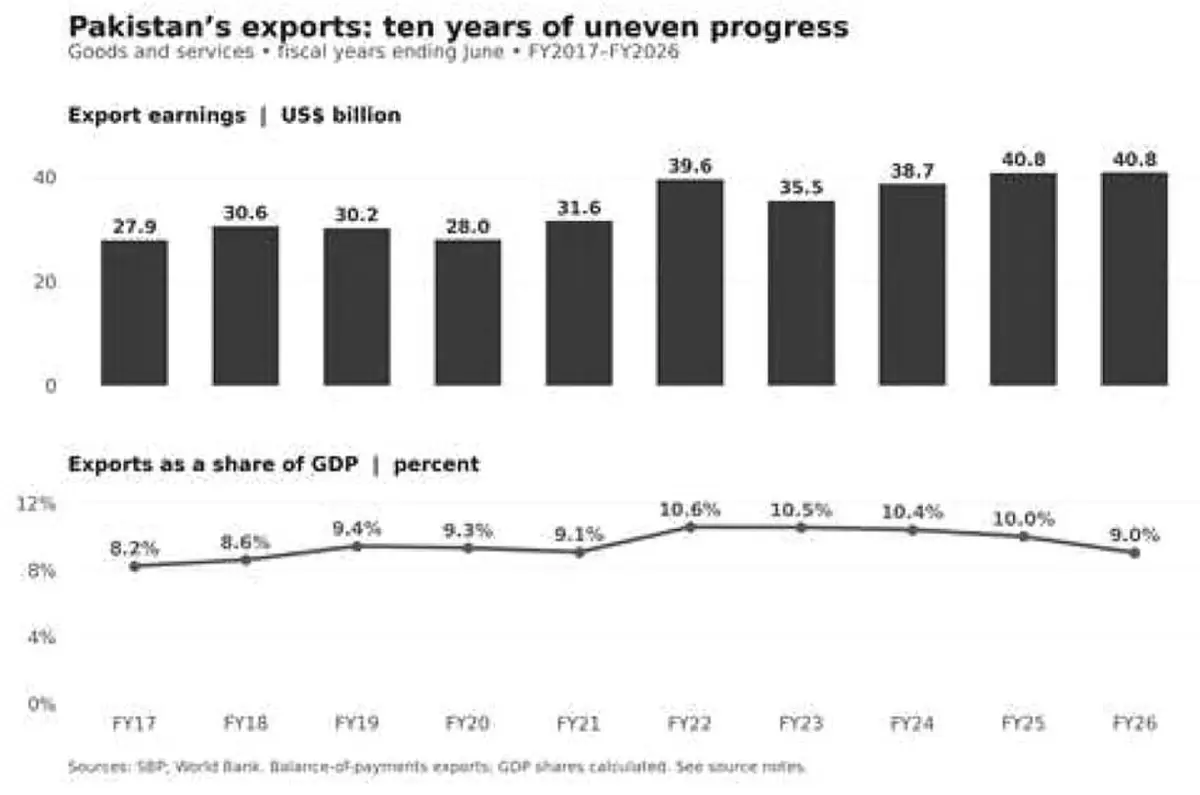
Figure 1. Total goods and services exports, not merchandise exports alone. Fiscal years end in June. Nominal US dollars; FY2026 GDP is an estimate.
The 10-year record deserves an honest reading. Exports rose from USD 27.9 billion in FY2017 to USD 40.8 billion in FY2026: about 4.3 percent annual growth in nominal dollars. Their share of GDP rose from 8.2 percent to a peak of 10.6 percent in FY2022, then slipped to 9.0 percent. The decade contains gains, reversals and a failure to sustain momentum. A government serious about exports would explain what will make the next decade different.
Population growth makes this failure more urgent. The 2023 census recorded 241.49 million people and average annual population growth of 2.55 percent between 2017 and 2023. Each successive cohort needs productive employment. With a growing population, flat export earnings mean fewer export dollars per person; domestic demand and import requirements meanwhile keep expanding. A demographic dividend requires education, skills, women’s participation and firms capable of selling beyond our borders. Voluntary family planning and girls’ education belong alongside economic reform. Sending more young people abroad cannot be the principal answer to failing to create opportunities for them at home.
My recent Business Recorder article with Nadeem ul Haque, published on October 12, 2026, was titled “The dollars come home. Pakistan’s future leaves.” We argued that celebrating remittance records conceals the costs of dependence. Tresmark’s distinction between excessive remittances and insufficient exports is useful, but incomplete: the two are connected through the incentives facing producers and policymakers.
The mechanism is straightforward. Remittance inflows can support a stronger nominal rupee, or sustain it while domestic prices rise. Spending on land, construction and other locally supplied services can also raise their prices relative to internationally traded goods. Exporters then face higher local costs while their selling prices remain constrained by world markets. This real appreciation squeezes margins and can make property or protected domestic business more attractive than exporting: the familiar Dutch-disease risk.
Dependence adds another cost: transfers finance consumption and imports while easing pressure on the state to remove barriers to production. Migration can also take away technicians, managers and entrepreneurs whom export firms need. Remittances can finance education and enterprise; their effects are not uniformly harmful. The indictment is of a policy model that relies on them to accommodate weak exports, even as that dependence can weaken the incentives to export.
Instead, the debate repeatedly retreats to the price of the dollar. Tresmark supplies the necessary warning: “A weak Rupee is not an export strategy.” Depreciation can improve returns on domestic production sold abroad, but it also raises the cost of imported fuel, machinery and raw materials. It cannot compensate indefinitely for expensive energy, obstructive taxation, low productivity and rules that change after an investment has been made.
Nor does a motionless exchange-rate display prove that competitiveness is intact. The World Bank estimates that Pakistan’s real effective exchange rate appreciated by 10 percent between end-June 2025 and July 2026. When domestic costs rise relative to those of competitors, a stable nominal rupee can conceal a worsening commercial position. The exporter feels the deterioration in a rejected quotation long before it appears in a policy speech.
Tresmark’s sharpest observation deserves to be repeated: “You cannot distort the price of a currency for a decade and expect one sharp correction to produce a decade’s worth of export growth.” A devaluation cannot instantly create machinery, trained workers, certifications or relationships with international buyers. Those require investment over years. Repeatedly suppressing adjustment and then administering a shock destroys the predictability that investment needs.
The State Bank should allow the exchange rate to respond to economic conditions, curb disorderly trading and improve access to hedging. Promising a depreciation path, as Tresmark suggests, could itself encourage speculation. Predictability should come from credible institutions and consistent policy.
The deeper failure lies in what Pakistan rewards. As Tresmark puts it: “An economic system that rewards protection over productivity will struggle to produce globally competitive businesses.” The State Bank has itself identified the anti-export bias of our tariff structure. Protection makes domestic sales more attractive while duties on inputs can make exports more expensive. Businesses respond to the incentives governments create. Ministers should stop expressing surprise at the result.
Industry must also answer for its choices. Firms cannot demand international prices for inputs while insisting on permanent protection for their products. Support should be transparent, open to new entrants and subject to review. Public policy must make competition possible and require businesses to compete.
Productivity is central to this argument. Pakistan will not achieve the transformation it needs while sheltering firms from international competition. Overseas buyers compare price, quality and delivery against the world’s best available suppliers. Meeting that test forces businesses to reduce waste, adopt technology, improve management and train workers. Larger markets make specialised equipment and research commercially worthwhile; demanding buyers transmit knowledge and standards. Education and investment create the capacity to improve, while sustained competition supplies the pressure to use it. Higher output and value per worker allow wages to rise without pricing products out of the market.
Where are Pakistan’s global industrial champions? We have capable exporters, but have failed to build a broad base of companies with world-scale sales, proprietary technology and internationally recognised brands. The World Bank has documented the underlying stagnation: formal firms operating for 10–15 years were roughly the same size as firms operating for more than 40 years. This is a verdict on an economic system that fails to reward expansion, innovation and productivity. The state’s task is to create conditions in which competing firms can grow to international scale. Protecting established groups from competition achieves the opposite.
Then comes the tax system. Wonder of wonders, exporters face high and economically illogical tax burdens and an additional export-specific advance deduction from their receipts, alongside minimum-tax collection. This particular export-proceeds deduction does not apply to ordinary local sales, although domestic businesses face their own advance-tax and withholding obligations. Calling the deduction “adjustable” does not put the cash back into the exporter’s bank account when the next order must be financed.
Raw materials must be purchased, wages paid and shipments completed before the final annual tax liability is settled. For firms working on thin margins, advance deductions, delayed refunds and expensive borrowing drain working capital and can put expansion beyond reach. The exporter is compelled to finance the treasury while searching for finance to keep the factory running. The government then asks why investment is weak. It should first calculate how much capacity to invest its own collection practices have removed.
The reduction in collection on export proceeds is welcome, but the cash-flow problem remains. Collections should reflect likely liability, with prompt adjustments where deductions exceed it. Refunds need enforceable deadlines and interest on unjustified delays. Fraud should be pursued through targeted scrutiny. Withholding a compliant exporter’s money is an easy way to improve a revenue statement and a costly way to weaken the business that generates the revenue.
Energy policy exposes the same contradiction. The stated purpose of the captive power levy includes moving industry to the grid and improving the utilisation of surplus generation capacity. But an exporter cannot send an overseas buyer a supplementary invoice for Pakistan’s unused power plants. A charge imposed to repair electricity-sector finances can make an export order unviable. The effect must be measured against the export earnings, employment and investment put at risk.
Efficient cogeneration must be assessed on useful electricity and heat together. Gas pricing should recognise scarcity and allow competitive supply through regulated network access. The grid must earn industrial customers through dependable service and competitive costs. Making an alternative more expensive does not establish that the grid has become efficient.
Pakistan must also stop taxing and restricting the inputs its exporters need to compete. Fibres, chemicals, machinery and components are often essential to producing the next shipment. Protecting one upstream producer can raise costs for many downstream exporters. A published tariff reform schedule, efficient access to export inputs and firm action against diversion would serve production better than another discretionary exemption negotiated behind closed doors.
Diversification requires practical decisions: competitively priced man-made fibres for textiles, testing and certification for manufacturers, reliable connectivity for services, and finance against credible orders for smaller firms. A list of priority sectors is useless if the same bottlenecks obstruct each one.
None of this excuses fiscal irresponsibility. Permanent subsidies financed by borrowing will eventually return as another surcharge on production. Reform must broaden taxation of undertaxed income and property, restrain wasteful expenditure and address loss-making public enterprises. The treasury cannot secure lasting revenue by repeatedly squeezing the businesses already visible to it.
The prime minister should require one export reform programme with named ministers, published deadlines and consequences for failure. Within ninety days, disclose refund arrears, the full taxes and levies embedded in industrial energy costs, and the principal regulatory obstacles to fulfilling export orders. Within 12 months, report progress on refund times, customs clearance, energy costs, new exporters and investment in capacity. Publish export volumes and market share alongside dollar receipts so that price movements cannot masquerade as industrial success.
Every ministry proposing a new charge on production should explain its effect on the delivered cost of an export. Business associations should be heard alongside smaller firms, potential entrants and independent researchers. Export policy will remain compromised if those with the strongest access to government can preserve their privileges while passing the costs down the production chain.
My mentor’s message was an appeal from someone who has committed capital, effort and faith to Pakistan. Such people should not have to plead for commercial survival while officials celebrate stabilisation. Stability must make room for productive firms to grow, hire, innovate and compete abroad.
I hope someone in the corridors of power reads this and acts. Patriotism cannot replenish working capital. An appeal to national duty cannot make an uneconomic export order profitable. If Pakistan wants its exporters to earn more dollars, it must stop taking away the means to earn them.
Copyright Business Recorder, 2026



















Comments