



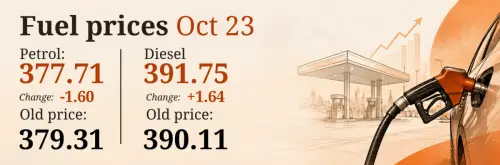
EDITORIAL: The Monetary Policy Committee meeting to review the 11.5 percent policy rate is scheduled for 26 October and there are serious concerns that the rate may be raised as inflation remains in double digits due largely to the rise in the international prices of petroleum and products as the Middle East conflict will enter eighth month on the 1 November.
In May, the Consumer Price Index (CPI) was 11.7 percent, in June 11.1 percent, dipping in July to 9.2 percent and rising again to 11.1 percent in August and with a less than one per cent decline in September to 10.3 percent.
In contrast, core inflation has been more resilient, hovering between 8.6 percent in September and 8.8 percent in August 2026 - an indicator used to justify the MPC’s decision not to raise the policy rate since 28 April 2026 – a rate that remained prevalent even when core inflation rose from 7.4 percent in March this year to 8 percent in April and 9 percent in May. This lack of synchronicity between inflation and the policy rate is justified through business survey results undertaken by the State Bank of Pakistan and the consistent claim in the Monetary Policy Statement that medium-term inflation outlook remains between 5 and 7 percent.
It is little wonder that the prevailing opinion of independent economists is that the actual decision to adjust the policy rate is taken during discussions with the International Monetary Fund (IMF), which may explain why there is no majority decision on the rate. In this context it is relevant to note that after each quarterly review under the ongoing Extended Fund Facility programme there is an exhortation to maintain “an appropriate monetary stance,” which in the 7 October press release issued after the fourth staff-level agreement was reached clarified that the SBP “should continue maintaining appropriately tight policy stance to ensure inflation returns durably to the SBP’s target range.”
It is relevant to note that in Pakistan the linkage between the policy rate and inflation control is tenuous at best for two reasons: (i) growth of government consumption outpaces the growth of household consumption - 18.8 percent against 11.37 percent in 2026 - with the former accounting for 82 percent of GDP while the latter, which is mainly budgeted for current expenditure, accounts for 9.94 percent (rising from 8.86 percent in 2024); and (ii) the major borrower domestically is the government and not the private sector, which has been subjected to a negative inflow of credit – estimated at 364 million rupees July-September this year against negative 1790 million rupees in the same period of last year.
Be that as it may, there are also growing concerns about data credibility and in this context the IMF extended a technical assistance (TA) to Pakistan noted in its 10 October 2024 documents, adding that “important shortcomings remain in the source data available for sectors accounting for around a third of GDP, while there are issues with the granularity and reliability of the Government Finance Statistics (GFS).
The authorities are prioritizing addressing these weaknesses, supported by Fund TA on the GFS and a new Producer Price Index and the Pakistan Bureau of Statistics will soon begin fieldwork for four major surveys ahead of the upcoming NA rebasing to FY26.”
The objective of the PPI component of the TA was to track price changes across the entire supply chain – including farm gate prices, ex-factory/manufacturing prices, and retail levels, which would replace or improve the older metrics; however, it was scheduled for completion by end-June this year; however, an IMF review expressed concerns over the required refinements in methodology and data integration that led to the deferral of its completion date to end October 2026. There has been no official confirmation that the TA has been satisfactorily completed; however, independent economists express their serious concerns over data integrity.
There is overwhelming evidence that a rise in inflation not backed by a rise in output is a contributor to a rise in the percentage of the Pakistanis below the poverty line – 44.7 percent as per the World Bank. It is critical for the government to initiate policies not premised on a trickle-down theory; for example, incentivizing the rich industrialists and landlords in the hope that it would be felt at the grass-root level, like in previous administrations, and instead to focus on more inclusive policies, which would require in-house out-of-the-box solutions.
Copyright Business Recorder, 2026




















Comments