


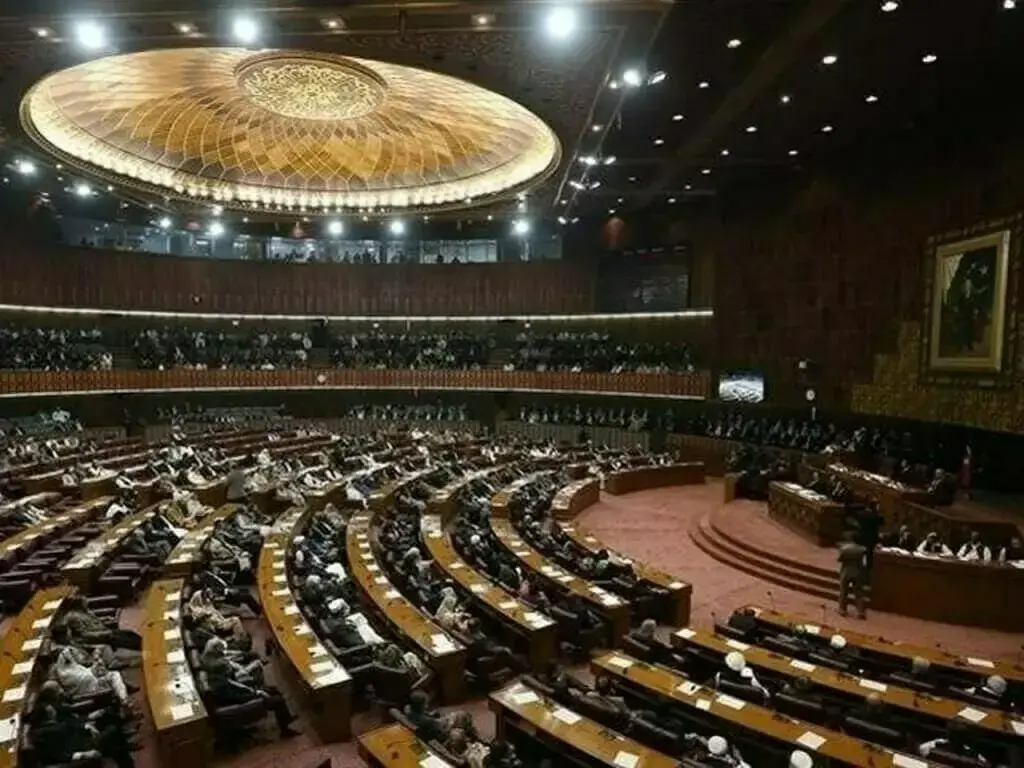
ISLAMABAD: Amid fierce protests and strong opposition criticism, a joint sitting of the parliament on Thursday approved two resolutions endorsing the presidential proclamations imposing a state of emergency and Governor’s Rule in Khyber Pakhtunkhwa (KP) on October 11.
Chaired by National Assembly Speaker Ayaz Sadiq, the joint sitting ratified, through two separate resolutions, the state of emergency proclaimed by President Asif Ali Zardari under the second proviso to Article 232(1) of the Constitution, in accordance with Article 232(7).
Through a separate resolution, the joint sitting of parliament endorsed the presidential proclamation issued under Article 234(1) of the Constitution, pursuant to Article 234(3), approving the imposition of governor’s rule in the province.
READ MORE: NA, Senate endorse governor’s rule, emergency in KP
The passage of the two resolutions formalised parliament’s approval of the presidential proclamations concerning KP under the relevant constitutional provisions.
Carrying placards bearing the slogans “emergency namanzur, governor’s rule namanzur” (emergency and governor’s rule are unacceptable), PTI-led opposition MPs tore up copies of the resolutions in protest.
The uproar erupted as Parliamentary Affairs Minister Tariq Fazal Chaudhry moved a motion to suspend certain rules to allow the resolutions to be tabled. Despite the opposition’s resistance, the motion was adopted by 214 votes to 56, paving the way for the passage of the resolutions.
Opening the debate, Law Minister Azam Tarar defended the imposition of emergency and governor’s rule in Khyber Pakhtunkhwa as a “last resort”, citing the deteriorating security situation and deliberations by the federal cabinet.
“This option was exercised as a last resort,” he said, adding that the K-P governor had written to the president and prime minister warning of escalating terrorism-related violence in the province.
He said Prime Minister Shehbaz Sharif had referred the matter to the federal cabinet after reviewing the available material. The cabinet deliberated for two and a half hours before recommending that the prime minister advise the president to invoke the relevant constitutional provisions.
Speaking at House, Interior Minister Mohsin Naqvi defended the government’s decision, saying all alternatives had been exhausted and efforts to avert the intervention had continued until the last moment.
In a pointed challenge to Achakzai, he questioned whether the opposition leader could honestly claim to have been elected without the controversial Form 47, asking: “You accuse the treasury benches of being elected through Form 47, but can you swear that you were not elected through the same controversial form.”
Recounting negotiations held on October 3, he said the federal government had proposed an emergency in 12 districts, a proposal that members of the PTI negotiating team had accepted in principle.
He claimed that the government negotiating team had offered to impose an emergency in “12 districts” of KP, alleging that the PTI negotiation panel had responded, “Fine, let’s do it.”
He further claimed that PTI leader Asad Qaiser, who was present during the talks, was prepared to sign an agreement but was advised to consult the KP government before proceeding.
“By God, our hearts did not want to do this,” he said, accusing Chief Minister Sohail Afridi of avoiding military operations for political reasons.
He referred to discussions on strengthening police in five districts, convening the provincial apex committee and issuing a joint declaration against terrorism.
Naqvi also alleged that the chief minister had stopped attending military funerals after an incident in February.
PTI Chairman Barrister Gohar Ali Khan rejected the allegations, demanded an apology from the prime minister to the people of KP and accused the government of portraying his party as sympathetic to militancy. He cited PTI’s support during the conflict with India and rejected claims that its leaders had shunned the funerals of security personnel, saying he had attended several.
Gohar reiterated his party’s willingness to negotiate if its demands were met and vowed to eliminate terrorism if it returned to power.
Mehmood Khan Achakzai, head of the opposition alliance Tehreek-i-Tahafuz-i-Ayin-i-Pakistan, criticised what he described as the rulers’ faulty decisions and accused the speaker of mishandling the proceedings. Drawing a parallel with the separation of East Pakistan in 1971, he rejected attempts to portray the KP chief minister as a terrorist and questioned reports that Afridi had been taken into preventive custody.
Achakzai traced the roots of militancy to the recruitment of fighters during the Soviet-Afghan war and their subsequent abandonment in the tribal areas. He offered support for dialogue aimed at ending terrorism and upholding parliamentary supremacy.
PTI-backed opposition leader in the Senate Raja Nasir Abbas blamed the government’s negotiating team for the collapse of talks, arguing that more time could have salvaged the process. Referring to the February 2024 general elections, he linked public anger to the imprisonment of former Prime Minister Imran Khan and described the Constitution as the principal safeguard of citizens’ rights.
PPP Senator Sherry Rehman, a member of the government’s negotiating team, rejected claims that the government had abandoned the October 3 talks. She said she and the National Assembly speaker had remained willing to negotiate until 5am or 6am, but the PTI team had left at 3am. She also questioned the party’s proposed march being confined to KP.
Jamiat Ulema-i-Islam-Fazl Senator Kamran Murtaza challenged the legality of governor’s rule, saying no documentary evidence had been presented to justify it. He alleged that Governor Faisal Karim Kundi had not supplied the report purportedly required under Article 234 and questioned why emergency measures were being considered selectively when insecurity persisted in Balochistan and the Katcha areas.
Senator Ali Zafar also demanded that the government produce the governor’s report and explain the basis on which the president had reached the constitutionally required satisfaction for imposing governor’s rule. Citing Article 148, he challenged the government to justify its action. His speech prompted a heated exchange with PML-N Senator Abid Sher Ali, with Defence Minister Khawaja Asif intervening.
Awami National Party president Aimal Wali Khan said responsibility for KP’s deteriorating security could not rest solely with the provincial government. Questioning PTI’s past approach towards the Taliban and alleged efforts to resettle militants in the province, he argued that the federal government should also be held accountable if the provincial administration was removed over terrorism.
Federal Minister for Kashmir Affairs Amir Muqam recalled the 2014 Army Public School massacre and questioned how Tehreek-i-Taliban Pakistan fighters had allegedly been allowed to return. Deputy Prime Minister Ishaq Dar defended the National Action Plan, saying Parliament had approved it and that it was subsequently revised under the PTI government.
Former prime minister Raja Pervez Ashraf condemned threats to paralyse Islamabad and the use of provincial resources for political mobilisation. He urged restraint, suggesting the emergency and governor’s rule could be reversed if political conduct improved.
Copyright Business Recorder, 2026




















Comments