


'Ghost particle' hunter Francis Halzen wins 2026 Nobel Physics Prize
- Halzen realised that ice at the South Pole could be used to track neutrinos
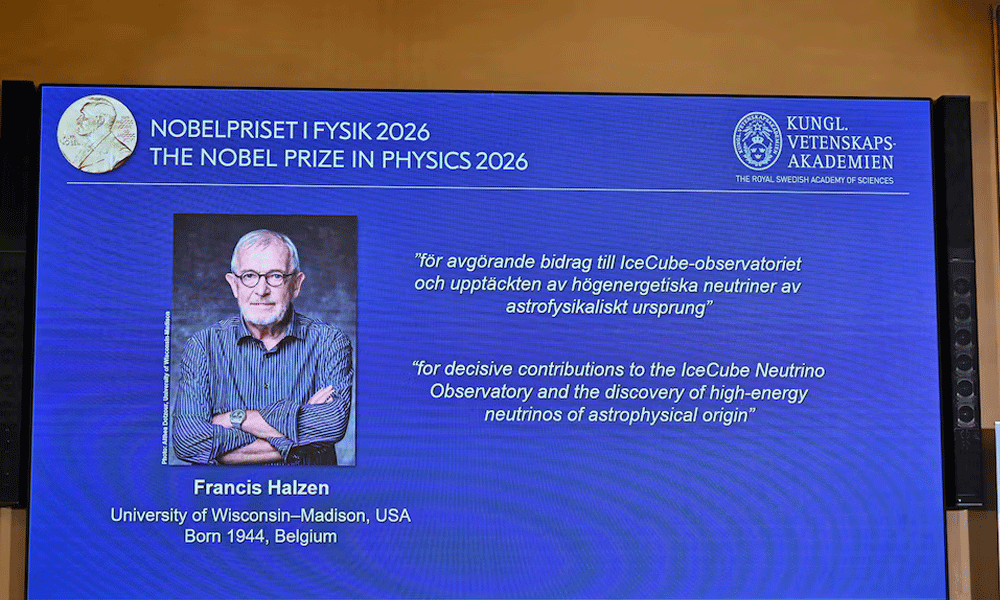

STOCKHOLM: Belgian-American particle physicist Francis Halzen won the 2026 Nobel Prize in Physics for ground-breaking work creating an observatory to detect some of the universe’s most elusive particles, high-energy neutrinos, and how they are created.
Halzen realised that ice at the South Pole could be used to track neutrinos, sometimes known as ‘ghost particles’ for the way they pass through the Earth and our bodies without a trace, and only interact with matter extremely rarely.
“The messengers bring information from the cosmos,” Eva Olsson, of the Royal Swedish Academy of Sciences, told a press conference. “They open the door to distant galaxies and tell us about the processes of exploding stars.”
Halzen hailed for detecting ‘messengers from the cosmos’
The neutrino interactions collected by the IceCube observatory in Antarctica provide researchers with knowledge about how high-energy neutrinos are created, potentially even revealing previously unknown cosmic phenomena, the body said.
“Francis Halzen has led an international team of researchers and engineers who have provided us with a fantastic instrument,” Mark Pearce, chair of the Nobel Committee for Physics, said in a statement.
“His tenacity and scientific vision has paved the way for a new kind of astronomy.”
In 2014, the US-based Smithsonian magazine, dubbed Halzen “Neutrino Man” when giving him one of its ingenuity Awards, acclaiming him for an “amazing experiment (that) heralds the beginning of a new era in astronomy”.
It even published a comic illustrating his life: “How One Physicist’s Pursuit of the Cosmos Took Off in Antarctica”
The winners of the Nobel physics prize are selected by the Royal Swedish Academy of Sciences and receive a prize sum totalling 12 million Swedish crowns ($1.2 million), which is shared among the winners if there are several.
The Nobel Prizes were established under the will of Swedish inventor and entrepreneur Alfred Nobel, whose fortune was built in part on the invention of dynamite.
First awarded in 1901, the prizes honour achievements in science, literature and peace, with the economics award added later by Sweden’s central bank.
Winners from einstein to bohr and the curies
Physics occupied a prominent place in Nobel’s will and the prize remains one of the discipline’s highest distinctions. Over the decades it has recognised discoveries that have fundamentally reshaped humanity’s understanding of the universe.
Among past laureates are some of the most celebrated figures in science, including Albert Einstein, Marie and Pierre Curie, Max Planck and Niels Bohr, whose work helped establish the foundations of modern physics.
Last year’s physics prize was awarded to US-based scientists John Clarke, Michel Devoret and John Martinis for experiments that demonstrated the principles of quantum physics in action, research seen as helping to advance the next generation of computing and other digital technologies.
The award was the second of this year’s Nobels to be unveiled, following Monday’s medicine prize announcement, with chemistry next on Wednesday.
Nobel medals are presented to the winners by Sweden’s King Carl XVI Gustaf at a ceremony in Stockholm on December 10, the anniversary of Alfred Nobel’s death. The awards are followed by an elaborate banquet at Stockholm City Hall.
The peace prize, the only Nobel not presented in Sweden, is awarded separately in Oslo.






















Comments