


The pricing of fuel—II
Global oil prices are surging due to escalating Middle East conflicts, pushing Brent crude to over $107. This will likely cause significant retail fuel price hikes and increased inflation.
- Escalating Middle East conflict driving oil price surges.
- Projected significant increases in retail petrol and diesel prices.
- Potential for widespread protests and higher inflation.
- Government's options for fuel pricing policy adjustments.

The price of Brent crude has spiralled up to USD 107.86 per barrel on the 11th of September. This is the highest level since May 2026. There has, in fact, been an extraordinary increase in the price of Brent crude last week of 13 percent.
There has also been a corresponding increase in recent weeks in the international prices of petrol and HSD oil, as reported by OGRA in its daily pricing system. Accordingly, Table 1 shows the recent trend in the prices.
Table 1 clearly highlights the difference in the rate of inflation. Between July 21st and August 29th, a period of 39 days, the cumulative rise in the international price of petrol was 7.6 percent.
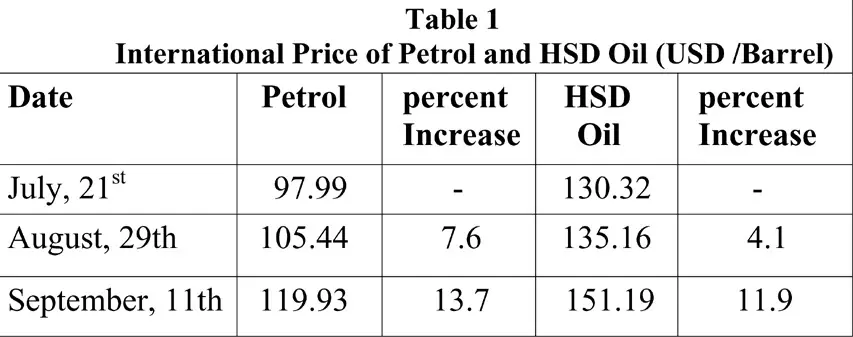
However, between August 29th and September 11th, a period of only 13 days, the price of petrol has gone up by 13.7 percent.
The difference in the rate of inflation in HSD oil is even larger. In the first period, it was 4.1 percent, while in the subsequent much shorter period it was 11.9 percent.
The worsening situation in the Middle East war is primarily responsible for the acceleration in the rate of inflation in international oil prices. The global oil market has now begun to engage in pricing, reflecting both the duration and the severity of the conflict.
READ MORE: The pricing of fuel
This has happened because of intensification of attacks by the Yemeni Houthis on Saudi energy infrastructure and tanker traffic in the Red Sea. There has also been a takeover of Port Mokha on Yemeni Red Sea. The flow of oil traffic in the Strait of Hormuz remains restricted.
A new development is the destruction of oil tankers, which will affect global supply capacity. There are indicators of a stalemate in the confrontation between the USA and Iran. President Trump has indicated that it will stretch beyond the US Mid-Term elections in November.
There is need now to project the retail prices of petrol and diesel as per the methodology for price determination adopted by the OGRA, the oil and gas regulator. The likelihood is that the price of Brent crude will rapidly increase and exceed the peak of USD 118.26 per barrel as of the 29th of April 2026. There are even some projections that if the deadlock in the war persists, the price of Brent crude could rise to as much as USD 150 per barrel. In fact, the highest ever price of Brent crude was recorded at USD 147.02 per barrel on the 11th of July 2008.
A set of projections are made of the likely retail prices if the international prices of petrol and HSD escalate by 10 percent, 20 percent and 30 percent, respectively, in relation to the level as of September 11th.
The methodology for pricing is the same as that adopted by the OGRA in its daily pricing announcements. The freight cost is expected to rise in line with the rise in fuel prices. It is assumed that SBP will maintain its, more or less, fixed exchange rate policy, although the rupee could come under some pressure because of the rising trade deficit. Further, the absolute size of the various margins is assumed to remain unchanged. The combined petroleum and climate support levy remains unchanged at Rs 85 per liter in the projections.
The projected prices of petrol and HSD oil are given in Table 2.
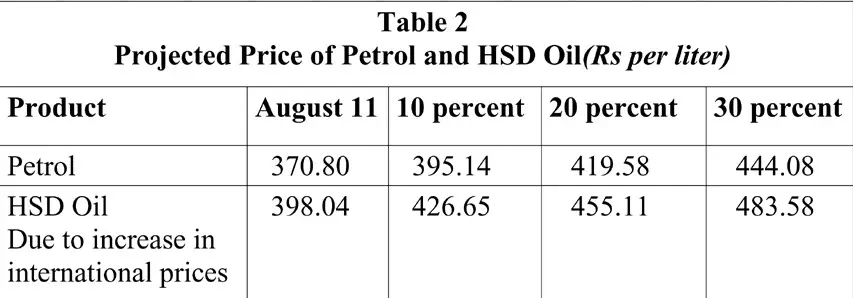
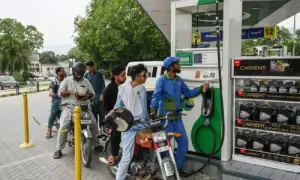
The price of petrol could increase by 6.6 percent to 19.8 percent in coming months. It is important to note that it could rise to well above Rs 400 per litre. This may ignite widespread protests in the country.
The price of diesel is projected to increase by 7.2 percent to 21.5 percent. It could approach the price of almost Rs 500 per liter. This will add significantly to transport cost of goods, especially food items.
The time has come therefore for the government to focus on the pricing policy of petrol and HSD oil. In particular, the high level of petroleum plus climate support levy of Rs 85 per liter will be extremely difficult to sustain. Also, the level of customs duty may have to be revised downwards.
An estimate has also been made of the likely impact of the higher fuel prices on the rate of inflation in the Consumer Price Index in the country. The estimated impact is addition of 1.5 percent to 4.5 percent points to the rate of inflation. As such, it could lead to a rise in the rate of inflation from 11 percent to 12.5 percent to 15.5 percent, depending on the magnitude of the increase in international prices.
The fact is that as of the 7th of September the retail prices of petrol and HSD oil are much higher in Pakistan than the prices in many Asian countries. For example, the diesel price in Pakistan, as of the 7th of September, was 48 percent higher than in Bangladesh and 34 percent higher than in India. This is bound to reduce the competitiveness of Pakistan’s exports.
Overall, as emergency measures, the petroleum levy should be brought down to below half its present level. The emergency provision in the Federal budget of Rs 430 billion can cover part of the loss of revenues. The regressive impact of the jump in fuel prices must be avoided to the extent possible.
Copyright Business Recorder, 2026
The writer is Professor Emeritus at BNU and former Federal Minister














Comments