


Nepal's glacial collapse: Melting into disaster
A massive glacier collapse on the Nepal-Tibet border caused widespread devastation, highlighting how climate change is already manifesting in catastrophic events in vulnerable mountain regions like the Himalayas.
- Immediate devastation from the Nepal-Tibet glacier collapse.
- Climate change's role in accelerating glacier retreat and mountain instability.
- Pakistan's high vulnerability to climate hazards despite low emissions.
- The importance of cross-border data sharing and disaster preparedness.
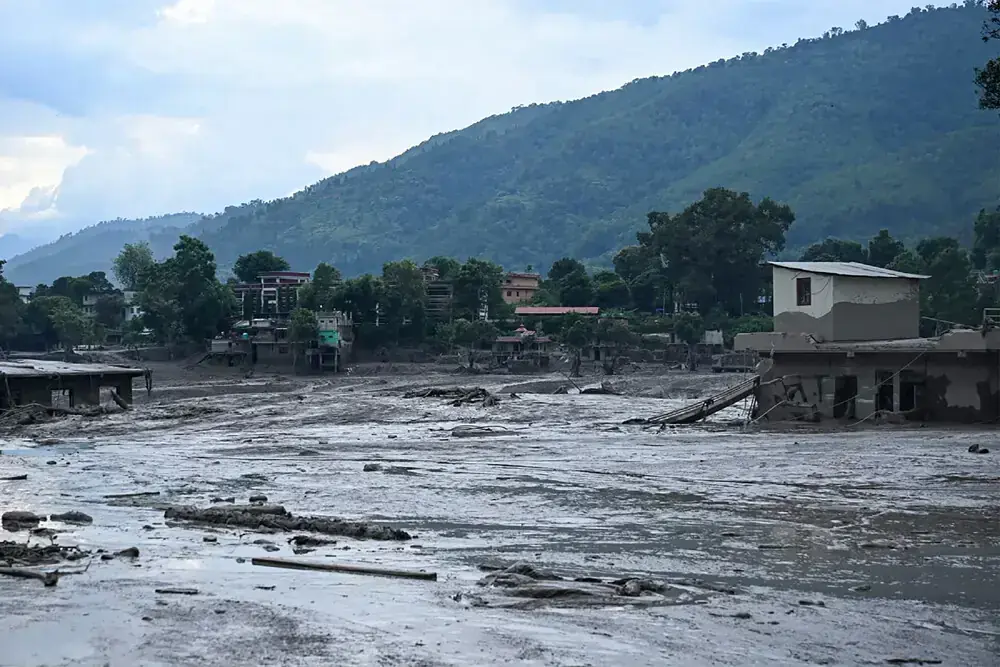
EDITORIAL: The catastrophe along the Nepal-Tibet border has already moved far beyond the scale of an isolated Himalayan emergency. By Sunday, nearly 800 people had been confirmed dead and more than 3,000 remained missing after a massive glacier collapse sent ice, rock, mud and water crashing through valleys and settlements on both sides of the border.
More than 90,000 people have been affected, infrastructure has been destroyed and rescuers are still struggling to reach communities cut off by debris and fresh flood risks.
The exact chain of events is still being studied, and scientists are rightly cautious about attributing a single disaster solely to climate change. Satellite analysis indicates that part of a glacier collapsed from high altitude, generating an ice-rock avalanche and a massive debris flow. Yet the broader climate context is impossible to ignore.
Scientists have repeatedly warned that rising temperatures are accelerating glacier retreat, destabilising mountain permafrost and increasing the risk of landslides, avalanches and catastrophic flooding across the Hindu Kush-Himalayan region.
That should be the real lesson from Nepal and Tibet.
Climate change is no longer a distant environmental argument about temperatures several decades into the future. Its consequences are already being measured in destroyed homes, damaged infrastructure, lost livelihoods and body counts.
The Himalayan region is warming at roughly twice the global average, while glaciers there are retreating rapidly. As ice disappears and frozen mountain slopes become less stable, entire downstream populations face risks that existing disaster-management systems were never designed to handle.
Pakistan has a particular reason to pay attention. The country contributes less than one percent of global greenhouse-gas emissions, yet remains among those most vulnerable to extreme weather and climate change. Its geography leaves it exposed to multiple hazards at once: melting glaciers in the north, extreme heat, erratic monsoons, floods, drought and growing pressure on water resources.
The devastating floods of recent years have already demonstrated how quickly abnormal weather can overwhelm infrastructure, agriculture and public finances.
The injustice in this equation is obvious, but vulnerability cannot become an excuse for helplessness. Pakistan must continue pressing major emitters for faster emissions reductions, climate finance and meaningful support for adaptation and loss and damage. At the same time, it must strengthen its own capacity to survive what is already coming.
Glacier monitoring, early-warning systems, flood-risk mapping, resilient infrastructure and better coordination between meteorological, disaster-management and local authorities can no longer be treated as secondary development priorities.
The Nepal disaster also underlines the importance of cross-border data sharing. Nepal had reportedly sought stronger cooperation with China on glacier movements and water levels months before the catastrophe.
Although experts do not regard the absence of such information as the principal cause of the disaster, the episode shows why countries sharing mountain systems and river basins need formal mechanisms for exchanging real-time hazard data.
Pakistan faces the same imperative across a region where rivers, glaciers and weather systems pay little attention to political borders.
The immediate priority must, of course, remain rescue, relief and support for the thousands displaced in Nepal and Tibet. But the wider warning should not be lost once the headlines move on. Disasters of this kind are becoming part of the climate reality confronting vulnerable mountain regions.
The world has spent decades debating when climate change would become an emergency. In the Himalayas, that debate has already been overtaken by events.
Copyright Business Recorder, 2026
















Comments