


Pakistan’s cash flow: a four-year overview: An analysis of federal government inflows and outflows

The following table depicts the place from where the money comes for the federal government and where it goes.
Pakistan’s financial situation is pretty rough right now. Here’s the breakdown of why:
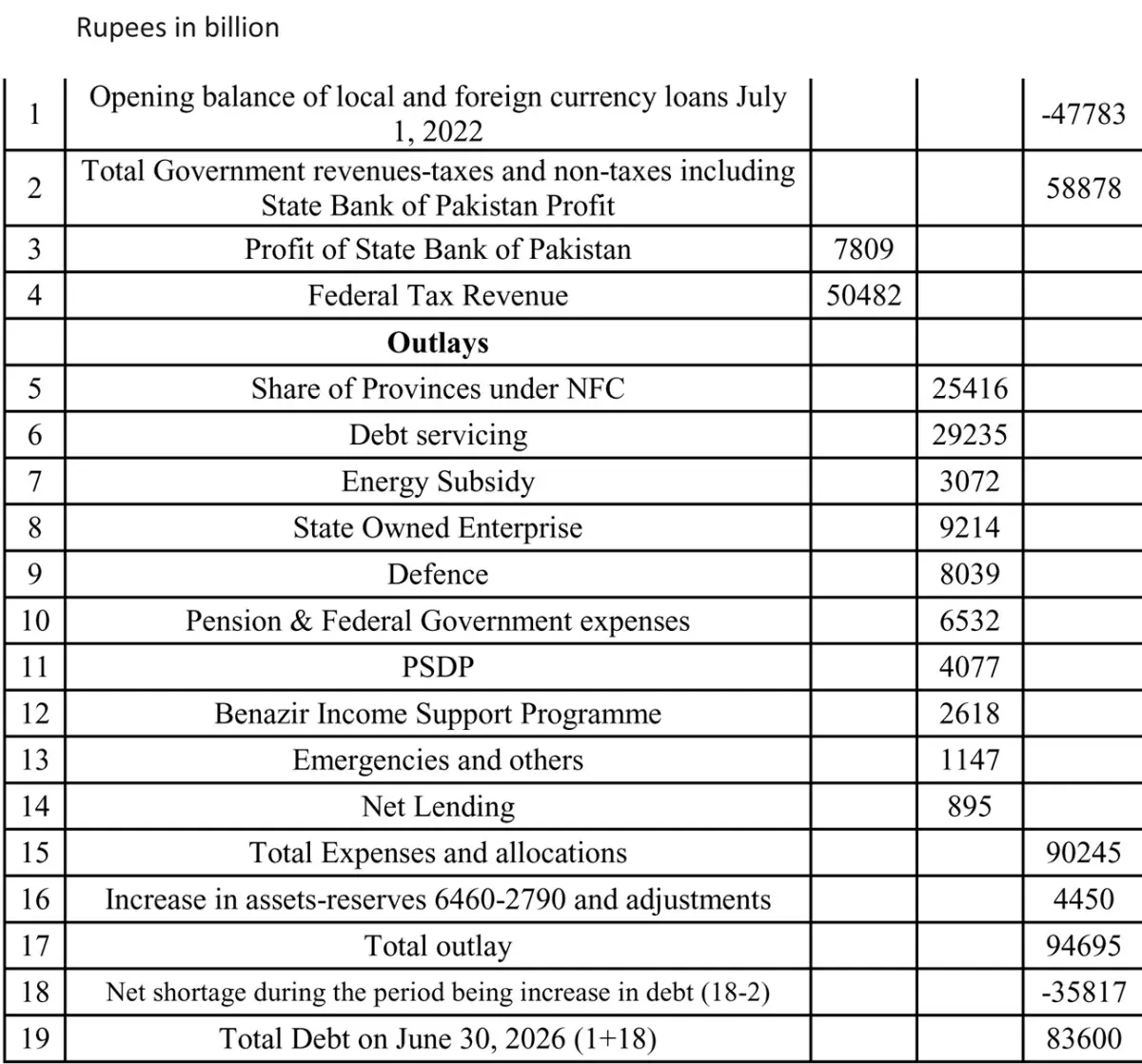
• Massive debt: We started with Rs47.8 trillion in debt back in July 2022, and it’s ballooned to Rs83.6 trillion by June 2026.
• Big spending gap: The government brought in Rs58 trillion in revenue over those four years, but spent Rs90 trillion. That’s a huge Rs32 trillion shortfall.
• Most money goes to ‘status quo’: Over 90 percent of the budget is just keeping things running, not building for the future. Huge chunks are eaten up by debt payments (Rs29 trillion), provincial transfers (Rs25 trillion), losing state-owned companies (Rs9 trillion), defence (Rs8 trillion), and energy subsidies (Rs3 trillion).
• Development is neglected: We’re barely investing in the country’s future. Only about Rs4 trillion went into the Public Sector Development Programme (PSDP). To really grow, we need to be aiming for 20–25 percent of the budget on development, but we’re way off the mark.
• Tax problems: Taxes are up, but the way we’re collecting them is hurting the economy. It relies too heavily on indirect taxes (like on fuel and electricity), which hits average people hard and discourages businesses from formalizing and growing.
• Private savings, not investment: Instead of public savings going into new industries, they’re basically being used to fund the government’s daily expenses. There’s almost no real industrial investment happening.
Between July 1, 2022, and June 30, 2026, Pakistan’s fiscal landscape underwent a significant deterioration. The national debt expanded from Rs47.8 trillion to Rs83.6 trillion, driven by a fundamental structural imbalance. While the government generated Rs58 trillion in revenue over this four-year period, it incurred expenditures totalling Rs90 trillion. This Rs32 trillion shortfall is the primary catalyst for the current debt crisis.
The financial breakdown
The following data summarizes the federal cash flow:
• Total revenue (taxes &non-taxes): Rs58,878 billion
• Total outlay: Rs94,695 billion
• Net shortage (increase in debt): Rs35,817 billion
Major expenditures:
• Debt servicing: Rs29,235 billion
• Provincial transfers (NFC: Rs25,416 billion
• State-owned enterprise (SOE) losses: Rs9,214 billion
• Defence: Rs8,039 billion
- Pension and federal government expenses: Rs6,532 billion
•Public Sector Development Programme (PSDP: Rs4,077 billion
• Energy subsidies: Rs3,072 billion
• Benazir Income Support Programme: Rs2,618 billion
The expenditure crisis: maintaining the status quo
Over 90 percent of the Rs90 trillion budget is directed toward maintaining existing operations rather than fostering growth. The state is effectively cannibalizing its future to fund debt payments, provincial transfers, loss-making enterprises, and administrative expenses.
• SOE and energy losses: These represent significant systemic drains, totalling Rs12.28 trillion combined. Without structural reform to these sectors, the budget will continue to be hollowed out by operational losses and subsidies.
•Debt servicing: Consuming Rs29 trillion, debt servicing has become the single largest expenditure, a direct consequence of the reliance on floating domestic debt.
The development neglect
Allocation for the Public Sector Development Programme (PSDP) remains inadequate. With only Rs4 trillion allocated for direct capital expenditure, the country is failing to build the necessary infrastructure to compete globally. Historically, Pakistan relied on foreign aid to bridge this gap, but that funding has largely evaporated. Major projects, such as the ML-1 railway and urban transit systems, remain stalled.
To achieve meaningful economic growth, a minimum of 20–25 percent of the total budget must be ring-fenced for development; currently, Pakistan is far below this benchmark. The failure to utilize the CPEC framework for productive corridor investment — focusing instead on power generation — has exacerbated this stagnation.
Taxation traps and structural distortion
While tax collection has increased by over 100 percent since 2022, the methodology behind this success is detrimental to long-term health:
-
Reliance on indirect taxation: Over 70 percent of tax revenue is derived from indirect levies, such as sales tax on fuel and electricity. This places an inequitable burden on the population and discourages consumer spending.
-
Anti-formalization incentives: The tax structure actively discourages businesses from transitioning to formal, corporate entities.
-
Policy regression: The rollback of post-2000 VAT reforms has reduced the sales tax to an excise-like levy, failing to capture the true value of goods and excluding the retail and wholesale sectors from documentation, despite their significant contribution to the economy.
Monetary policy and debt servicing
Pakistan’s debt servicing costs have risen to approximately 50 percent of the total budget. The central bank’s response — raising the policy discount rate to combat inflation — has paradoxically increased the cost of domestic floating debt.
While the policy rate has been adjusted from a 22 percent peak to approximately 11.5 percent, the environment remains constrained by the need to anchor inflation expectations and stabilize the currency against external financing benchmarks. A complicating factor is that the agricultural, retail, and wholesale sectors — which constitute a vast portion of the economy — are largely decoupled from the policy rate, limiting the efficacy of traditional monetary transmission mechanisms.
Private savings vs. public expenditure
A unique and alarming feature of the Pakistani fiscal model is the near-total reliance on private sector savings — held in the National Saving Certificates and bank deposits — to fund the government’s current expenditures. There is virtually no industrial investment occurring in the private sector, with total public offering during this period failing to exceed $250–300 million. This creates a closed loop where the public’s savings are not used to build industry or create jobs, but are instead consumed by the state to cover its deficits.
Conclusion: critical inquiries
Flawed NFC restructuring rationale
There is no sound financial or accounting justification for altering the National Finance Commission (NFC) award. Transfers to the provinces constitute approximately Rs25.4 trillion of the overall Rs90 trillion budget. Considering the high political volatility surrounding the issue, even a 20 percent cut in provincial funds yields a mere Rs5 trillion — far too modest a figure to risk political instability. The primary problem stems not from the allocation ratio itself, but from the provinces’ reluctance to generate their own tax revenues while remaining reliant on federal disbursements. The real solution lies in delegating financial power to local governance structures, fostering greater transparency and driving responsive municipal service delivery.
Captive to provincial revenue collection authorities
The stagnation of Pakistan’s tax system is not solely the result of deficiencies within the Federal Tax Collection department. Comparable — if not more severe — deficiencies exist within the provincial revenue collection departments, which hold the authority to levy and collect:
a. Agricultural income tax
b. Urban immovable property tax;
c. Sales tax on services
d. Excise duties on liquor, among others
Consider the comparison: Mumbai, with a population of 22 million, generates approximately $740 million in property taxes. By contrast, Lahore, with a population of roughly 15 million, collects only about $29 million. This leaves an uncollected shortfall exceeding $500 million, perpetuated by vested interests and a complete lack of political will to tax property owners. Consequently, the tax burden is shifted onto lower-income segments through indirect taxes on essential goods such as petrol, electricity, tea, and sugar.
The current trajectory raises following foundational questions for the state’s fiscal policy:
-
Does the current cash flow structure leave any fiscal space for essential infrastructure development?
-
Is the current tax collection methodology, which relies heavily on indirect levies, inherently detrimental to long-term economic growth?
-
Are there unconventional methods available to mitigate the crippling costs of debt servicing?
-
Is it possible to decouple the federal budget from the persistent drains of energy subsidies and state-owned enterprise losses?
-
Does the existing cash flow dynamic afford any fiscal room for critical infrastructure investment?
-
Does a tax collection framework heavily reliant on indirect levies fundamentally undermine long-term economic expansion?
-
Can non-traditional approaches be deployed to alleviate the severe burden of debt servicing?
-
Is it feasible to insulate the federal budget from the continuous drain of energy sector subsidies and losses in state-owned enterprises?
-
What mechanisms exist to break free from the current restrictive posture of provincial tax collection authorities?
An evaluation of fiscal governance from 2022 to 2026, as well as preceding years, demonstrates the breakdown of the current fiscal framework. This failure serves as a key driver accelerating the decline of Pakistan’s economic future. When viewed alongside previous discussions on administrative units, this analysis indicates that the governance framework operating in Islamabad is no longer viable. Persisting with it offers no utility; instead, a structured and deliberate disassembly of the system is necessary to prevent an unmanaged collapse and avoid severe repercussions.















Comments