


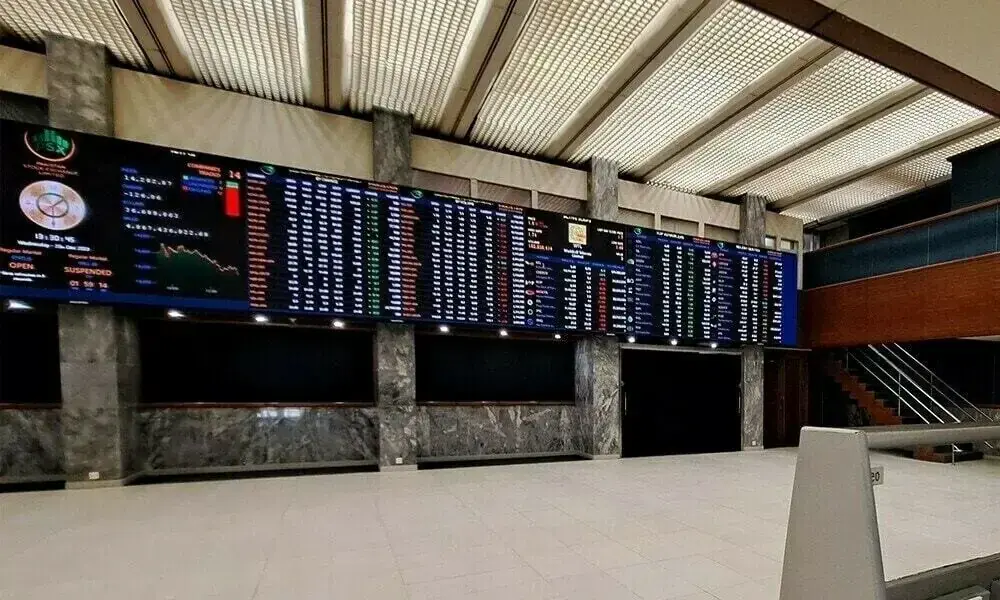

KARACHI: The Pakistan Stock Exchange (PSX) rebounded strongly during the week, snapping a three-week losing streak as easing geopolitical tensions following the cessation of hostilities between the United States and Iran significantly improved investor sentiment.
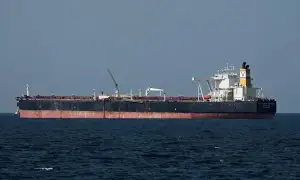
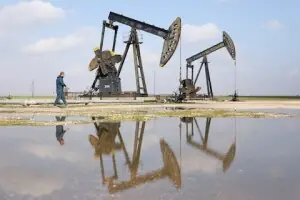
The decline in international Brent crude oil prices by around 9 percent week-on-week to below USD90 per barrel further boosted risk appetite, helping the benchmark KSE-100 Index recover more than 5,000 points over the week.
According to the weekly market review, the benchmark KSE-100 Index gained 5,072.93 points, or around 3.0 percent week-on-week, to close at 176,094.13 points, compared with the previous week’s close of 171,021.20 points.
Although the market witnessed some profit-taking towards the end of the week, analysts noted that the early-week rally, triggered by the geopolitical ceasefire, remained the primary driver of the week’s positive performance, while caution persists due to lingering regional uncertainties.
The recovery was also reflected in the Business Recorder indices. The BRIndex100 advanced from 18,716.85 points to 19,346.81 points, gaining 629.96 points during the week. The index recorded a total turnover of 3.426 billion shares, translating into an average daily turnover of approximately 685.12 million shares. Similarly, the BRIndex30 climbed from 67,530.25 points to 69,567.15 points, posting a gain of 2,036.90 points. Weekly turnover on the BRIndex30 stood at 1.640 billion shares, with an average daily turnover of approximately 327.91 million shares.
The rebound in equities also restored investor wealth, with the total market capitalization of the Pakistan Stock Exchange increasing by 2.5 percent during the week. The market’s capitalization in rupee terms rose from Rs19.278 trillion to Rs19.756 trillion, adding nearly Rs477.32 billion. In US dollar terms, market capitalization increased from US$69.38 billion to US$71.11 billion, reflecting a similar growth of 2.5 percent.
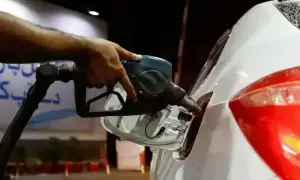
The week’s performance was supported by several macroeconomic developments. The State Bank of Pakistan kept the benchmark policy rate unchanged at 11.5 percent, citing inflationary risks arising from regional geopolitical uncertainty while maintaining its FY27 GDP growth projection in the range of 3.5 to 4.5 percent. Meanwhile, the government increased retail prices of motor spirit (petrol) and High-Speed Diesel by Rs4.63 per litre and Rs15.38 per litre, respectively, while ruling out any reduction in the Petroleum Development Levy without an IMF-supported fiscal plan.
Pakistan’s external position also received support after Saudi Arabia agreed to roll over its US$5 billion deposit with Pakistan for another three years, reducing the country’s external financing requirement for FY27 to USD21.5 billion.
On the trade front, the United States imposed a 10 percent tariff on Pakistani exports, replacing the previous baseline rate. Although the tariff remains lower than those imposed on several regional competitors, it nevertheless attracted investor attention during the week.
On the fiscal side, government spending under the Public Sector Development Programme exceeded its revised FY26 allocation by Rs96 billion, while the State Bank’s foreign exchange reserves declined by US$229 million over the week to US$17 billion.
Trading activity improved considerably across the ready markets. Average daily turnover on the ready market increased by 19.4 percent to 831.29 million shares, compared with 696.04 million shares in the previous week. Average daily traded value rose 14.1 percent to Rs31.66 billion, while the dollar value increased by 14.2 percent to US$113.96 million.
Sector-wise trading activity remained concentrated in a handful of sectors. Investment banks accounted for 19 percent of total market volume, followed by Technology & Communication with 16 percent, Refineries with 15 percent, Cement with 8 percent, commercial banks with 5 percent, while all other sectors jointly contributed 38 percent.
Nearly all major sectors closed the week in positive territory. Refineries led the rally with gains of 6.3 percent, followed by Fertilizer (4.1 percent), Textile Companies (3.9 percent), Commercial Banks (3.2 percent), Cement (2.6 percent), Automobiles (2.5 percent), Engineering (2.4 percent), Technology & Communication (2.4 percent), Chemicals (2.2 percent), Exploration & Production (1.8 percent), Food (1.3 percent), Oil Marketing Companies (1.2 percent), Power (1.1 percent) and Pharmaceuticals (0.8 percent).
Among individual stocks, Adamjee Insurance Company Limited (AICL) emerged as the top weekly performer, gaining 19.0 percent to close at Rs92.46. Other notable gainers included Maple Leaf Cement Factory (MLCF) (+7.6 percent), Pakistan International Bulk Terminal (PIBTL) (+7.5 percent), Kohat Cement (KOHC) (+7.4 percent), IBFL (+7.3 percent), Cherat Cement (CHCC) (+7.1 percent) and Interloop Limited (ILP) (+6.9 percent).
On the losing side, HGFA declined 8.1 percent, followed by PIOC (-5.0 percent), PGLC (-3.8 percent), YOUW (-3.4 percent), TPLRF1 (-3.0 percent), JDWS (-2.6 percent) and FFL (-2.5 percent).
Market participants believe that while the easing of geopolitical tensions has restored confidence and encouraged bargain hunting, the sustainability of the rally will largely depend on regional developments, international oil prices, domestic macroeconomic indicators, and policy measures in the coming weeks.
Copyright Business Recorder, 2026







Comments