


Over 2,000 terrorists killed in 2026 operations, no talks with terrorists: DG ISPR
- Says terrorists must surrender before the state and face accountability

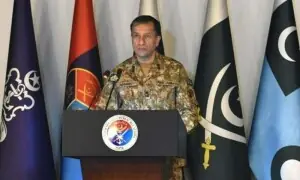
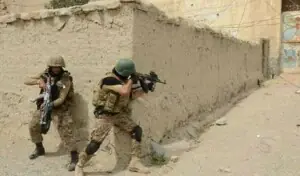
Pakistan’s security forces conducted 40,348 intelligence-based operations (IBOs) across the country in 2026, killing 2,084 “verified” terrorists, Director General Inter-Services Public Relations (ISPR) Lieutenant General Ahmed Sharif Chaudhry said on Friday, adding that there was no room for negotiations with terrorists.
Addressing a press briefing in Rawalpindi, the military spokesperson said the highest number of operations, 31,080, were carried out in Balochistan, followed by 7,177 in Khyber Pakhtunkhwa, while 2,091 operations were conducted in the rest of the country.
He said 3,145 terrorist incidents were recorded during the period, including 1,971 in Khyber Pakhtunkhwa, 1,148 in Balochistan and 26 elsewhere in the country.
Lt Gen Chaudhry said the security forces eliminated 2,084 verified terrorists, averaging nearly 10 terrorists killed per day, which he described as the highest daily average recorded to date.
He said 819 Pakistanis were martyred during the year, including 303 military personnel, 194 law enforcement officials and 322 civilians.
The DG ISPR said 28 suicide bombings occurred during the period, adding that most of the suicide bombers were Afghan nationals.
He noted that 2023 was the first year in which the number of security personnel martyred exceeded the number of terrorists killed, but said security forces subsequently enhanced the effectiveness of their counterterrorism operations, leading to significant operational gains against terrorist groups.
Lt Gen Chaudhry ruled out any possibility of negotiations with terrorists, saying they must surrender before the state and face accountability under the law.
He reaffirmed that security forces would continue counterterrorism operations until terrorism was completely eradicated and said every possible measure would be taken to ensure lasting peace and stability in the country. “Either they will surrender or we will eradicate them,” he said.
The DG ISPR said we should not indulge in ethnical politics and prioritise the country over other things. “Politics exist due to the existence of the state,” he said.
The problem of Balochistan was its elites and sardars, he said. He also criticised elitism in the province, saying some Baloch leaders sought appeasement from the state and demanded to talk to them for controlling terrorism.
The ISPR director general said the impression was being promoted that the situation in Balochistan was continuously deteriorating, but the ground realities were different.
“A negative perception is being created about Balochistan, whereas the real issues are terrorism, elitism and the tribal Sardari system,” he said.
He said Pakistan was not currently a “hard state.” According to him, a hard state does not mean one governed by the armed forces; rather, it means a state where the Constitution and the rule of law are enforced equally for everyone, with no exceptions.
Lt Gen Chaudhry said there was no room for elitism in a hard state. He added that if all affairs were conducted strictly in accordance with the Constitution and the law, Pakistan could become a true hard state.
The military officer said smuggled diesel was being brought into the country and sold at several times its original price, while attempts were also being made to exploit Balochistan’s strategic location and abundant natural resources. “Allah has blessed Balochistan with immense natural wealth, but certain tribal leaders want to preserve an exploitative system,” he said.
He said India and Afghanistan shared one common factor: the sponsorship of terrorism. He added that narratives of deprivation, lack of political representation, and the issue of missing persons were also being used as propaganda tools.
The DG ISPR said Gwadar, a city of nearly 350,000 people, now had three universities, reflecting the region’s educational progress. Similarly, he talked about Turbat and other cities, saying they had scores of educational institutes so the narrative of lack of facilities holds no importance.
On missing person, he said when a list of missing persons was compiled a commission throughout the country, it turned out that most of the cases had been disposed of as either the alleged missing persons had returned home, in jail custody, died or misreported missing case.
“Out of 10,901 total cases in the country, only 2,933 cases were reported in Balochistan and 2,767 of them have been traced back. It leaves 166 remaining. These are the people who are identified when killed in exchange of firing with security forces in Gwadar, Jivani, Turbat or other cities,” he added.
If the terrorist organisation BLA provided list of those in its camp, the missing persons would be found, he said.
To a query regarding Interior Minister Mohsin Naqvi’s statement that the governance has failed in Pakistan, the military spokesperson said he could not comment on the interior minister’s remarks.
However, he said, good governance is key to security and stability of Pakistan. Without good governance you cannot resolve the issues, he added.
Referring to the National Action Plan, he said all the points mentioned in this required good governance. “Yes, the good governance is quite essential for Pakistan. How to get the good governance is for the political parties to decide,” he said, adding that there has to be a serious discussion to resolve those matters. That meant that something should be done for good governance, he maintained.
“If that good governance requires an administrative reset, then let this happen. But it has to be done through the constitutional method, legal method and through the political representatives and as per the will of the people of Pakistan,” he said.
More to follow…


















Comments