



For years, communication professionals and brand strategists operating from Karachi, Lahore and Islamabad have shaped what Pakistanis buy, where families spend their holidays, and which products and services earn public trust. Billions of rupees have been invested in campaigns designed to influence decisions across consumer goods, telecommunications, banking, fashion and tourism. The formula was straightforward: tell a compelling story, appeal to aspirations and emotions, and consumers would respond.
Then came social media and the explosion of influencers. These days, one well-timed TikTok reel from a Karachi food reviewer or a single Instagram post by a Lahore tech enthusiast can drive more sales than entire traditional advertising campaigns. In many cases, young people trust these digital personalities far more than established institutions or corporate messaging.
Now another shift is underway.
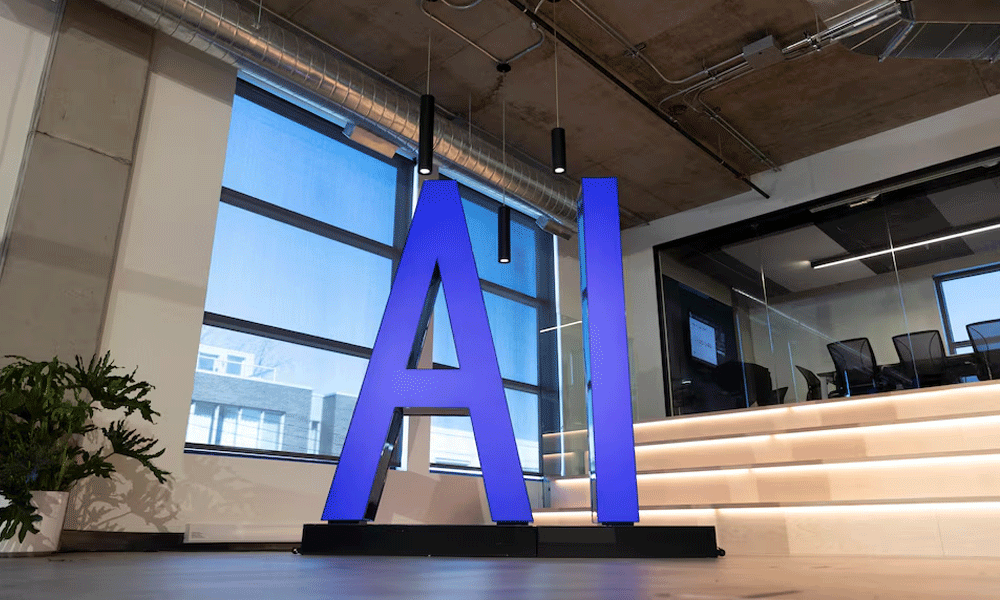
Around the world, consumers are increasingly consulting artificial intelligence before making decisions. Whether choosing a smartphone, comparing universities, planning a holiday or evaluating financial options, people are turning to AI platforms for guidance. Instead of searching through countless websites, reviews and social media posts, they can ask a direct question and receive an immediate response based on information gathered from multiple sources.
This development presents a challenge to long-held assumptions about influence and persuasion. For decades, businesses sought to reach consumers directly through advertising, public relations and marketing. Social media changed the equation by placing creators and influencers between brands and audiences. Artificial intelligence introduces yet another intermediary. Recommendations may increasingly come not from a trusted friend, celebrity or columnist, but from an algorithm capable of analysing vast amounts of information in seconds.
The implications are significant. If AI becomes a primary source of advice, businesses will have to rethink how they build credibility and trust. Advertising will remain important, but it may no longer be sufficient. Organisations will need accurate information, strong reputations and demonstrable performance. In an environment where claims can be checked against data almost instantly, substance matters.
At the same time, artificial intelligence should not be viewed as an infallible oracle. AI systems are trained on information produced by governments, corporations, media and individuals. They can reflect biases, inaccuracies and omissions found within those sources. The future is unlikely to be a contest between objective machines and subjective influencers. Rather, it may become a competition among different sources of information, each seeking to shape public understanding and consumer behaviour.
For Pakistan, the stakes are particularly high. The country has a young, digitally connected population that has readily embraced new technologies. Businesses that rely heavily on advertising budgets, celebrity endorsements and influencer partnerships may soon find that credibility, transparency and verifiable information are among their most valuable assets. In an AI-driven marketplace, facts may prove more persuasive than slogans.
None of this suggests that human judgement will become obsolete. Consumers will continue to be influenced by stories, relationships and personal experiences. Trust is not built by data alone. Yet the balance is shifting. The organisations that thrive will be those that combine authentic communication with reliable information and genuine value.
Pakistan has witnessed several communication revolutions over the past three decades, from satellite television to social media. Artificial intelligence may prove even more consequential. The question is not whether it will affect communications and marketing. That much seems certain. The more important question is whether businesses, institutions and communicators are prepared for a world in which a customer’s first conversation is not with a person, but with a machine.
Copyright Business Recorder, 2026
The writer is the former Executive Director of the Management Association of Pakistan


















Comments