


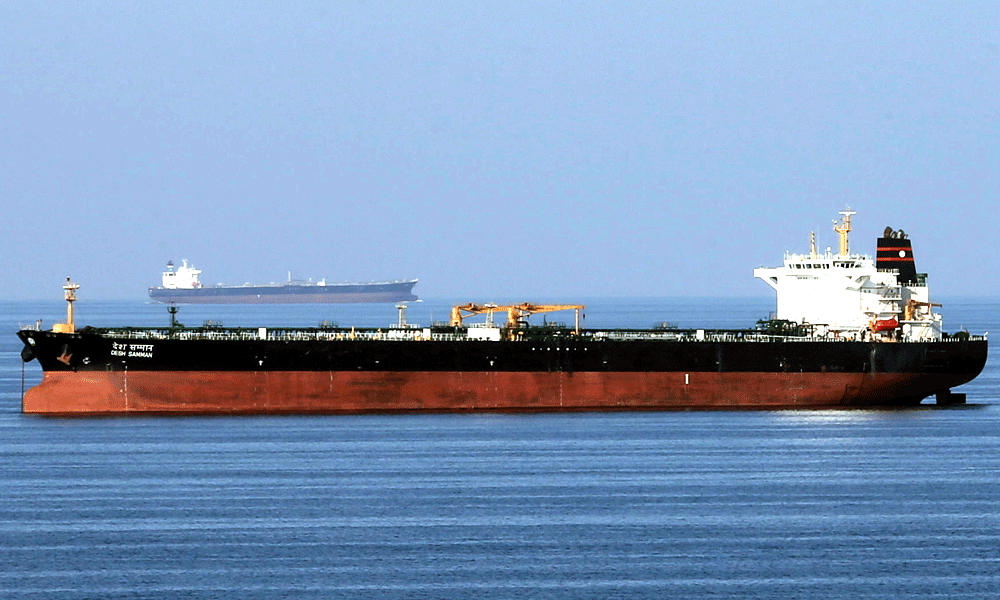

On 28 February 2026, US and Israeli forces launched coordinated strikes on Iran under ‘Operation Epic Fury’, triggering one of the most serious disruptions in global energy markets in history.
Iran responded by effectively closing the Strait of Hormuz — the world’s most critical oil chokepoint. Since then, shipping traffic through the strait has fallen to roughly five percent of pre-war levels.
Nearly 20 percent of global oil flows and all of Qatar’s LNG exports, which normally pass through this narrow passage, have been severely disrupted. The International Energy Agency described the level of disruption as ‘the greatest global energy security challenge in modern history’.
Pakistan’s energy sector relies heavily on imported fossil fuels from the Middle East; therefore, the US-Israel and Iran war was not a distant geopolitical event for Pakistan.
Rather it was a supply shock striking at the heart of Pakistan structurally fragile energy system. With limited strategic reserves and minimal procurement flexibility, energy disruption from the Middle East quickly translated into domestic fuel shortages, higher transportation costs, and inflationary pressure across the economy.
The energy induced economic disruption exposed a basic flaw in Pakistan’s energy model, i.e., Pakistan’s total reliance on a single maritime supply corridor and heavy reliance on imported hydrocarbon. Structurally, this model performed adequately under a stable geopolitical condition, but the model collapsed when the Strait of Hormuz was chocked and the global energy and maritime crisis was unfolded.
In this backdrop, Pakistan officially requested Saudi Arabia to reroute oil supplies through the port of Yanbu in the Red Sea, but this makeshift arrangement could not cure the perennial problems of Pakistan’s energy sector. This exposed an uncomfortable truth, i.e., Pakistan had no pre-planned, institutionalized mechanism to maintain strategic oil reserves and supply route diversification and thus Pakistan paid a price for it. Had Pakistan maintained 90-day strategic reserves, it could have absorbed the shock and could have maintained the growth momentum. The current crisis showed that it will be difficult for Pakistan to bear another energy shock without maintaining strategic reserves and exploring an alternative energy import route.
Though easy said but building 90-day strategic reserves and energy import diversification is not a simple task for a developing country like Pakistan. Pakistan should utilize China-Pakistan Economic Corridor (CPEC) as an opportunity not merely for infrastructure development but for redesigning Pakistan’s energy security architecture by coordinated policy execution. The latter has historically been a challenge.
Gwadar, the crown jewel of CPEC. Gwadar and CPEC together can represent one of the most significant opportunities to address Pakistan’s energy crisis and trade issues.
Gwadar’s location near the mouth of the Persian Gulf positions it closer to major global shipping routes. By establishing large-scale oil storage facilities and strategic petroleum reserves in Gwadar, Pakistan can build genuine emergency buffers against supply disruptions. Expanding storage capacity from the current 28 days toward the international benchmark of 90 days standards would considerably improve the country’s ability to sustain temporary supply shocks and would make global energy crisis more manageable.
Beyond maritime infrastructure, Pakistan must reassess its position in the broader Eurasian energy landscape. Central Asia possesses substantial hydrocarbon and hydropower potential that Pakistan remains largely disconnected from.
Afghanistan’s security environment has historically been the most significant impediment. However, keeping in view that China has already built an extensive oil and gas supply network linking Central Asian energy market to its western provinces on CPEC routes, Pakistan should seriously consider the development of energy corridors connecting it to Central Asia via CPEC.
Energy imports from Central Asia will help Pakistan diversify supply routes and reduce its dependence on overly exposed maritime Middle Eastern routes.
Electricity connectivity presents another compelling opportunity. Central Asian countries generate surplus hydropower during the summer months — precisely when Pakistan faces peak electricity demand due to cooling loads.
Developing regional transmission infrastructure could allow Pakistan to import this surplus during peak seasons, enhancing both affordability and system reliability.
While regional connectivity is a medium to long-term objective, domestic energy resilience must be built in parallel. Many areas of Balochistan, Khyber Pakhtunkhwa, and Gilgit-Baltistan still lack reliable access to electricity and face the economic brunt.
Connecting those areas to the national grid is often economically not feasible for given dispersed populations and challenging terrain. Hybrid renewable-based microgrids — combining solar, micro-hydropower, and wind with battery storage — offer a practical and resilient alternative that simultaneously reduces dependence on imported fuel.
Transportation is another critical sector that needs attention. Pakistan’s transport sector accounts for approximately 60 percent of the country’s petroleum consumption. This means every fuel price shock is going to affect the economy through logistics and food costs.
Electric mobility has the potential to significantly reduce long-term oil demand and reduce its adverse impact on the economy. CPEC 2.0’s emphasis on B2B investment and industrial cooperation opens concrete avenues for investment in battery manufacturing, EV assembly, and charging infrastructure. Such developments would not only reduce fossil fuel imports and trade deficits but also support domestic industrial development.
Pakistan must also carefully plan the future composition of its power generation mix. The country has invested extensively in fossil-fuel-based power plants, including many projects dependent on imported fuels.
Expanding further in this direction would compound the exposure that the Hormuz crisis has so painfully illustrated. Future investments should instead prioritize renewable energy, grid modernization, and storage technologies.
Though the US-Iran conflict exacerbated the energy problem, the crisis has, unexpectedly, elevated Pakistan’s regional standing. As a mediator in one of the world’s most consequential geopolitical flashpoints, Pakistan has demonstrated that it possesses both relationships and credibility.
Pakistan can use this credibility and CPEC 2.0 as enabling factors to connect Pakistan to wider regional energy networks while simultaneously restructuring domestic energy infrastructure mix. These two dimensions — diplomatic weight and physical infrastructure — can reinforce each other, but only if the policy framework keeps pace.
We consider that the current crisis has added urgency to what was already a compelling case. By investing in strategic storage, regional connectivity, decentralized renewable systems, and electrified transportation, Pakistan can move from its current fragile, import-dependent model toward a genuinely resilient energy future. This transition was necessary before the US-Iran crisis; it is now urgent.
In an era where geopolitical shocks can disrupt global energy flows overnight — strengthening energy resilience is no longer optional. It is a national imperative.
Copyright Business Recorder, 2026
The writer specializes in Energy Policy and Management and talks about energy and climate-related issues. He works at CPEC Center of Excellence, PIDE and can be reached at [email protected].
The writer is the Executive Director at the Centre of Excellence for CPEC, Pakistan Institute of Development Economics (PIDE)




















Comments