


Opportunities in global trade do not always arrive with clear signals. Sometimes, they emerge quietly in crisis. Today, one such moment is unfolding in the Middle East, where rising tensions are not only disrupting energy markets and international trade but also reshaping global shipping patterns. The current crisis, though detrimental to the global trade, has created new opportunities.
Rising tensions around the Strait of Hormuz are not just disrupting energy markets; they are reshaping how global shipping operates. What was once considered a stable and efficient route is now increasingly seen as costly and uncertain. Insurance premiums are rising, delays are becoming more frequent, and shipping companies are beginning to rethink their routes. Export firms are also trying to find new and secure routes where it does not pay the ‘insecurity tax’. The current crisis left many leading ports dysfunctional or at high risk and thus shipping companies are trying to find alternate ports mainly because transshipment and cargos cannot wait for stability to return or the damaged ports to get repaired. Rather they have to adjust and deliver in a real time.
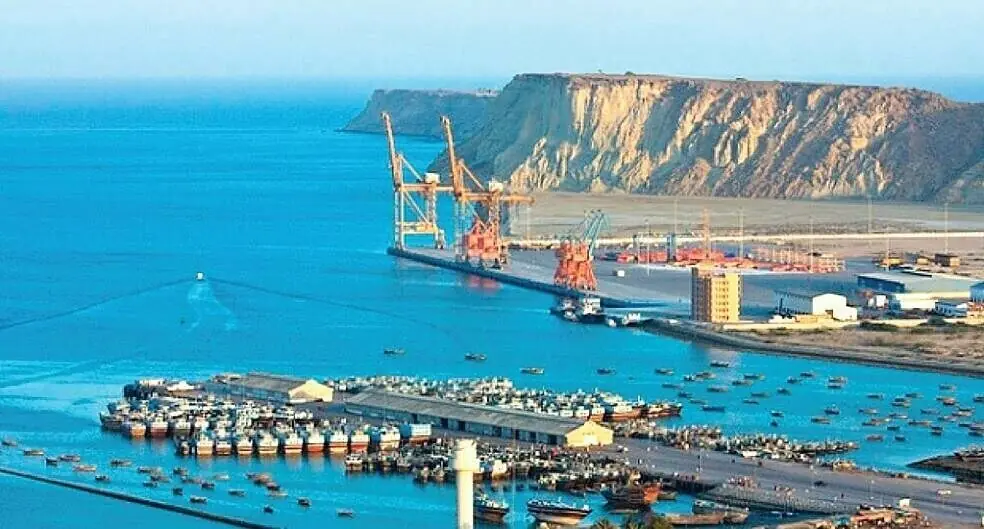
Pakistan coastline, especially the natural deep-water port of Gwadar, lies just outside the most vulnerable Gulf routes. Thus, the ongoing crisis makes Pakistani ports an ideal alternate. A modest 5-10 percent diversion of regional transshipment will create enough opportunities for Pakistan to benefit from it given that Pakistan is ready. Gwadar is a flagship project of CPEC and, therefore, it will not only provide a refuge to shipping but will also help firms to deliver their products to China and Central Asia. Despite all these benefits, Gwadar is overlooked by shipping companies not because of its geography but because of its performance.
Geography created an opportunity for Gwadar, but institutional inefficiencies have prevented its realization. Jebel Ali port in the UAE handles over 15.5 million TEUs annually (UNCTAD, 2024) while Gwadar handles less than 0.1 million tonnes of cargo despite an installed capacity of nearly 11 million tonnes. This reflects severe underutilisation of Gwadar port and this is not a temporary lag; it reflects a structural inability to convert potential into actual trade flows. This also shows that global trade does not reward potential; it rewards reliability and the ecosystem. Therefore, in order to provide a conducive and enabling environment, Gwadar ports has to fix a number of issues, e.g., cargo remains stuck at Pakistani ports for an average of 6.2 days, compared to a global benchmark of around 1.2 days, while customs clearance at Pakistani ports takes up to 340 hours instead of less than 24 hours (World Bank, 2023; PIDE, 2025). These delays are not minor inefficiencies, rather they directly translate into higher costs, uncertainty, and lost competitiveness and thus many firms avoid using inefficient ports. This is precisely why Gwadar is missing the current wave of trade diversion. While maritime insecurity is pushing cargo away from high-risk Gulf routes, it is not automatically pulling it toward Pakistan. The lesson is simple. Trade does not move to the nearest port; it moves to the most dependable one.
Recently, cargo at Gwadar reported a record 1100 percent growth between 2025 and 2026 (Ministry of Maritime Affairs, 2026). But this growth comes from an extremely low base, making it more of a signal than a structural shift. The deeper issue lies beyond Gwadar itself. With a Logistics Performance Index score of 2.5, Pakistan lags behind regional competitors such as the UAE (3.8) and Singapore (4.2) (World Bank, 2023). This gap reflects systemic weaknesses slow processes, weak coordination, and fragmented logistics systems that extend across the entire trade ecosystem. Gwadar has to address these issues if it wants to benefit from the crisis provided opportunity. This is where CPEC 2.0 becomes critical not as another phase of construction, but as a shift toward ‘Soft Infrastructure’ performance, i.e., efficiency, and digital integration.
In April 2026, Gwadar port handled 11,000 containers, surpassing its entire throughput in the last year. For many vessels it became a transshipment node. This is the first time that Gwadar proved itself as a commercial hub and generated revenue. This is the good news for CPEC 2.0 and for China Pakistan 75th diplomatic anniversary.
Though Gwadar is a deep sea port, Gwadar needs dredging in order to further enhance its attraction for ‘Mother Vessels’. The current Gwadar port depth is 12.5 meters. This depth is not ideal for Panamax and Newpanamax mother vessels. The latter requires a depth of 15.5 to 16.5 meters to berth at Gwadar. The arrival of ‘Mother Vessels’ at Gwadar will increase its regional status and connectivity.
Similarly, if Gwadar port wants to be mattered, then customs clearance must be reduced from days to hours through full-scale implementation of a National Single Window (NSW) and AI-driven digitization. Port dwell time must fall sharply through performance-based management. It also requires coordination. A fully functional Port Community System (PCS) can integrate ports, customs, shipping lines, and logistics operators into a single, seamless network. Furthermore, Gwadar must generate its own momentum through industrial activity in the Free Zone. Without it, the port will struggle to sustain cargo flows.
Moreover, it should be considered that the current shift in global trade is temporary. This opportunity created by the “insecurity tax” is limited and temporal. Therefore, Pakistani ports, especially Gwadar, need to give due and equal importance to infrastructure and performance. CPEC 1.0 provided infrastructure and CPEC 2.0 can increase the performance if utilized properly. This is a moment for Gwadar to reap geopolitical arbitrage under CPEC 2.0 and at times when trade flow is shifting from traditional routes. Otherwise, this opportunity will pass quietly, just like it arrived.
Copyright Business Recorder, 2026
The writers Mujtaba Arshad is a Research Associate at the CPEC Centre of Excellence at PIDE. He can be reached at: [email protected]
The writer is the Executive Director at the Centre of Excellence for CPEC, Pakistan Institute of Development Economics (PIDE)



















Comments