


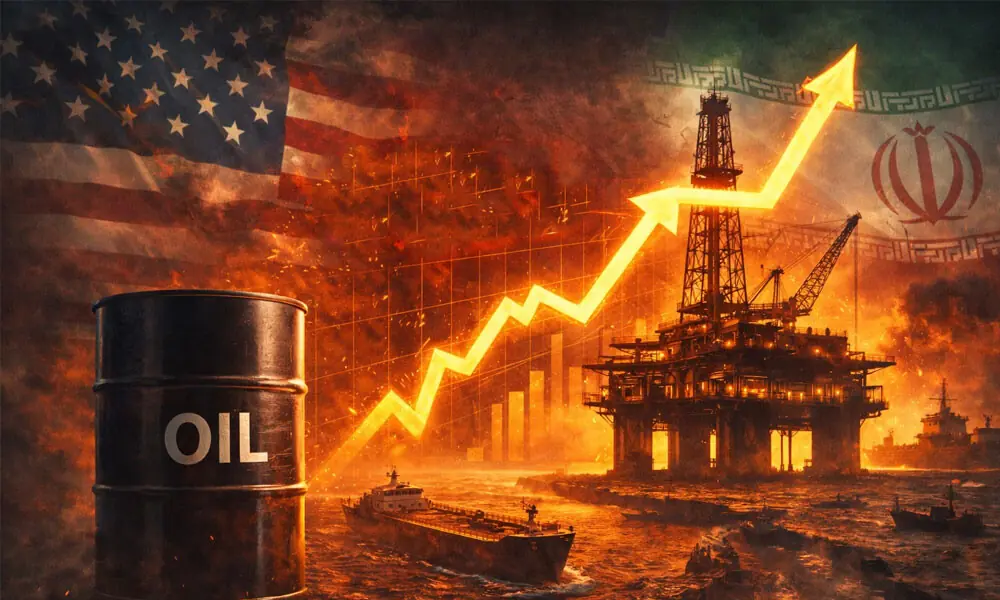
EDITORIAL: US President Donald Trump has ordered the US central command to begin a blockade on all traffic entering and exiting Iranian ports starting Monday 10am Eastern Time, with ships coming or going from elsewhere allowed to pass through the Strait of Hormuz.
The intent, the President told a television channel, was not to let “Iran make money on selling oil to people they like and not people they don’t like.” The objective of the directive is to allow all or nothing to pass through the strait. While critics point to the fact that this would require US ships to approach the strait – be it to mine the strait or physically ensure the blockade – which may be a challenge as US ships are currently parked well beyond the target range of Iranian hyper ballistic missiles – yet any opening of the strait to restore traffic to pre-28 February levels without payment of a toll tax to Iran would undoubtedly be welcomed globally. A key question remains: whether any country would assist the US in this exercise as envisioned by President Trump, given that several countries, including strong US allies like Japan, South Korea and France, have successfully negotiated with the Iranians to allow their oil tankers pass the strait.
Another question that is being asked is what action will the US Navy employ against a ship carrying oil for, say, China and/or other allies, and what retaliatory measure they may adopt, if any?
Be that as it may, the blockade will compromise President Trump’s earlier decision to lift sanctions on Iran and Russia with the aim of increasing supply to decrease fuel prices – two adversaries who had struggled to deal with the economic impact of US-led Western sanctions against their trade with the world. While the President has backed off from some of his other maximalist directives it is unclear whether he will do so in this instance.
Iran’s Revolutionary Guard Corps (IGRC) has warned that any military ships approaching the Strait of Hormuz will be viewed as violating the two-week ceasefire and would be dealt with harshly and decisively. Given that the two protagonists have already violated key ceasefire components that formed the basis of the talks in Islamabad – Israel continues to bombard Lebanon while the strait traffic continues to be controlled by Iran - the consensus is that the implementation of the President’s directive would almost certainly lead to the end of the ceasefire with the associated potential destruction of the Gulf Cooperation Council states, barring Oman.
This is not the first time the world has been subjected to serious oil supply disruptions. In 1973 Arab members of the Organisation of Petroleum Exporting Countries (OPEC) embargoed fuel supply to US in retaliation against the US decision to supply Israel with armaments, later resolved through Kissinger’s successful diplomacy. The embargo, however, prompted France to shift to nuclear energy to meet its domestic demand. In 2011, an earthquake in Japan triggered off a 15-meter-high tsunami that disabled the power supply and cooling of three Fukushima reactors, causing a nuclear accident triggering the decision by several Western European countries to move away from nuclear and towards renewables.
Pakistan proactively engaged with the US and Iran to ease tensions and to move towards a permanent ceasefire, a role appreciated not only by the two countries but also globally. One would hope that we remain engaged in this exercise in the short term. However, the government must consider policies that would provide a buffer against the re-emergence of any such major oil supply disruption in future. This would require the government to divert reliance toward nuclear and renewable energy sources in the middle to long term – a time period that would be determined by the expiry of the ongoing contracts with the Independent Power Producers (IPPs) with a capacity payment clause.
Copyright Business Recorder, 2026























Comments