


Fed’s Williams says Middle East war will drive up inflation: Bloomberg
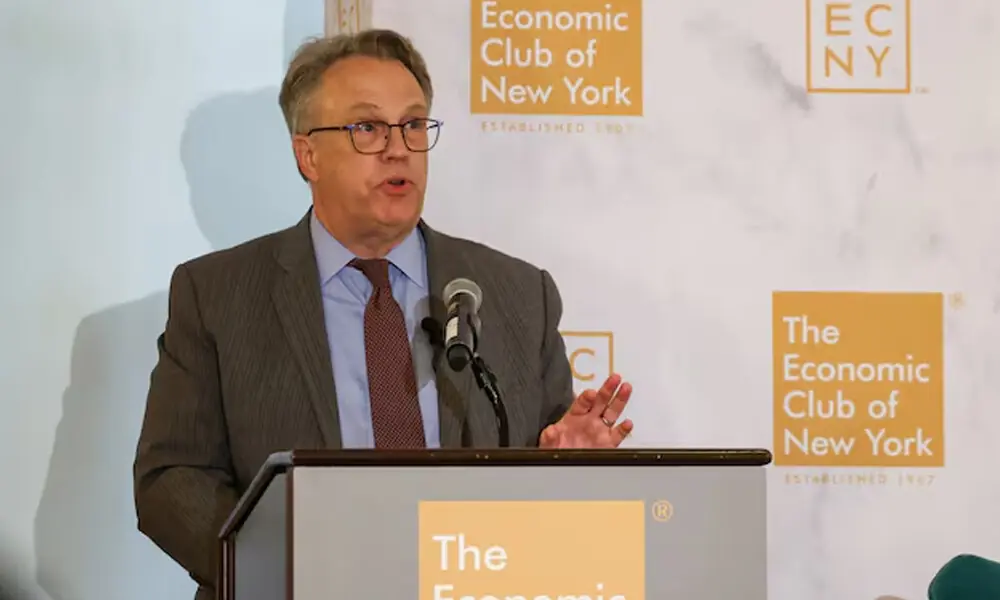

Federal Reserve Bank of New York President John Williams said on Tuesday the Middle East war energy shock will drive up overall inflation over the course of this year, while reiterating monetary policy is in the right place to deal with what happens in the U.S. economy.
The war impact “will directly go into headline inflation because energy prices are an important component of that,” Williams said in an interview on Bloomberg’s television channel. “I expect headline inflation to actually be elevated, you know, in the middle of this year” and come in at around 2.75% for the year, he added.
In the near term, as the shock from the Middle East war, launched by U.S.-Israeli attacks on Iran, works its way through the economy, Williams said it is possible for inflation to go over 3%, noting that markets are expecting such an outcome.
READ MORE: Powell says Fed can ‘wait and see’ how war affects inflation
He said he’s got a close eye on what’s happening to underlying inflation, and there the energy shock will also lift prices, just not by as much.
“Overall, I’m kind of where I’ve been for a while, with core inflation around two and a half percent this year,” Williams said, referring to inflation excluding food and energy.
Williams reiterated in his interview that he doesn’t see any imminent need to change the setting of monetary policy. The Fed’s interest rate target is currently in a range of 3.5% to 3.75%, with officials at last month’s policy meeting having penciled in one quarter-point rate cut this year.
“Monetary policy today is really well positioned, given where all of those dynamics have been playing out, and well positioned to kind of wait and see on some of the effects of…what’s happening today,” Williams said. “I’m not saying we’re just, you know, in some kind of ‘we can’t act’” stance, instead, “I think this monetary policy is exactly where it needs to be.”
Williams said the impact of the war and the increase in prices it has brought will likely pull down growth a bit as consumers are forced to spend more on energy. He also said in the current low-hire, low-fire economy he expects the unemployment rate to hold mostly steady going forward.
“I’ve been bringing down my forecast for growth this year, probably somewhere between two and two and a half percent for growth this year, and unemployment rate probably staying around where it is now,” he said.
Williams also said in the interview he doesn’t see the uncertainties around the confirmation of Kevin Warsh to be Fed chair, and the possibility that current leader Jerome Powell will need to stay on longer, affecting the Fed’s work.
“I would just highlight the most important thing here is that, you know, we’re just focused on doing our work. There’s no issue about continuity or things like that,” Williams said.




















Comments