


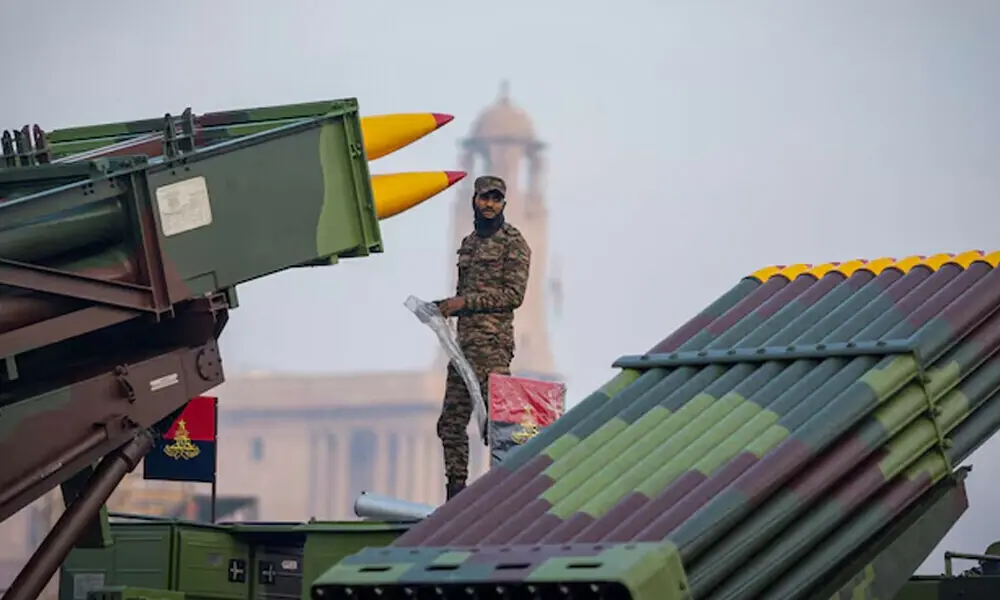
EDITORIAL: India’s decision to unveil a record defence budget of USD 85 billion raises a number of uncomfortable questions, particularly when set against the backdrop of last year’s brief but intense conflict with Pakistan, an episode New Delhi exited with its swagger dented rather than its dominance affirmed. The scale and timing of the increase are therefore being read in Islamabad less as routine modernisation and more as a political signal, one that carries implications for an already fragile regional balance.
Within Pakistan, there is a growing perception that India’s leadership has yet to fully absorb the domestic fallout of that confrontation. Expectations of a decisive outcome were loudly cultivated, but the reality proved messier. India lost aircraft, its reputation, and the initiative. International scrutiny followed, and domestic approval ratings have since show signs of strain. In such circumstances, defence spending can easily take on a second function, projecting strength outward to compensate for unease at home. That possibility cannot be dismissed, given South Asia’s history of security crises shaped as much by internal politics as by external threats.
The contours of the budget reinforce this concern. Planned investments span fighter aircraft, drones, submarines, missiles and high-speed military infrastructure, alongside a push to integrate defence spending with domestic manufacturing and strategic autonomy. From India’s perspective, this aligns security with industrial ambition. For its neighbours, however, it signals a sharper edge to regional competition. Military capacity, once built, alters behaviour regardless of official assurances. Intentions may change, capabilities endure.
READ MORE: India budget pledges defence boost
For Pakistan, the immediate worry is not simply the numbers, but the context in which they appear. Defence expansions following unresolved conflicts tend to narrow diplomatic space rather than widen it. They encourage signalling, escalation ladders and risk-taking, particularly when domestic political incentives reward confrontation. In a nuclearised environment with compressed decision-making timelines, that combination is inherently dangerous.
These regional anxieties sit within a far more troubling global pattern. Since President Donald Trump’s return to the White House and his renewed disruption of trade, alliances and security norms, international restraint has weakened sharply. Defence spending is rising across Europe, the Middle East and parts of Asia, driven less by confidence than by uncertainty. Arms budgets have become insurance policies against a world perceived as unpredictable and transactional.
India’s budget hike fits squarely into this trend. It reflects a global drift towards militarisation as diplomacy struggles to keep pace with shifting power balances. Yet history offers little comfort that higher arms spending produces stability. More often, it entrenches suspicion and accelerates arms races that feed on themselves. South Asia, with its legacy of crises and mistrust, is particularly exposed to these dynamics.
Pakistan’s challenge, therefore, is twofold. First, it must assess India’s defence posture with realism rather than rhetoric, recognising both the domestic drivers and the strategic consequences. Second, it must resist being pulled into reactive escalation that serves short-term political narratives elsewhere. Pakistan’s experience in recent years suggests that restraint, backed by credible deterrence and diplomatic engagement, has denied provocation its intended payoff. That lesson remains relevant.
At the same time, restraint should not be confused with complacency. A region witnessing rapid military build-up cannot rely on assumptions of rational behaviour alone. Crisis management mechanisms, communication channels and confidence-building measures matter more, not less, when arsenals expand. The absence of such guardrails increases the risk that miscalculation, rather than strategy, determines outcomes.
There is also a broader question that extends beyond Pakistan and India. Rising defence budgets across continents are symptoms of a deeper malaise in the international system. As economic uncertainty grows and multilateral frameworks weaken, governments are turning to arms as substitutes for order. This may satisfy domestic audiences briefly, but it leaves societies poorer, less secure and more divided in the long run.
India’s defence budget will be defended in New Delhi as prudent, necessary and forward-looking. From Pakistan’s vantage point, it sharpens concerns about intent, timing and consequence, especially so soon after a conflict that established Pakistan’s tactical superiority. Combined with global trends towards militarisation, it reinforces the sense that the world is edging towards confrontation rather than accommodation.
For Pakistan, the imperative is clear. Read the signals calmly, strengthen deterrence without theatrics, and keep the focus on preventing crises rather than responding to them. In a region where the costs of misjudgement are well known, prudence is not weakness. It is indeed strength.
Copyright Business Recorder, 2026

























Comments
Comments are closed for this article.