


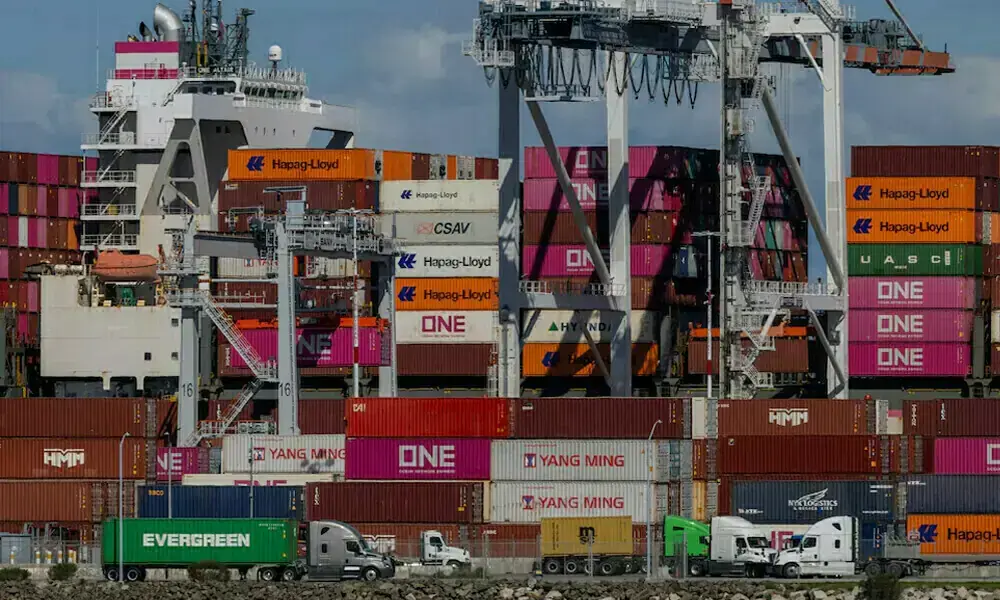

Global trade and geopolitics are entering a new era shaped by evolving trade rules, strategic partnerships, and shifting alliances. Traditional allies are increasingly drifting apart, whereas former rivals are moving closer together.
At the center of the emerging global order, many call it ‘disorder’, stands the President of the United States, Donald J. Trump, who in his inaugural address called himself as a “peacemaker and unifier”.
During the first year of his second term, Donald Trump played a manifest role in mediating multiple international conflicts, including the two-year-long war between Hamas and Israel, a conflict that claimed lives of more than 50,000 children, alongside a separate and significant loss of civilian men and women.
In South Asia, tensions between Pakistan and India escalated into direct confrontation, during which Pakistan downed Indian aircraft, damaged air defense systems, and established air superiority. President Trump claimed his role in de-acceleration of Indo-Pak armed conflict, as well as diplomatic engagements in disputes involving Israel and Iran, Rwanda and the Democratic Republic of Congo, Thailand and Cambodia, Armenia and Azerbaijan, Egypt and Ethiopia, and Serbia and Kosovo.
Besides conflict diplomacy, President Trump has systematically deployed tariffs as a strategic instrument of diplomacy. By imposing tariffs on countries with which the United States runs constant deficits, tariffs have been transformed into leverage tools to force renegotiation of economic and political relationships.
READ MORE: Trump invites more leaders to join Gaza ‘Board of Peace’
President Trump’s approach has brought multiple states to the negotiating table in pursuit of more favourable deals for the United States. However, it has also compelled close US allies to seek alternative trade routes and partnerships, including Canada, the European Union, and India.
Canada has faced US criticism over trade barriers, persistent trade deficits, high tariffs on American dairy products, failure to meet NATO’s 2 percent defence spending commitment, and the imposition of a 3 percent digital services tax on US technology firms. The European Union has similarly been targeted on both trade and security grounds.
President Trump has repeatedly described European Union (EU) trade policy as structurally unfair to his country’s interests, particularly in the automobile and agricultural sectors. He has also criticized European states for underfunding NATO obligations, overreliance on US security guarantees, migration policies, and the EU’s multilateral governance framework, which he views as misaligned with American strategic priorities.
India has also not been exempted from this pressure. Despite US involvement in facilitating de-escalation with Pakistan, Washington has expressed dissatisfaction with India’s continued purchase of Russian oil, its trade barriers against US products, and its broader economic policies. The United States has imposed elevated tariffs on Indian exports and threatened punitive measures of up to 100% tariff should India fail to alter its energy and trade policy.
Beyond trade and tariffs, President Trump has advanced a parallel diplomatic architecture. The announcement of a “Board of Peace”, ostensibly designed to manage Gaza’s reconstruction and oversee peace and stability between Hamas and Israel, signals the creation of a new multinational platform operating alongside and effectively outside, the United Nations (UN). Trump’s repeated criticism of the UN and his direct invitations to selected states reflect an effort to create an alternative governance mechanism under US leadership.
The major European Union countries and India declined participation. However, Canada’s invitation was later withdrawn. On the contrary, several Middle Eastern states, including Pakistan and other regional actors, joined the initiative, highlighting perceptions of a parallel institutional order emerging outside traditional multilateral frameworks.
This restructuring of alliances has been further intensified by President Trump’s assertive foreign policy posture, including public interest in acquiring Greenland, a move widely viewed as destabilizing for NATO unity. Additional economic pressure has followed, including new tariff surcharges on European states opposing US positions and threats of large-scale tariffs on European exports. However, these policies have drawn domestic criticism for their confrontational approach toward long- standing allies, the administration frames them as consistent with the “America First” doctrine.
The consequence has been strategic shift, as traditional US partners are now actively seeking new trade and defence partners. Canada’s strategic engagement with China, including the signing of strategic cooperation agreements and tariff reduction frameworks, reflects this shift, even as Ottawa remains cautious under renewed US threat of 100% tariff. The European Union has similarly recognized that long-term dependence on US economic and security structures, without alignment to American strategic demands, is no longer sustainable. As a result, Europe has begun rushing for external trade partnerships.
This strategic adjustment is most visible in the EU and India trade agreement. The growing trade pressure on India has enhanced its strategic expansion, resulting in the long delayed EU-India deal. The agreement represents more than diplomatic symbolism. It reflects an economic restructuring of India’s trade posture through phased tariff reductions across industrial sectors.
The concessions on European machinery, chemicals, and electrical equipment signal a deliberate opening of protected markets, whereas the automotive provisions are particularly significant. The projected reductions in tariffs on European vehicles from levels exceeding 110% to near 10% within a quota framework mark a clear departure from established tariff barriers toward managed liberalization.
The export gains for India are focused in high-consumption sectors such as textiles, jewellery, and marine products, offering access to an advanced European consumer base. However, the benefits remain uneven. EU’s challenge to meaningful agricultural access, particularly for sugar, poultry, dairy, and bovine meat, exposes the structural asymmetry of the agreement. The industrial market opening without reciprocal agricultural access limits India’s capacity to translate tariff reductions into broad-based export growth, highlighting a familiar North and South trade pattern.
The bigger challenge for implementation of the agreement lies beyond tariffs. Regulatory framework, EU standards enforcement, labour protections, environmental compliance, and technical certification regimes will shape outcomes more decisively than headline tariff cuts.
The compliance costs and enforcement asymmetries introduce friction for exporters on both sides, whereas ratification delays and phased implementation reduce immediate impact. As in many North-South agreements, institutional capacity gaps and execution risks threaten to dilute negotiated gains.
The geopolitical dimension of the deal is equally consequential. The framing of this agreement as a counterweight to US trade pressure introduces strategic risk into what is formally a commercial arrangement. India’s post-Ukraine expansion of Russian oil imports, although economically rational for inflation control, already wrenched relations with Western partners by indirectly softening sanctions pressure. The deeper trade autonomy now risks highlighting perceptions of strategic departure rather than durable cooperation.
The transition risk is further intensified by EU’s suspension of tariff preferences for most Indian exports under the Generalized Scheme of Preferences (GPS) from January 2026. This sequencing creates a competitiveness gap, exposing exporters to higher duties and compliance costs before FTA benefits take effect. The result is a reduction of India’s price competitiveness in European markets during the interim period.
EU-India agreement therefore reflects a strategic shift rather than a simple trade expansion. Its success will depend less on tariff schedules and more on regulatory coherence, enforcement capacity, institutional coordination, and geopolitical management.
At the same time, prospects of an India–US trade deal remain structurally complex and politically fragile. The negotiations are driven less by mutual liberalization and more by pressure tactics, sectoral carve-outs, and strategic bargaining. US demands on digital trade, agriculture, energy sourcing, and market access confront India’s domestic protection priorities and industrial policy goals.
Even where partial agreements emerge, they are likely to be narrow, conditional, and enforcement heavy rather than transformational. This produces uncertainty for investors and exporters, because tariff relief may be reversible and compliance obligations asymmetrical. The deal, if concluded, may function more as leverage architecture than stable trade integration. However, Pakistan’s investment architecture has remained comparatively static and domestically preoccupied.
The broader implication is systemic, global trade is restructuring around power blocs, regulatory regimes, and strategic alliances. The emerging world order will not be shaped by trade agreements alone, but by the coordinated economic, regulatory, and strategic power of the United States and its allies in defining the rules, standards, and institutional architecture of the new global economy.
Copyright Business Recorder, 2026
The writer is a lawyer and author, is an Adjunct Faculty at Lahore University of Management Sciences (LUMS), member Advisory Board and Senior Visiting Fellow of Pakistan Institute of Development Economics (PIDE)
The writer, an Advocate Supreme Court, Adjunct Faculty at Lahore University of Management Sciences (LUMS), member Advisory Board and Visiting Senior Fellow of Pakistan Institute of Development Economics (PIDE), holds LLD in tax laws
The writer is a corporate lawyer based in the US with extensive expertise in financial regulations, including Virtual Asset Service Providers (VASPs), corporate governance, and global economic policies. He holds an LLM from Washington University in St. Louis and has completed the Management Development Program at the Wharton School. He has developed regulatory frameworks for North American and South American Financial Institutions and has consulted and trained bureaucrats of different regions. He can be reached at [email protected]


























Comments
Comments are closed for this article.