


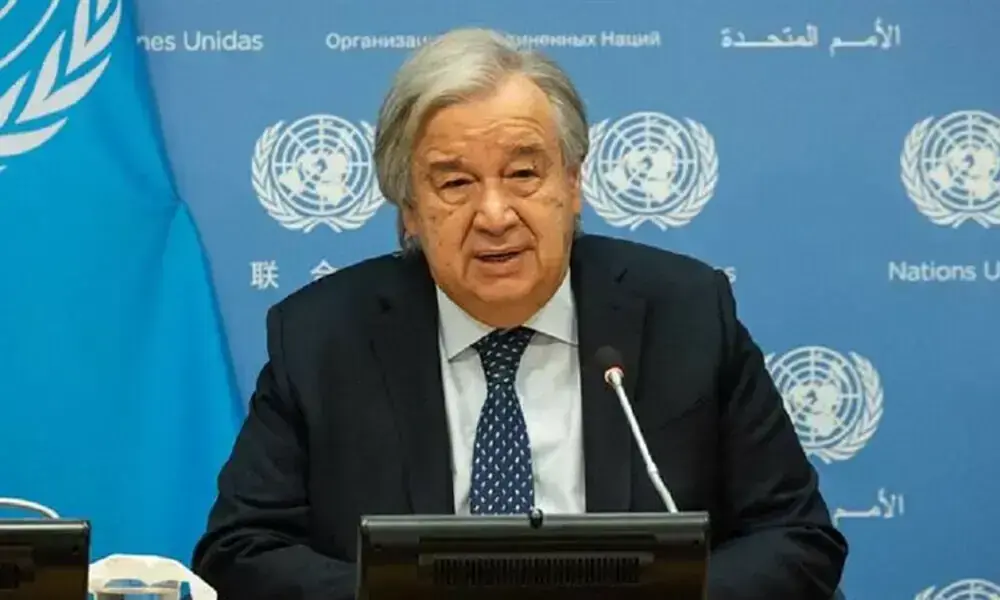
EDITORIAL: UN Secretary-General António Guterres’ warning at a recent news conference was less a diplomatic observation than an alarm bell for an international system in visible decay. His assertion that global problems cannot be solved by one power “calling the shots” or by two powers dividing the world into rival spheres of influence speaks directly to a growing crisis of legitimacy in global governance. At the heart of this crisis lies the erosion of international law, multilateral cooperation, and shared norms—mechanisms designed to restrain coercive power and offer weaker states at least minimal protection.
Guterres’ emphasis on impunity as the driving force behind today’s conflicts—“fuelling escalation, widening mistrust, and kicking the doors open for powerful spoilers”—is particularly telling. When violations of international law go unpunished, escalation becomes inevitable. In such an environment, diplomacy gives way to coercion, and rules are replaced by raw power. His remarks gain added significance in the context of recent initiatives by US President Donald Trump, notably the launch of his so-called Board of Peace. While presented as an effort to resolve the Gaza conflict, the initiative has been widely seen as serving Israeli strategic interests, particularly through demands to disarm Hamas without addressing the deeper political roots of the conflict, while also assigning the body a broader role to advance American interests. The refusal of major European powers to endorse the initiative underscores growing unease even among traditional allies about unilateral approaches that sideline established multilateral frameworks.
Trump’s own dismissive attitude toward international law only reinforces Guterres’ concerns. His reported claim that he does not “need international law,” and that the sole constraint on his power is his “own morality,” encapsulates a worldview fundamentally at odds with the post-World War II international order. Instead, it evokes the ancient realist maxim that “the strong do what they can and the weak suffer what they must” - a notion the United Nations was explicitly created to overcome. When the leader of the world’s most powerful state openly rejects legal and institutional constraints, the message to others is unmistakable: rules are optional, and power is paramount.
Yet this very unilateralism may be accelerating the decline of the dominance it seeks to preserve. As powerful states bypass multilateral institutions, others are increasingly motivated to construct alternatives. The expansion of the BRICS group reflects this shift. Emerging powers are not merely reacting against Western dominance; they are actively building parallel networks of economic cooperation, diplomatic engagement, and cultural exchange. Their emphasis on sovereign equality and non-interference resonates with many states that feel marginalised or pressured within the Western-led system.
The growing influence of groupings such as BRICS thus reflects a broader desire for an international system grounded in sovereign equality, mutual respect, and development-oriented cooperation rather than coercion. Multipolarity, if anchored in revitalised multilateral institutions and a renewed commitment to international law, can restore legitimacy to global governance. The UN chief’s warning should therefore be read as a call to ensure that the emerging multipolar order is governed by rules, accountability, and cooperation rather than by unchecked power and impunity.
Copyright Business Recorder, 2026




















Comments
Comments are closed for this article.