


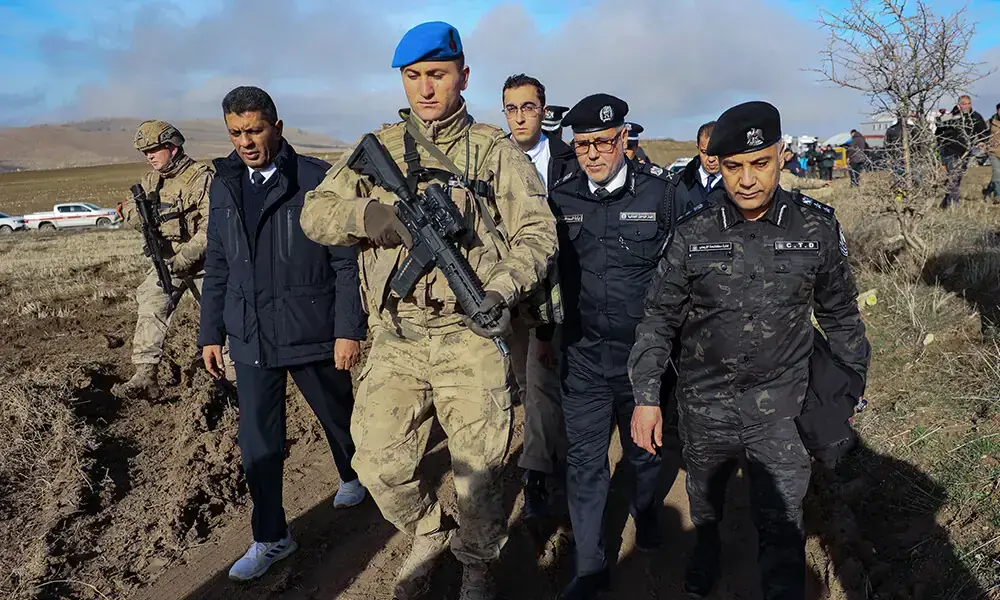
EDITORIAL: Pakistan’s arms agreement with Libya marks a genuinely encouraging breakthrough. It reflects a moment where military capability, defence-industrial capacity and external demand have aligned in a way that carries both strategic and economic significance. The scale and timing of the deal matter, but more important is what it signals: Pakistan’s defence sector is beginning to convert operational credibility into tangible export outcomes.
The agreement with the Libyan National Army, valued at over $4 billion, marks one of Pakistan’s largest-ever defence export transactions. It places Pakistan in a small group of states able to supply complex conventional military equipment across air, land and sea. More importantly, it signals that Pakistan’s defence industry is no longer operating purely on aspiration. It is being taken seriously as a supplier.
That credibility did not emerge in a vacuum. It followed Pakistan’s performance during the summer conflict with India, which drew global attention to its operational readiness, command-and-control capability and indigenous platforms. The conflict was closely watched by major powers and international institutions, not because of escalation alone, but because it tested doctrines, equipment and response under real conditions. Pakistan’s ability to hold its ground, manage escalation and demonstrate operational coherence altered perceptions well beyond South Asia.
This recalibration has been visible in diplomatic and strategic engagement since then. Pakistan’s military performance was noted internationally, including in western capitals and across the Muslim world, where defence cooperation has long carried political as well as commercial weight. The Libyan deal appears to be one of the first tangible commercial outcomes of that shift, and it is unlikely to be the last.
For the armed forces, the implications are straightforward. Sustained export orders help justify investment in domestic platforms, improve economies of scale and reinforce a cycle of innovation, testing and refinement. For the defence industry, this is validation. Aircraft such as the JF-17 and training platforms like the Super Mushak were designed with export markets in mind, but consistent large-scale orders have been elusive. A deal of this magnitude changes that equation.
The economic implications are equally significant. Pakistan’s traditional export sectors, particularly textiles, have struggled to deliver the growth and foreign exchange earnings expected of them. Structural weaknesses, energy costs, compliance burdens and global demand shifts have all taken their toll. As a result, exports remain narrow and vulnerable, while import needs continue to exert pressure on reserves.
Defence exports offer something different. They are high-value, technologically intensive and less exposed to the commodity cycles that plague traditional sectors. Payments are typically structured over multiple years, providing a steadier foreign exchange inflow. For an economy facing chronic balance-of-payments stress, even a handful of such contracts can make a meaningful difference at the margin.
There is also a strategic dimension to this outreach. Defence cooperation often deepens broader relationships, opening space for training, maintenance, joint production and longer-term industrial collaboration. If managed carefully, arms exports can anchor wider economic and diplomatic engagement, particularly in regions where Pakistan already has political goodwill and defence familiarity.
None of this diminishes the risks, of course. Libya remains a fragmented theatre, subject to international scrutiny and legal complexity. Defence exports must remain compliant with international frameworks and carefully calibrated to avoid reputational or diplomatic fallout. But those are issues of execution, not direction.
What stands out is that Pakistan has, at least for now, aligned three important elements: military credibility, industrial capability and economic need. The defence sector has long argued that exports could become a meaningful pillar of economic strategy. Until recently, that claim rested more on potential than proof. This deal provides proof.
The challenge now is not celebration but consolidation. One transaction does not make a strategy. To turn this breakthrough into a sustained trend, Pakistan will need policy coherence, industrial planning and disciplined diplomacy. Defence exports should complement, not substitute for, the revival of civilian industry. But in a moment when traditional engines are underperforming, this new stream offers a welcome and timely lift.
If Pakistan can translate battlefield credibility into industrial reliability, and industrial reliability into repeat orders, the implications will extend well beyond defence. For a country searching for viable export pathways, that would be a breakthrough worth building on.
Copyright Business Recorder, 2025




















Comments
Comments are closed for this article.