


Major Japan quake injures 30, damages roads
- The Japan Meteorological Agency said the magnitude 7.5 quake at 11:15 pm on Monday
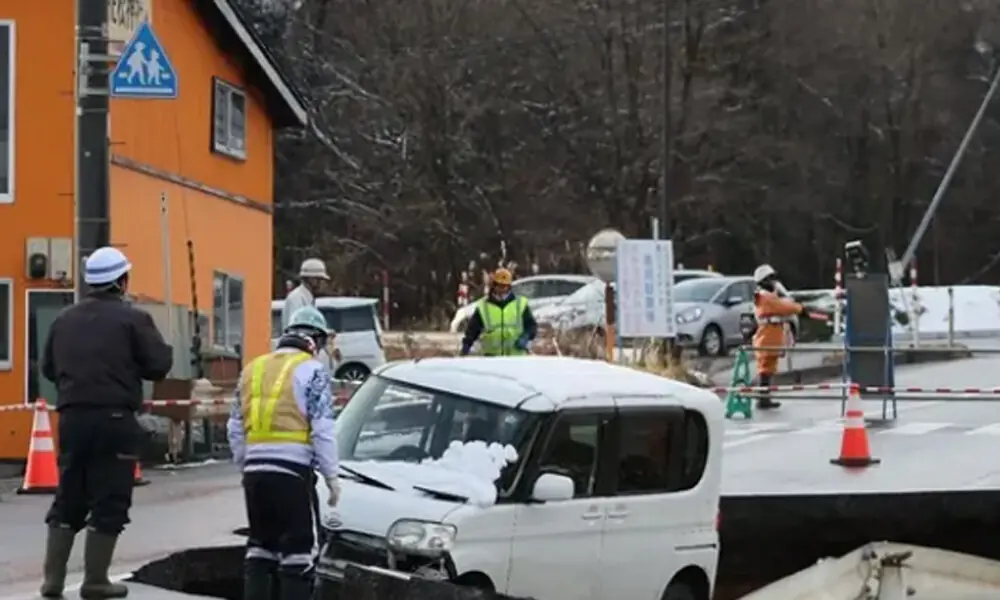

SAPPORO: A big quake off Japan injured at least 30 people, authorities said Tuesday, damaging roads and knocking out power for thousands in freezing temperatures.
The Japan Meteorological Agency said the magnitude 7.5 quake at 11:15 pm on Monday (1415 GMT) – downgraded from its first reading of 7.6 – raised the chances of similar or larger tremors in the coming days.
Prime Minister Sanae Takaichi said 30 people were injured in the quake off the coast of the northern Aomori region, which triggered tsunami waves up to 70 centimetres (28 inches).
Daiki Shimohata, 33, a civil servant in Hashikami on Honshu island, told AFP that he and his family rushed outside their home.
“The tremor was something that we’ve never experienced. It lasted maybe for about 20 seconds,” Shimohata said by phone.
“We were holding our children – a two-year-old girl and a one-year-old boy – in our arms. The shaking reminded me of the disaster (in 2011),” he said.
One person was seriously hurt in the main northern island of Hokkaido, according to the Fire and Disaster Management Agency.
Footage showed people in a supermarket clinging to a table with items having fallen off shelves, as well as crevasses in roads and at least one car in a hole.
Elsewhere broken glass from windows was scattered on roads and pavements.
Initially there were reports of several fires but government spokesman Minoru Kihara said Tuesday that was one confirmed blaze at a house.
On the main northern island of Hokkaido, an AFP reporter said the ground shook violently for around 30 seconds as smartphone alarms alerted residents.
In the city of Hachinohe the quake reached upper six on Japan’s seven-level Shindo scale of shakiness, the point at which it’s impossible to move without crawling.
With temperatures around freezing point, around 2,700 homes were without power but by Tuesday morning electricity had been restored to most areas, according to utility providers.
At first the JMA warned of tsunamis up to three metres (10 feet), which could have caused major damage.
Around 28,000 people were initially advised after the quake to evacuate, emergency services said, and media reports said some makeshift shelters were full.
In the end the biggest waves recorded measured up to 70 centimetres and after several hours the tsunami warnings were lifted.
Shinkansen bullet-train service was suspended in some areas while engineers checked for any damage to the tracks.
No abnormalities were detected at the Higashidori or Onagawa nuclear power plants, operator Tohoku Electric Power said.
The JMA warned people to be cautious of further quakes of a similar intensity for about a week.
“Additionally, there is a possibility of even stronger earthquakes occurring, so please stay alert,” it said.
Geologists Kyle Bradley and Judith A. Hubbard said that there was no way to tell whether a strong earthquake will be followed by a similarly strong, or even stronger, one.
“Instead, we must rely on historical statistics, which tell us that very few large earthquakes are soon followed by even larger events,” they said in their Earthquake Insights newsletter.
“It does happen, just not very often.”
‘Megaquake’
In 2011, a magnitude-9.0 quake triggered a tsunami that left 18,500 people dead or missing and caused a devastating meltdown at the Fukushima nuclear plant.
Japan sits on top of four major tectonic plates along the western edge of the Pacific “Ring of Fire” and is one of the world’s most tectonically active countries.
The archipelago, home to around 125 million people, experiences around 1,500 jolts every year.
The vast majority are mild, although the damage they cause varies according to their location and depth below the Earth’s surface.
Magnitude-6.0 quake shakes northeast Japan, no tsunami alert
Quakes are extremely hard to predict, but in January a government panel marginally increased the probability of a major jolt in the Nankai Trough off Japan in the next 30 years to 75-82 percent.
The government then released a new estimate in March saying that such a “megaquake” and subsequent tsunami could cause as many as 298,000 deaths and damages of up to $2 trillion.




















Comments
Comments are closed for this article.