


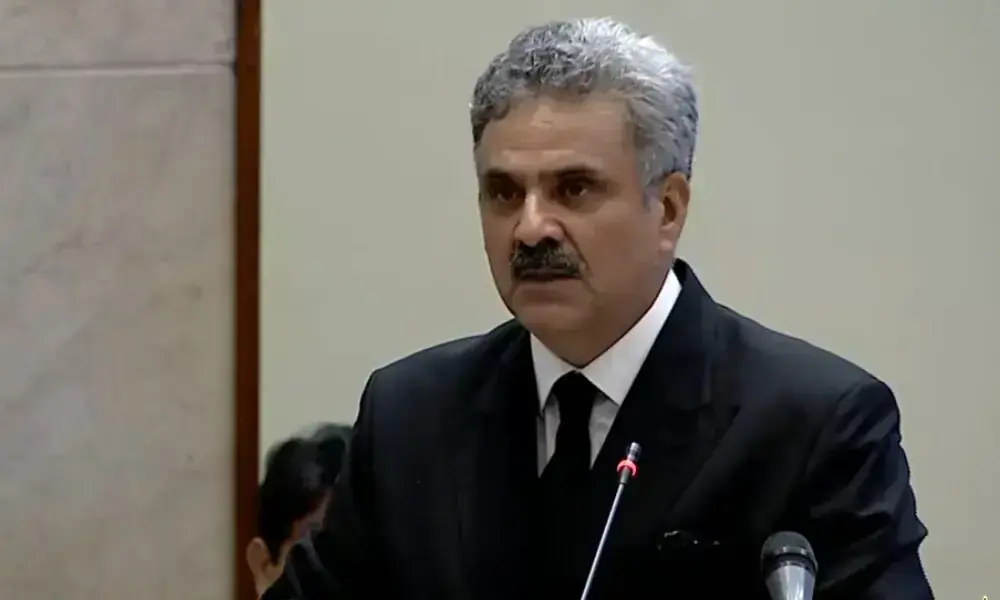

ISLAMABAD: Chief Justice of Pakistan Yahya Afridi proposed amendments to the Code of Conduct for Judges, seeking to establish an institutional mechanism for responding to extraneous influence.
Justice Yahya, while chairing the 55th meeting of the National Judicial (Policy Making) Committee (NJPMC) on Friday, apprised the members that he has proposed amendments to the Code of Conduct for Judges seeking to establish an institutional mechanism for responding to extraneous influence.
The proposed amendments also include additions that were approved by the Supreme Judicial Council in 1967 and 2003 and circulated for compliance at the relevant time, but were not incorporated in the notified Code of Conduct; substitution of an article relating to exposure of judges to media was also deliberated upon in the meeting.
The NJPMC meeting was convened at the Supreme Court, which was attended by the Chief Justices of the Federal Shariat Court and of all the High Courts, while the Attorney General for Pakistan attended on special invitation.
The Chief Justices of the High Courts, after detailed deliberation, unanimously agreed and endorsed the proposed amendments, with necessary modifications and suggestions, urged CJP Yahya Afridi to place the same before the Supreme Judicial Council for consideration and approval.
The CJP acknowledged the efforts of all High Courts for notifying Standard Operating Procedures (SOPs), providing a mechanism for institutional response to extraneous influence on Judges at the district level. He observed that similar safeguards are necessary to protect the independence and integrity of the judges of the superior judiciary.
The Committee unanimously reiterated its resolve to strengthen institutional capacity, accelerate access to justice, and ensure efficient and effective justice delivery. It emphasised the importance of sustaining institutional coherence among all tiers of the judiciary to improve accessibility, efficiency, and integrity in the dispensation of justice.
The Attorney General informed the forum that the issue of enforced disappearances has almost been resolved through the recent amendment in Section 11EEEE of the Anti-Terrorism Act 1997, requiring the production of a detained person before a Magistrate within twenty-four hours.
He assured that a comprehensive mechanism to redress complaints of non-compliance with this legal requirement is being considered by the Government, which will be placed before the Committee in its next meeting.
The Committee reviewed the recommendations of the Sub-Committee constituted to address protracted litigation and injunctive orders in commercial, revenue, and fiscal cases. The Sub-Committee’s report highlighted key reforms, including the establishment of dedicated benches, curtailment of frivolous litigation, constitution of a screening committee at the FBR level, avoidance of coercive revenue targets for state-owned enterprises, and improvements in tribunal structures.
The Committee noted that the High Courts have notified specific timelines for the disposal of different categories of cases and have circulated these directions for strict compliance. The Chair appreciated the High Courts for introducing these timelines as a measure to enhance judicial predictability. In particular, the Committee lauded the efforts of the Peshawar High Court for the launch of the first-ever double docket court at Abbottabad. The Chief Justice, Peshawar High Court apprised the Forum that requests are being received for extension of the facility to other districts.
It was also resolved that the High Courts will share data regarding the average time taken for issuance of succession certificate, disposal of inheritance cases of females, oldest succession cases, and cases of execution of decrees of recovery of maintenance, to be discussed in the next meeting.
The Committee was apprised that Model Civil Trial Courts (MCTCs) have been established across the provinces to prioritise the disposal of the oldest pending civil cases under a time-bound regime. The Chair appreciated the High Courts for piloting Model Courts for expeditious disposal of cases. In particular, the Committee appreciated the Model Courts established by the Lahore High Court for having disposed of 12278 cases within 45 days. Similarly, the Balochistan High Court was lauded for the disposal of 586 cases by its model courts.
The Committee reviewed the progress on the National Prison Reform Action Plan. The Lahore, Sindh, and Peshawar High Courts endorsed the proposals, while the Islamabad High Court emphasised the need to expedite completion of the Islamabad Model Jail project.
Copyright Business Recorder, 2025























Comments
Comments are closed for this article.