


Commercial import of old vehicles puts auto industry under ‘severe threat’
- Each imported unit replaces a locally-built car and with it, demand for hundreds of parts that keep 1.83 million jobs alive, says one expert


KARACHI: Earlier this week, the Ministry of Commerce issued an SRO, allowing commercial import of up to five-year-old vehicles with 40 per cent additional duty with immediate effect. Auto industrialists, experts and analysts say this will hurt the local auto industry, which is already struggling.
Talking to Business Recorder, Senior Vice Chairman of Pakistan Association of Automotive Parts & Accessories Manufacturers (PAAPAM) Shehryar Qadir said: “The local industry is under severe threat due to this initiative and will be fighting for its survival.“
Local manufacturers and assemblers have a manufacturing capacity of 500,000 units per annum but they are currently producing around 150,000 units, utilizing only 30% manufacturing capacity of the entire industry. Similar is the case with local part manufacturers, he said.
After allowing commercial import of used cars, the domestic auto industry will be at a risk of complete closure, he warned.
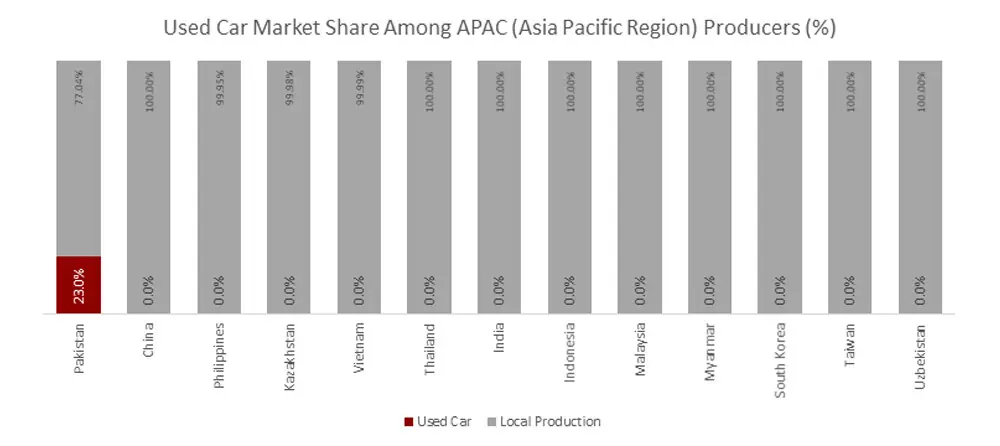
Maximum production of locally manufactured vehicles peaked in fiscal year 2021 in which 303,000 units were locally manufactured. The same year 27,000 units were imported, which accounted for 9% of the total market. Last year imports stood at almost 24%, while seriously denting the local production of the country.
What do the numbers say?
Qadir said demand for imported vehicles erodes demand for locally-manufactured vehicles. In the last fiscal year, used cars have captured almost 25% of the market with imports of over 41,000 units. This very conservatively translates into a direct loss of over Rs60 billion and 40,000 potential jobs to the local part manufacturing industry in one year alone.
He said after commercial import is regularised, these numbers are bound to increase. Each imported unit replaces a locally-built car and with it, demand for hundreds of parts that keep 1.83 million jobs alive. Higher import share will keep plants underused and vendors struggling.
Systematically dismantling the local auto industry will trigger an irreversible jobs, imports, climate, fiscal, and competitiveness shock that no fragile economy can absorb — with no credible alternative plan in place.
“We remain committed to Pakistan’s economic progress and global integration. We are not opposed to reforms that enhance efficiency, but we are deeply concerned about policies that will inadvertently weaken the domestic automotive base and jeopardize livelihoods,“ said Qadir.
PAAPAM’s recommendations
On behald of PAAPAM he made the following suggestions:
• Clear, sector-specific guidance from policymakers and the International Monetary Fund (IMF) on how used vehicle liberalization would coexist with and bolster, rather than undermine, New Energy Vehicle (NEV) localization and environmental goals.
• Concrete policy measures to safeguard employment, support retraining, and incentivize domestic manufacturing and technological advancement.
• Strategies to address tax, regulatory, and financial transparency gaps related to imports, including enforcement against illicit import channels.
• Transparent, evidence-based examples from comparable economies that illustrate successful harmonization of trade liberalization with sustained industrial growth.
• An explicit plan detailing phased implementation, risk controls, and performance metrics to protect Pakistan’s automotive ecosystem while pursuing efficiency gains.”
Speaking about the localization of the industry, Qadir Pakistan hosts a full-fledged auto parts manufacturing ecosystem that produces between 40% and 60% of a vehicle’s components locally, including critical assemblies such as engines and transmissions.
Far from being “screwdriver plants,” the industry represents decades of investment in tooling, technology, and quality systems that meet global standards (ISO-certified, UN Regulation compliant), forming the backbone of Pakistan’s automotive value chain.
New entrants, which mostly entered through the Automobile Development Policy (ADP) 2016-21, had no incentive to localise as they were given heavy incentives by the government including a 50% duty concession on already localised parts.
Rather than encouraging localisation, this policy rewarded import heavy assembly and eroded the market share of existing vendors who had already invested in local tooling.
When it comes to skyrocketing prices of locally-manufactured/assembled vehicles, auto experts and analysts said any short-term price relief comes at a high cost — forex drains, lost local jobs, weaker tax revenue, and stalled industrial growth. The gain is temporary; the damage is long lasting.
The real cost of local cars
The perception of “expensive local cars” arises primarily from taxation, not production costs.
Government levies other than custom duties, including Federal Excise Duty (FED), GST, withholding tax, and registration fees, cumulatively account for 35%–58% of the retail price of vehicles in Pakistan.
When these taxes are stripped out, locally-assembled models are competitive, and often cheaper than regional counterparts due to high localization, despite custom duty protection.
Experts say it is paramount that these other taxes be reduced or removed in order to kick in consumer demand which will increase industry volumes and its competitiveness by virtue of economies of scale.
On the flipside, slashing custom duties strips away crucial competitive advantage without necessarily reducing the burden on end consumers due to other taxes, and hence yield no significant economic benefit but result in industry closures and unemployment.
They said in the country, an auto policy changes faster than the model year—tariffs, targets, and incentives keep shifting, while promised goals and support never materialize, leaving the industry stuck in first gear.
Owing to this, local volumes stand today where they did two decades ago. The government has always failed to implement its own policies on account of these following factors including multiple, short-lived auto policies since 2007 with shifting directions and unmet goals; frequent, abrupt changes in tariffs, duties, and import rules; localization targets revised or bypassed (e.g., Automobile Development Policy (ADP) 2016-21 concessions); stop-start industrial strategy changes with every budget cycle; and promised infrastructure (testing labs, vendor financing) never delivered.
Hurting new investments
Meanwhile automobile expert Shafiq Ahmed Shaikh said importing old vehicles will also hurt new investments. As several new original equipment manufacturers (OEMs) with billions of rupees of investments come into country, import of old used cars of any year must be stopped.
Shaikh said: “Localisation is an investment and it depends on volumes, so if volumes are low then definitely localisation will be slow. In my opinion, it is a good sign that even with lower volumes, after seeing different ups and downs in the auto industry, localisation is intact and I think due to several new players it will improve.”
“In my opinion, support for the local industry is a must. The government and relevant stakeholders must sit together to make good long-term policies for consumers and also to generate job opportunities and scale up localization-cum-investment.“

























Comments
Comments are closed for this article.