


Floods, failure, and the enemy within: Who is responsible for Pakistan’s floods?
- Every year, the blame is cast outward — toward India, toward climate change, toward fate. But how long can a nation survive on denial?
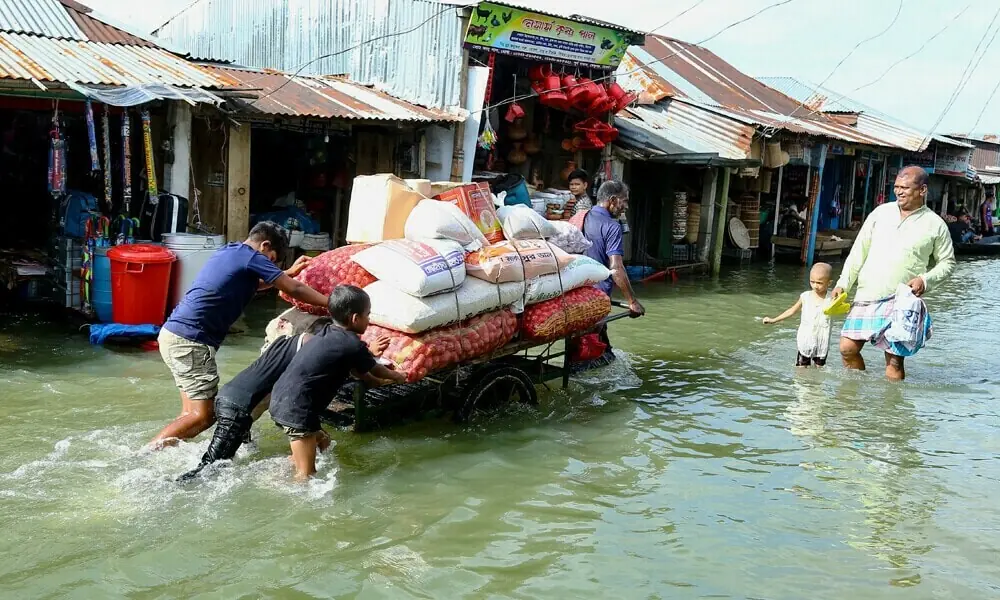

Every monsoon season, Pakistan drowns. Villages vanish, crops are destroyed, families are displaced, and lives are lost. And every year, the blame is cast outward—toward India, toward climate change, toward fate. But how long can a nation survive on denial?
Yes, India has released water into transboundary rivers without timely warnings. Yes, India suspended its participation in the Indus Waters Treaty, and yes, Indian officials have made provocative statements about using water as a weapon.
But let’s ask the harder question: Did India tell us to build housing schemes instead of dams? Did India instruct us to strip our mountains bare of trees, leaving behind landslides and erosion? Did India tell us to build residential communities on natural waterways, choking the very arteries that once carried floodwaters safely away? Did India advise us to pocket aid meant for flood victims, or to jail those chosen by the people and impose notorious criminals on the nation?
No. We did that ourselves.
The Myth of External Blame
Pakistan’s Planning Minister Ahsan Iqbal recently accused India of “water aggression,” citing sudden releases into the Ravi, Sutlej, and Chenab rivers. The National Assembly Speaker echoed this, calling it “water terrorism.” These accusations are not without merit. India’s suspension of the Indus Waters Treaty and its failure to share timely data have undeniably worsened Pakistan’s ability to prepare for floods.
But experts warn that blaming India alone is an oversimplification. As Dr. Hassaan Khan, a water expert at Tufts University, explained, dam spillways are designed to release water when capacity is exceeded—not necessarily as an act of aggression. And India itself has suffered devastating floods this year, with hundreds of dead in Himachal Pradesh and Indian Punjab. If India is weaponizing water, it is flooding itself in the process.
The Real Aggression: Our Own
Let’s be brutally honest. Pakistan’s flood crisis is not just about India. It’s about decades of internal mismanagement, corruption, and elite capture.
• We built housing societies on floodplains, turning natural drainage systems into concrete traps.
• We failed to build dams, despite knowing that water storage is essential for both agriculture and flood control.
• We deforested our mountains, destabilizing entire ecosystems and increasing runoff.
• We ignored climate science, failing to invest in predictive models, early warning systems, and resilient infrastructure.
• We politicized disaster relief, turning aid into a tool of patronage rather than rehabilitation.
And then we turned to the media—expecting it to hold power accountable. But what did our media do? It became the mouthpiece of a diabolic elite, obsessed with palace intrigue, celebrity gossip, and partisan warfare. It never told the people that China brought floods under control in just thirty years through reforestation, dam construction, and urban planning. It never told the people that India built hundreds of dams while we built only gated communities and golf courses.
The Case of Punjab: A Province Betrayed
Punjab, home to over 130 million people, has been ravaged by floods this year. Entire districts were submerged, and millions were displaced. And yet, the province continued to squander opportunities and give way to threats from floods.
Flood management requires technical expertise, administrative experience, and strategic foresight. It cannot be entrusted to political novices installed through dynastic arrangements. The people of Punjab deserve better. They deserve leaders who understand hydrology, infrastructure, and emergency response—not photo ops and press releases.
What India Did Right—and We Did Not
India, for all its flaws, has invested in water infrastructure. It has built over 5,000 large dams, improved its canal systems, and developed flood forecasting models. It has integrated satellite data into disaster response and created institutional frameworks for water sharing—even if imperfectly.
China, facing similar challenges, reengineered its rivers, planted billions of trees, and relocated vulnerable communities. It treated flood control as a national security issue, not a seasonal inconvenience.
And Pakistan? We built elitist residential societies. We built luxury towers in Karachi and invested the profits in Dubai and Portugal. We built nothing for the poor, nothing for the farmer, and nothing for the future.
A National Reckoning
Pakistan must stop outsourcing blame and start owning its failures. We need:
• A national water policy, developed with scientists, engineers, and local communities.
• Massive investment in dams, reservoirs, and reforestation.
• Urban planning reforms that prohibit construction on floodplains.
• Transparent disaster relief mechanisms, monitored by civil society and independent auditors.
• A media revolution, where truth replaces propaganda and public interest replaces elite agendas.
We must also demand accountability—from politicians, bureaucrats, and developers. Those who profited from environmental destruction must be held responsible. Those who ignored warnings must be removed. And those who still treat floods as divine punishment rather than policy failure must be educated.
Divine Warning: A Quranic Reminder
“Corruption has appeared throughout the land and sea by [what] the hands of people have earned so He may let them taste part of [the consequence of] what they have done that perhaps they will return [to righteousness].” — Surah Ar-Rum (30:41)
This verse is not just a spiritual reflection—it is a strategic indictment. It reminds us that environmental degradation and disaster are often the result of human choices. And it urges us to return—not just to faith, but to responsibility.
A Quote Worth Remembering
“Nations are born in the hearts of poets; they prosper and perish in the hands of politicians.” — Allama Iqbal
Iqbal’s words are a haunting reminder that visionary ideals mean nothing without principled leadership. Pakistan’s floods are not just a natural disaster. They are a man-made catastrophe. And until we confront the enemy within, no amount of diplomacy, prayer, or outrage will save us.
Conclusion: The Enemy Within
India’s water aggression is real. But it is not the only enemy. The greater threat lies within—among those who built empires on floodplains, who silenced experts, who looted aid, and who turned governance into theatre. Let the media speak truth. Let the people demand justice. And let the nation prepare—not just for war, but for survival.
Would you like me to help format this for submission to Dawn, The News, or Daily Times? I can also assist with a short abstract or author bio to accompany it.
The article does not necessarily reflect the opinion of Business Recorder or its owners.
The writer is a retired Group Captain of PAF, and now a security analyst




















Comments
Comments are closed for this article.