


Pakistan evacuates a million people as farming belt hit by worst floods in decades
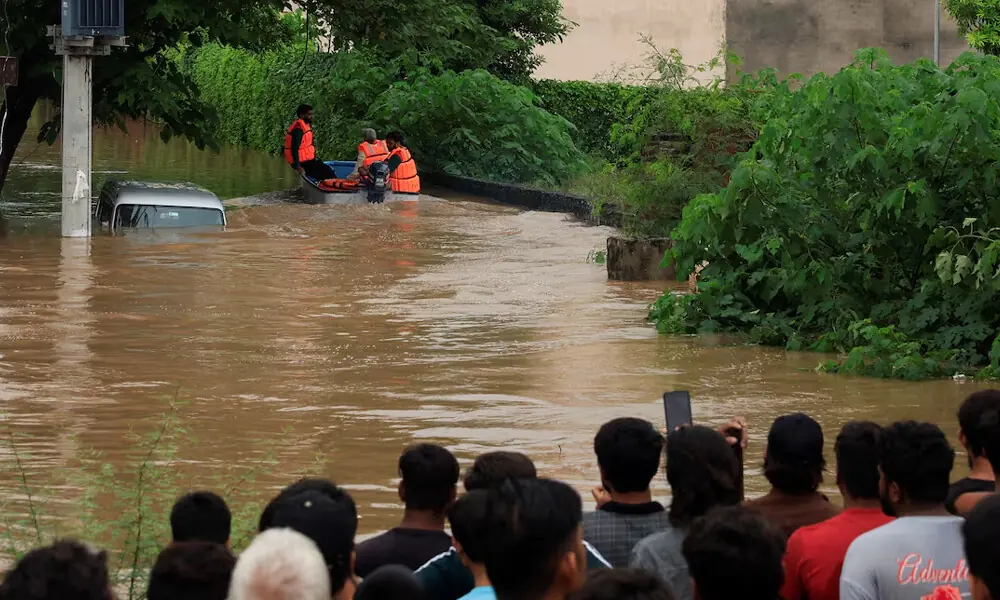

QADIRABAD: Pakistani authorities have evacuated more than a million people from homes in Punjab province this week, officials said on Thursday, as the worst flooding there in four decades caused havoc in hundreds of villages and submerged vital grains crops.
Torrential monsoon rain and neighbouring India’s release of excess water from its dams swelled three rivers that flow into the eastern province, forcing authorities to breach river banks in some places - causing flooding in more than 1,400 villages, Punjab’s disaster management authority said.
Residents of villages such as Qadirabad were walking through water up to their chests on Thursday after the River Chenab overflowed, causing sudden flooding.
“We spent the whole night awake and frightened,” Nadeem Iqbal, 26, a labourer, told Reuters as he waded through the water with one of his children.
“Everyone was frightened. Kids cried. Women were worried. We were helpless,” he said.
Officials say flooding has been worsened in Punjab - home to half of Pakistan’s people and a major producer of wheat, rice and cotton - by the release of water into the three rivers, the Ravi, Sutlej and Chenab, from Indian dams that were full.
Two Pakistan towns face flood risk if river barrage crumbles, officials say
India, which routinely releases water from dams when they get too full, passed on three flood warnings to its arch rival Pakistan this week, calling them a humanitarian measure.
Both countries are battling a heavy monsoon season that has unleashed flash floods. At least 60 people have died this month in hard-hit Indian Illegally Occupied Jammu and Kashmir (IIOJK), while Pakistan’s death toll since late June stands at 819.
At least 12 people have died this week in Punjab province, said Marriyum Aurangzeb, a senior minister in the provincial government.
‘Threat evaded’
The waters of the Chenab threatened early on Thursday to burst through a 3,300-foot (1,000-metre) concrete barrage at Qadirabad that regulates flows, siphoning some of the water into a canal irrigation network. A collapse of the barrage would have inundated two nearby towns.
To avert the danger, authorities deliberately blew up part of the riverbank at two places to release water onto nearby land before it reached the barrage, the provincial disaster management authority said.
India’s water manipulation, heavy rains compound Pakistan’s flood woes
By Thursday afternoon, the level was down to 754,966 cusec, having reached nearly 1 million cusec overnight – well over its capacity of 800,000 cusec. A cusec is a flow of volume equivalent to one cubic foot, or 28 cubic litres, every second.
“We have evaded the threat,” a spokesperson for the authority said.
Officials said shifting weather patterns were to blame for the floods in Pakistan, which has repeatedly been battered by flooding in recent years.
In 2022, unprecedented flash floods caused by historic monsoon rains washed away roads, crops, infrastructure and bridges, killing at least 1,000 people.
The head of Pakistan’s National Disaster Management Agency, Inam Haider Malik, said that for the first time, weather systems coming from the east, south and west had converged over Pakistan this monsoon season.
Planning Minister Ahsan Iqbal said climate change “is the new normal”.
“But it isn’t unmanageable,” he added.
On the other side of the India-Pakistan border, Himalayan river levels began to recede after days of downpours and forecasters said they expected the rain to start easing from Thursday.




















Comments
Comments are closed for this article.