


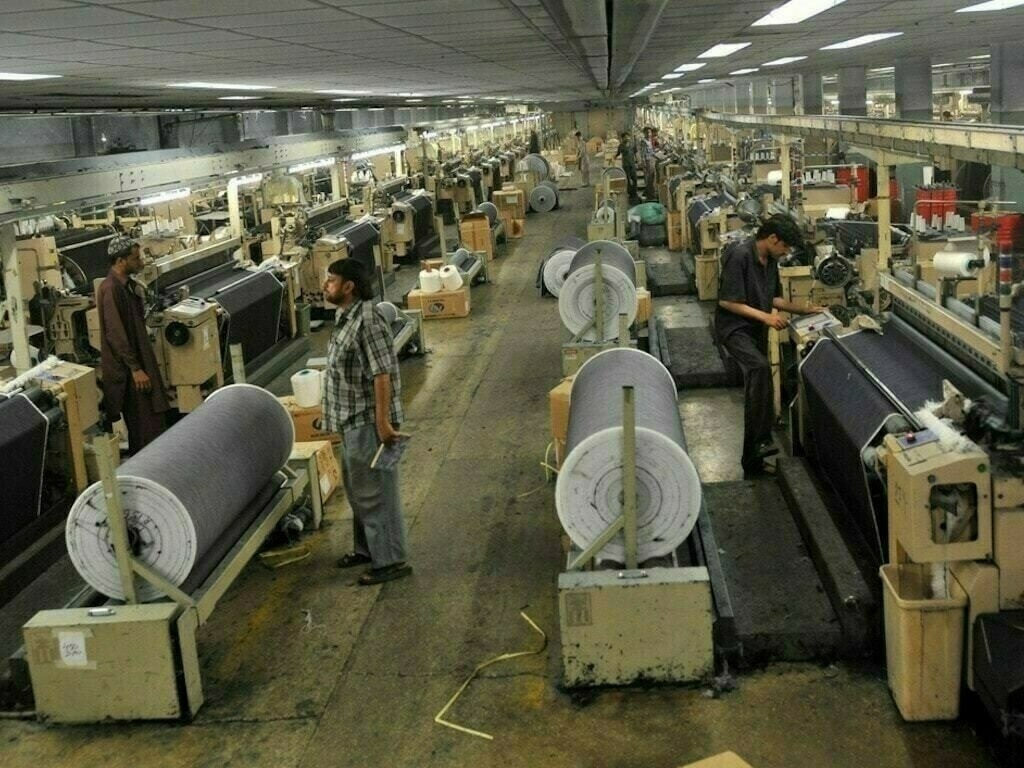
EDITORIAL: Large-scale manufacturing (LSM) registered a growth of 4.14 percent year-on-year (June 2025 compared to June 2024) and negative 3.67 percent month-on-month (June 2025 against May 2025) as per Pakistan Bureau of Statistics (PBS).
This data raises serious credibility questions given that (i) LSM annual average growth for 2024-25 is cited as negative 0.74 percent when compared with the year before; (ii) the Finance Division’s monthly Update and Outlook for July 2025 reveals July-May 2025 LSM growth at negative 1.21 percent; and (iii) the question is if the negativity increased substantially in June of 2025 as claimed by the PBS then why is the July-June 2025 average lower than the July-May average?
It is such questions that no doubt prompted the IMF state in its October 2024 documents that “serious shortcomings remain in the source data available for sectors accounting for around a third of Gross Domestic Product, while there are issues with the granularity and reliability of the Government Finance Statistics (GFS).
The authorities are prioritising addressing these weaknesses, supported by Fund Technical Assistance on the GFS and a new Producer Price Index, and the Pakistan Bureau of Statistics will soon begin fieldwork for four major surveys ahead of the upcoming NA rebasing to FY26.“ That work began last month and is scheduled to be completed by end June 2026 and once completed one would no doubt expect the data to be more credible.
There was considerable pressure on the government in general and the economic team leaders in particular to show positive growth in the LSM (with the capacity to raise job opportunities as well as reduce inflation as output rises) that had been registering negative growth since the onset of Covid-19 in 2020 with the exception of 2021-22 mainly attributable to higher sales, which led to lower inventories rather than a rise in output.
The onus on the economic team leaders for persistently low GDP growth, much lower (half that of regional competitors), was, it was argued, due to their failure to convince the International Monetary Fund (IMF) to phase out harsh upfront conditions envisaging a severely tight monetary and fiscal policy, which are anti-growth.
There is no doubt that the discount rate was halved — from 21 percent in June 2024 to 11 percent in June 2025 — however; this rate is still double that of regional countries and on its own cannot be deemed to be expansionary.
True that credit to the private sector has increased; however, reports suggest that the rise is due to speculation rather than a growth in LSM, which has not been refuted by the government.
In addition, the fiscal policy too remains tight and disturbingly the reliance on indirect taxes remains unchanged, whose incidence on the poor is greater than on the rich — to the tune of 75 to 80 percent — that are major factors in the rise in poverty levels in Pakistan to a high of 44.87 percent.
To add to government concerns, there are ongoing negotiations with several LSM sectors to make them more competitive internationally and domestically through reducing their input costs — utility rates, imported raw material costs, and borrowing costs.
The government can no longer support these sectors at the taxpayers’ expense, as in the past, because of IMF’s October 2024 credible statement: “The government’s intervention in price setting, including for agricultural commodities, fuel products, power, and gas (biannual), combined with high tariff and non-tariff protection tilted the playing field in favour of selected groups or sectors.
Despite all this support, the business sector has failed to become an engine of growth, and the incentives eventually weakened competition and trapped resources in chronically inefficient (including perpetually “infant”) industries.“
To conclude, the LSM sector remains under stress and for an uptick would require easing of monetary (relative to regional countries) and fiscal policies (with the latter showing signs of strengthening rather than easing the contractionary policies).
To date, there is no evidence that the Fund would allow any phasing out of the harsh conditions and hence this sector is likely to remain a hostage to the government’s dependency on borrowing externally as well as domestically.
Copyright Business Recorder, 2025

























Comments
Comments are closed for this article.