


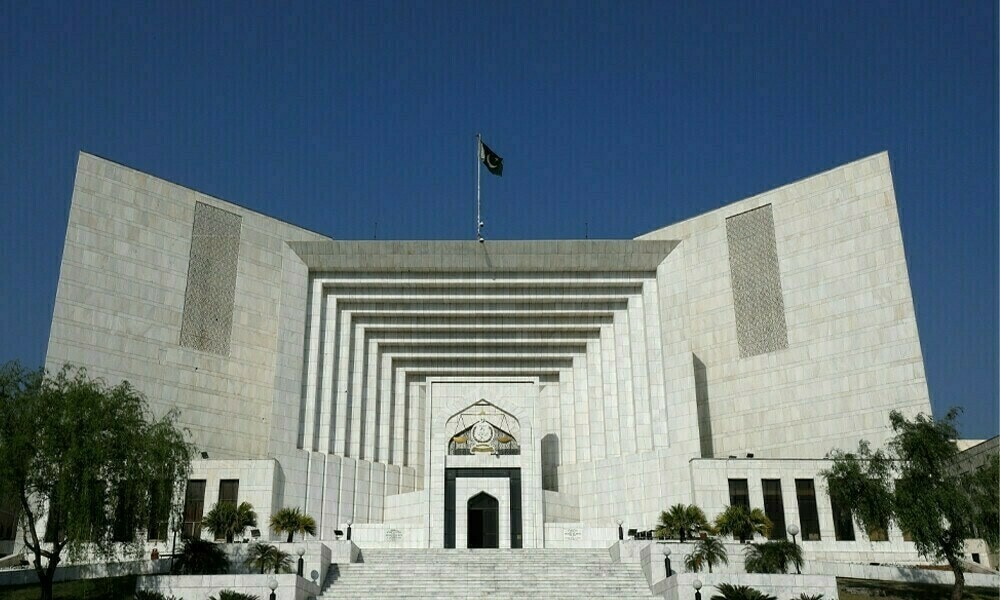

ISLAMABAD: The Supreme Court noted that if the trend of targeting military installations is not controlled then it will create anarchy in future in the country.
A seven-member SC Constitutional Bench, headed by Justice Aminuddin Khan, on Monday, heard intra-court appeals (ICAs) against the apex court’s decision on trial of civilians by military courts.
Justice Syed Hasan Azhar Rizvi said it has become a routine issue that for every wrong, people attack army personnel and the installations.
He remarked; “If any political party has any grievances then no one attacks the police, Governor House or any other place, but start attacking the military and its installations.”
MoD lawyer tells SC: May 9 ‘conspirators’, ‘masterminds’ will be tried in military court
He observed the situation in the country is not different from 1971, and the same thing happened on that day (9th May) the workers of a political party attacked army installations at eight to nine different places. He said; “If this situation is not controlled then tomorrow there will be anarchy in the country.” He said the counsels have been discussing the accused trial but none talked about their role.
Justice Muhammad Ali Mazhar said it seemed that the army wanted to exercise power over the civilians, adding in fact the army was always asked to help deal with such situations.
However, Uzair Bhandari, representing founding chairman of Pakistan Tehreek-e-Insaf Imran Khan, contended that in this case (9th May) the army has decided itself, because in the Corps Commanders conference it was decided that persons involved in 9th May attack need to be tried under Army Act, and the Parliament later on passed the resolution in this regards. He argued that the Parliament is competent to legislate but it also has to follow the constitution.
He stated that everyone is aware how independent Parliament is, as after switching off lights the persons were arrested from the Parliament building.
He contended that had the legislature had played its role the present situation might not have emerged. Uzair argued that as observed by Justice Afghan that this is the case of first impression and if it is like that then the Court has to see what the guidelines are in the existing system, adding the Court has to seek the guidance from the constitution.
The PTI founding chairman’s counsel said that the principles, legal framework and the jurisprudence in which FB Ali case was decided no longer exist because after the 1973 Constitution we now have Article 10A for due process and fair trial. He argued that since FB Ali the case law has developed, and the Court has ruled that reasons should be given for every order and the judgment.
Justice Naeem Akhtar Afghan earlier remarked: “There is no doubt that the present case before us is the case of first impression because each FB Ali and Sheikh Liaquat Hussain cases were decided in view of the particular circumstances and different jurisprudence.” Justice Mandokhail said at the time of FB Ali there was no issue of separation of judiciary from the executive as the magistrate were performing the judicial functions; therefore, the apex court judges did not mind trial of civilians by army colonels and majors in military courts.
Justice Afghan then said that there had been martial laws, insurgency, and terrorism not only in Balochistan, but is spilling over in other provinces, adding; “We always talk about the fundamental rights of the accused, but question ever anyone considering the rights of the victims.”
Justice Mandokhail said the courts in murder cases though convict the murderers, but whether awarding sentences has diminished the incidents of murders. “Why no one ever tried to examine the reasons for committing murders?” “Convicting people will not stop the incidents of murders”, he added.
Earlier, Justice Rizvi questioned whether the petitioner (Imran Khan) ever condemned 9th May events. The counsel replied that his client had done it in CMA. When the court inquired from Uzair what is his opinion on 9th May. He replied that if anyone is found attacking the military installations then he/she should be dealt with in accordance with the law.
He argued that even if the Army Act is annulled, the anti-terrorism law remains in place. He added that when multiple legal forums existed, it must be determined where the fundamental rights of the accused could be best ensured. He argued that Article 245 of the Constitution did not grant judicial powers to the military.
Uzair argued that if the Army Act permits the military trial of civilians, more offences could eventually be added under it.
In response, Justice Aminuddin said: “You are citing Article 245, but that is a completely separate matter.” Meanwhile, Justice Mazhar remarked: “Calling in the military under Article 245 does not mean granting it the authority to run courts.” Justice Mandokhail asked: “Can we declare the prime minister’s order null and void?” At this, lawyer Bhandari said that the court could do so.
Justice Aminuddin then remarked that no prime minister had ever completed five years in office. Justice Hilali rephrased the remark as “there has never been a brave premier who has completed five years.” Justice Mandokhail commented that “we have even legitimised military dictators”.
The case was adjourned until today (Tuesday).
Copyright Business Recorder, 2025




















Comments
Comments are closed for this article.