




WASHINGTON: An international team of astronomers on Monday announced the discovery of a large asteroid whose orbit crosses that of Earth, creating a small chance far in the future of a catastrophic collision.
The 1.5 kilometer- (0.9 mile-) wide asteroid, named 2022 AP7, was discovered in area notoriously difficult to spot objects due to the glare from the Sun.
It was found along with two other near-Earth asteroids using a high-tech instrument on the Victor M. Blanco telescope in Chile that was originally developed to study dark matter.
“2022 AP7 crosses Earth’s orbit, which makes it a potentially hazardous asteroid, but it currently does not now or anytime in the future have a trajectory that will have it collide with the Earth,” said lead author of the findings, astronomer Scott Sheppard of the Carnegie Institution for Science.
The potential threat comes from the fact that like any orbiting object, its trajectory will be slowly modified due to myriad gravitational forces, notably by planets. Forecasts are therefore difficult on the very long term.
The newly-discovered asteroid is “the largest object that is potentially hazardous to Earth to be discovered in the last eight years,” said NOIRLab, a US-funded research group that operates multiple observatories.
2022 AP7 takes five years to circle the Sun under its current orbit, which at its closest point to Earth remain several million kilometers away.
The risk is therefore very small, but in case of a collision, an asteroid of that size “would have a devastating impact on life as we know it,” said Sheppard. He explained that dust launched into the air would have a major cooling effect, provoking an “extinction event like hasn’t been seen on Earth in millions of years.”
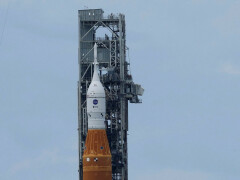
NASA targets November 14 for Moon rocket launch
His team’s results were published in the scientific journal The Astronomical Journal. The two other asteroids pose no risk to Earth, but one is the closest asteroid to the Sun ever found.
Some 30,000 asteroids of all sizes – including more than 850 larger than a kilometer wide – have been catalogued in the vicinity of the Earth, earning them the label “Near Earth Objects” (NEOs). None of them threaten Earth for the next 100 years.
According to Sheppard, there are “likely 20 to 50 large NEOs left to find,” but most are on orbits that put them in the Sun’s glare.
In preparation for a future discovery of a more threatening object, NASA conducted a test mission in late September in which it collided a spacecraft with an asteroid, proving that it was possible to change its trajectory.





















Comments
Comments are closed for this article.