



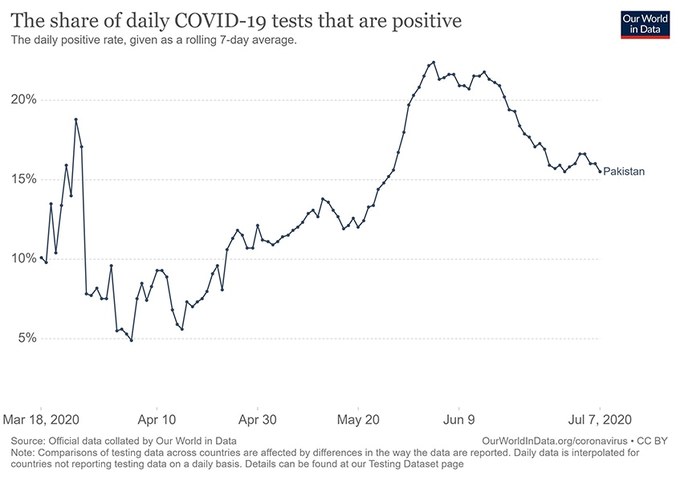
Covid-19 positive cases are witnessing a decline and not just because of a slowdown in countrywide testing, but also because the positivity rate is coming down too – from the high of 22.3 percent on June 4, 2020, to 15.7 percent as on July 7, 2020. Challenges such as under reporting of cases, insufficient testing and measures to curb the spread have been discussed at length in this space in the last couple of weeks. (For more read: Smart lockdown isn’t half bad; and Covid-19: Optimism vs evidence).
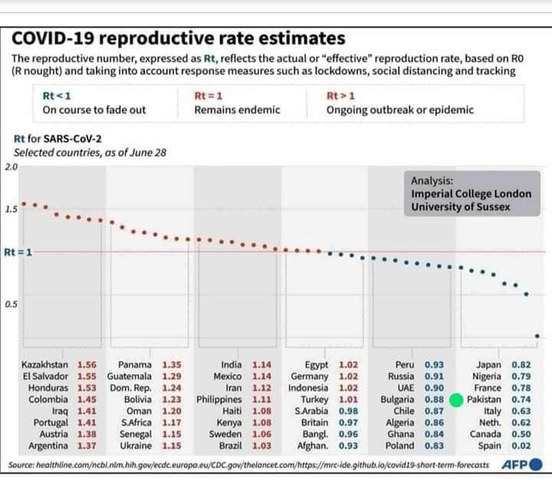
But with more real time data and analyses showing improving situation, the theory of falling number of cases and transmission appears validated. The latest one is by Imperial College London that has estimated that the pandemic in Pakistan is "on course to fade out” based on the declining reproduction rate. Reproduction rate denoted by Rt reflects the actual or the effective reproduction rate based on R naught and takes into account response measures such as social distancing, lockdowns, and tracking. A value equal to or greater than 1 signifies remaining endemic or epidemic, while Rt of less than 1 shows that the virus in on course to fade out. At 0.74, Pakistan’s Rt is not only the lowest in South Asia, but also among the lowest in the world.
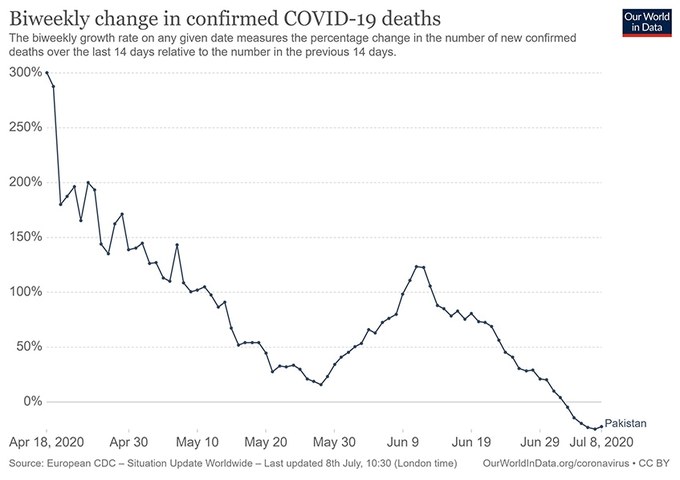
What is of prime importance here is that the biweekly growth rate in deaths is also declining – which is a sign for hope as while positive cases may go underreported - as many people with mild symptoms may go untested – but hiding an unusual spike in death is nearly impossible. Weekly Covid-19 deaths in Pakistan have declined to 577 in the week ending July 7, 2020 from 869 a week earlier. Also, the situation is quite in control compared to what Imperial College’s earlier study showed. Less than a month ago, the study released shocking projections for the number of infections, peak, and deaths caused by Covid-19 in Pakistan. It showed that total death count in Pakistan would be 2.23 million by 26th January 2021, with the virus reaching its peak on August 10 when the total death count would by close to 79,000.
Could this be the beginning of the end of Covid-19 in Pakistan? May be, it is still too early to issue judgement. But an acknowledgement from WHO for decline in cases since early June in a latest tweet thanking the PM for the update is also another reason to be a little optimistic.



















Comments
Comments are closed for this article.