


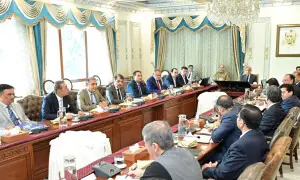
Health ministry officials on Monday discussed strategy to deal with outbreak of gastro-enteritis in the wake of recent floods in different parts of the country. Health director-general Dr Abdul Majeed Rajput chaired the meeting. The emergency plan would be carried out in 20 districts in Punjab, Sindh and NWFP to deal epidemic in wake of monsoon season and flood situation.
In this regard, the federal government will involve provincial and district governments to tackle the situation effectively.
In an outbreak situation, the best control measures were proposed by the meeting includes: early detection and investigation using epidemiological methods and laboratory confirmation measures to ensure safe drinking water sources, appropriate and timely treatment of patients with diarrhoea and dehydration.
The meeting reviewed the situation after outbreaks of gastro-enteritis recently in Larkana, Jacobabad, Hyderabad, Nawabshah, Shikarpur, Sanghar, Thatta, Dadu Mirpurkhas, Badin, Sukkur, Khairpur, and Karachi, Gujranwala, Sialkot, Rawalpindi and Kohat.
In June 2005, Chakwal, Sahiwal and Rahim Yar Khan districts reported outbreaks of gastro-enteritis, the official source said.
About the plan of action for preparedness and response to outbreaks of gastro-enteritis, sources said in view of the current situation, health teams should mobilise disease early-warning system (DEWS).
Provincial health officers should also be mobilised to take action in their respective constituencies to improve timely reporting of potential outbreaks. Similarly, district health officers should also be mobilised.
To support investigation and management of the epidemic, extra supplies of current items may have to be provided rapidly to peripheral laboratories to enable them to cope with an unusually large number of specimens and tests including disposable pipettes, tubes, petri dishes, specific reagents, disinfectants, refrigerating and incubating equipment.
Case management of increased number of patients with vomiting, diarrhoea and serious dehydration will require extra supplies of intravenous solutions, antibiotics, MG tubes, and other hospital supplies.
For timely mobilisation of essential drugs and supplies during an epidemic, they need to be stockpiled in advance, ie, procured and warehoused at a convenient location - a large buffer stock at the provincial level and smaller buffer stocks at high risk districts.
In preparation for response to an outbreak of gastro-enteritis, appropriate messages and materials need to be developed for a public awareness campaign.















Comments
Comments are closed for this article.