


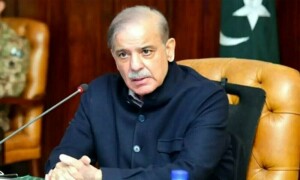
Prime Minister Shaukat Aziz has emphasised the need for the continuous change through reforms to get a place for the country in the comity of nations. Addressing the formal launching of Customs Administrative Reform Project (Care) at Customs House on Monday, he urged the people to fight any resistance to the change because if we do not carry out the process of reform we would become history.
The prime minister said that five years ago when President Musharraf took over the reign of the country the foremost priority before the government was to put the hamstrung economy on the path of progress through a comprehensive re-structuring reform agenda.
Recalling the scenario that existed before the present setup, he said there was no revenue growth for the last three years, and the inflation rate was higher than the revenue growth rate.
The government took bold initiatives to bring changes in the goods handling processes, which dated back to the World War II. The clearance of goods then required huge documentation, including several registers, 16 photo copies and 18 signatures.
He said the Customs reforms initiated in 2000 had multi-faced aspect, and its main objective among other things was to broaden the tax net. "In Pakistan, the tax GDP ratio is lesser than the neighboring countries because we are not paying enough tax in accordance with the size of population. The reforms were on making procedures simple and transparent and eliminate all laws and regulations which created exceptions", he added.
Shaukat Aziz recalled the horrible system of income tax assessment in which income tax officers (ITOs) behaved as Thanedars (police)." The Stone-Age procedures were in vogue in determining income and expenditures, while assessment procedures found place in budget announcements".
He said the modern universal self-assessment system (USAS) introduced by the CBR equally applied to all with only 10 to 15 percent cases subjected to audit for scrutiny of records.
The system was resisted by some quarters, which would bring a revenue loss and a large number of ITOs would become surplus. He suggested that ITOs should search for new tax-payers as our tax base was very narrow.
Describing the Care project, a landmark in the history of Customs, the prime minister said it took 15 days in clearance of goods at the Karachi Port Trust and Customs. The new system would reduce the Customs procedures time to four hours against 15 days earlier.
He expressed the hope that Care would be improved to allow clearance in four hours in line with the Customs practices in vogue in Singapore. The system should be extended to all ports and dry ports as the delay in clearance resulted in dead inventories, which was a national loss.
He said that X-ray machines installed at Port Qasim and airports were doing a good job. Many people are not happy with the machines, which are an important tool of reforms. The screening by X-ray machines is a must to go along with the nations of the world. People should use their full force to fight resistance against the change.
Shaukat Aziz, however, made it clear that the change would not take place only with the use of computers, but the process would have to be re-designed and the mindset changed to bring a change in the real spirit, which we owe to our nation.
Appreciating the new Customs system, through which importers and exporters would file their goods declaration (GD) on line, is not new or unique one in the world, as Iran and other countries were using the system for their transit traffic. "We are exporting software to other countries, but could not devise the same for our procedures earlier due to our negligence", he added.
Pakistan has to adopt modern automated procedures to compete in the world, which has become a small global village, said the prime minister, adding: "Our people have all the talent to compete with other nations. We are proud of the Customs team which worked hard and with dedication to put in place the Care system."
"We have to shun old thinking and adopt modern technology to make Pakistan a modern progressive country. We will become history if we do not reform our systems", he added.
Earlier, welcoming the chief guest, Central Board of Revenue (CBR) Chairman Abdullah Yousuf said that for the first time in the history of the country $150 million was being spent on modernisation of tax procedures and development of human resources.
He said in the first phase of organisational reforms in the CBR, a large taxpayer unit (LTU), and medium taxpayer units (MTU) in Lahore and Karachi have been set up, while MTUs in other major cities would start functioning in next few months. There is also a plan to set up 12 regional tax officers (RTOs) in the country to deal with income tax, sales tax and central excise under one-roof, he added.
The CBR chief said that Pakistan was one of 14 countries which has signed the revised Kyoto Convention calling for risk-based automated tax producers like Care and universal self-assessment scheme (USAS).
He said that Care would not only ensure fast clearance of import and export consignments, but would also reduce cost of doing business, as there would be no un-receipted expenses.
Abdullah Yousuf said that by December 2006 Care would be extended to all customs stations in the country, and would be electronically linked to all other tax collecting departments.
He announced two years salary as a reward for three-member core team of Care, including Collector of Model Collectorate Azhar Majeed Khalid, Ashir Azim Gill and Irfan Sarfraz. One-year salary was also announced for Care pioneer staff, Iqbal Munib, Lubna Jaffar Ali, Umar Shafiq, Tasleem Akhtar, Khalid Mahmood and Rafiqullah Bangash, while three months salary was announced as a reward for Asif Saeed, Farrukh Sajjad, Ashad Jawad, Masroor Kazi, Naseeb Qureshi, Hammadullah, Usman Tahir and Asif Azad.













Comments
Comments are closed for this article.