


Nepal quake tragedy as embassy wall collapses

Normal 0 MicrosoftInternetExplorer4
st1\:*{behavior:url(#ieooui) }
/* Style Definitions */
table.MsoNormalTable
{mso-style-name:"Table Normal";
mso-tstyle-rowband-size:0;
mso-tstyle-colband-size:0;
mso-style-noshow:yes;
mso-style-parent:"";
mso-padding-alt:0in 5.4pt 0in 5.4pt;
mso-para-margin:0in;
mso-para-margin-bottom:.0001pt;
mso-pagination:widow-orphan;
font-size:10.0pt;
font-family:"Times New Roman";}
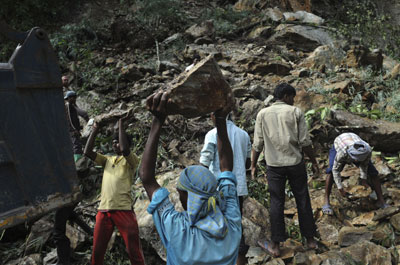 KATHMANDU: A Nepalese motorcyclist and his eight-year-old daughter were killed when a wall of the British embassy compound in Kathmandu collapsed in a strong earthquake as they rode past.
Police frantically dug through remains of the wall to search for any other victims as Sajan Shrestha, 36, his daughter, who was riding pillion, and another man were rushed to emergency care.
All three were declared dead at the Man Mohan Memorial Hospital on Sunday evening, as the scale of damage from the earthquake centred in northeast India began to emerge. Eight people in Nepal died in total.
"Police personnel were clearing the bricks and were trying to find out whether there were any additional casualties," Kailash Khadka, a local reporter, told AFP.
"A crowd with more than 100 locals had surrounded the area. There was a sense of grief, fear and anger over the incident."
Santosh Kumar Jha, a doctor at the hospital, said the father was dead on arrival.
"Both had serious head injuries. We tried unsuccessfully to save his daughter Anisha but then the third patient, 19-year-old Bir Bahadur Majhi, was brought in.
"There was heavy bleeding and the relatives were crying."
John Tucknott, British ambassador to Nepal, visited relatives of the dead on Monday to express his condolences, as the mission said it would do everything possible to help those affected.
"The British embassy deeply regrets the deaths of three Nepali citizens and injuries to others as a result of the collapse of part of the embassy compound perimeter wall," it said in a statement.
Nirmal Lama, 38, whose bakery is next to the embassy, recounted how he climbed onto his roof after the quake hit on Sunday evening.
"The electric poles were swaying and when the wires collided, there was fire. I had never seen anything like this," he told AFP.
"I saw that a car was buried beneath the wall. No one ventured into the site, probably because of fear.
"Half an hour later, a group of policemen arrived. They started to search for those buried."
The 6.9-magnitude earthquake was on the border of India's Sikkim state and eastern Nepal, and police in Kathmandu said hundreds of homes and at least 35 police posts were damaged in eastern districts. Two people were killed there.
The Nepalese home ministry said in a statement 22 districts had been affected by the earthquake, with 168 houses destroyed and a further 146 damaged.
The government announced immediate relief packages of 25,000 rupees ($328) for families of the dead, with another 100,000 rupees available for long-term support later.
Relief efforts have been hampered by heavy monsoon rain and the only highway into the remote area has been blocked by mudslides, Nepalese police spokesman Binod Singh told AFP.
"We have formed rescue teams in each affected district. They are assessing the damage and organising the rescue and relief operations," he said.
The death toll in Nepal rose to eight on Monday after officials said a child had been crushed in the country's northeastern hills when a house collapsed. Two adults also died in separate incidents.
At least 63 people were killed in India, Nepal and Tibet.













Comments
Comments are closed for this article.