



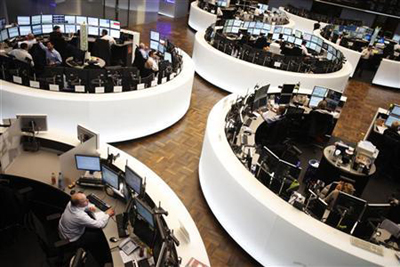
 LONDON: European shares fell on Tuesday after oil prices gave up early gains as four producers agreed to freeze but not cut output.
The yen and the euro rose against the dollar in a sign of investor caution after last week's sell-off of risky assets.
Brent crude oil, which has been on a roller-coaster ride this year, hit a 12-day high of $35.55 a barrel after oil producers Russia, Saudi Arabia, Qatar and Venezuela agreed to freeze output to tackle a global oil glut but last traded at $33.88, up 50 cents on the day, as expectations for an immediate deal faded.
"Even if they do freeze production at January levels, you've still got global inventory builds which are going to weigh on prices. So whilst it's a positive step, I don't think it will have a huge impact on supply/demand balances, simply because we were oversupplied in January anyway," said Energy Aspects analyst Dominic Haywood.
Earlier, Chinese stocks closed with their biggest daily percentage gain in more than three months. Remarks by Premier Li Keqiang were interpreted as hinting at more stimulus for the world's second biggest economy, and China reported bank lending rose to a record high in January.
The impact of an economic slowdown in China has been at the heart of investor concerns that have seen world stocks drop nearly 10 percent this year.
The mood has brightened somewhat this week, although some analysts have struggled to pin down exactly why. They say such threats as slowing global growth and the spread of negative interest rates have not gone away.
"Risk appetite is back, but there is no guarantee it will continue," said Jussi Hiljanen, SEB's head of fixed income research.
The pan-European FTSEurofirst 300 index stocks index, which rose 6 percent in the last two trading days, fell 0.5 percent. They had earlier risen, led higher by energy and mining shares.
U.S. stock index futures were up around 1.2 percent, suggesting Wall Street, which was closed on Monday for a holiday, would open higher.
MSCI's broadest index of Asia-Pacific shares outside Japan gained 0.9 percent. Mainland China shares hit three-week highs, with the Shanghai Composite index posting its biggest daily percentage gain since Nov. 4.
Premier Li Keqiang said on Monday the economy faced great challenges but that China had plenty of room to manoeuvre given its high savings rate.
Data showing Chinese banks extended a record 2.51 trillion ($385.40 billion) in new loans last month also helped stocks.
In Japan, Tokyo's Nikkei index followed its 7.2 percent gain on Monday with a more modest 0.2 percent rise, led by a 16 percent surge in telecoms group SoftBank, which said it would buy back up to 14.2 percent of its own shares.
DOLLAR FIRMER
In foreign exchange markets, the dollar weakened 0.6 percent against the yen to around 113.87 yen. It remained well off a 15-month low of 111.99 yen hit last week, when investors piled into yen as a safe haven and expectations faded that the Federal Reserve would raise interest rates again.
"Because Fed tightening has been priced out, risky assets are starting to perform better. That's important for FX because it suggests that even if we have a risk-on move, the extent to which the dollar is going to be able to benefit is quite limited," said BNP Paribas currency strategist Sam Lynton-Brown.
The euro edged up 0.2 percent to $1.1178, down from last week's four-month high of $1.1377. Against a basket of currencies, the dollar firmed by 0.5 percent.
The appeal of low-risk government debt, also sought as a shelter in troubled times, dimmed. German 10-year bond yields rose 2 basis points to 0.26 percent, having fallen as far as 0.13 percent last week.
U.S. equivalents yielded 1.79 percent, compared with 1.75 percent at the close of Friday's U.S. trading session.
Gold, which had its best week in four years last week, earlier dropped to $1,199 an ounce but last traded at $1,1280.




















Comments
Comments are closed for this article.