



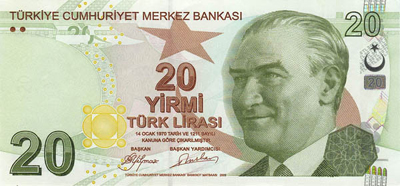
 ISTANBUL: Turkey's lira jumped 4 percent against the dollar this week, its biggest weekly gain for 3-1/2 years, on expectations the ruling AK Party could form a government on its own after a June vote, though without enough seats to change the constitution.
Still, the lira is down 10 percent this year, the worst performing major emerging market currency after Brazil's real, on dollar gains and worries about the election outcome and political meddling in monetary policy.
The lira traded at 2.5911 at 1317 GMT, little changed on the day but gaining from 2.6960 a week earlier, in a rally also supported by global dollar losses.
Investors have taken their cue from recent polls indicating Prime Minister Ahmet Davutoglu's AK Party will secure a majority in the June 7 election.
"Aggregated polls are showing an ideal scenario for the AK Party in which it would be able to form a single-party government but not enough support for the party to make a push for an executive presidency," Deniz Invest said in a note.
President Tayyip Erdogan aims to boost his powers with the introduction of an executive presidency but the AKP would need 367 seats in the 550-seat assembly to achieve that directly and polls indicate it will not secure that level of support.
Data on Friday painted a mixed picture on the economic outlook with unemployment remaining high at 11.2 percent in the first quarter while budget data showed a surplus in April and and Finance Minister Mehmet Simsek said strong tax revenues pointed to a recovery.
A central bank survey separately showed expectations for end-year consumer price inflation rising to 7.5 percent from 7.29 percent in a poll one month earlier.
Attention was now set to switch to next Wednesday's central bank monetary policy committee meeting, its last before the June 7 vote.
All 19 economists in a Reuters poll forecast that the central bank would leave key interest rates on hold. With an eye on the vote, the bank left key rates unchanged last month, while using other policy tools -- hiking what it pays on lira reserves and cutting the cost of borrowing dollars -- in an effort to shore up the lira.
Economists said such "tinkering" with monetary policy highlighted the difficult position faced by the bank, which had been under heavy pressure from President Tayyip Erdogan in recent months to cut rates before the polls.






















Comments
Comments are closed for this article.