


Greek PM to form new government on Thursday

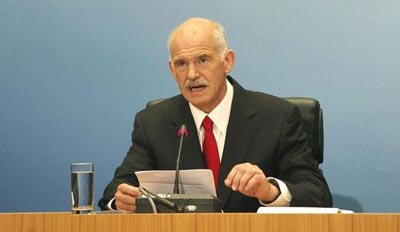 ATHENS: Greek Prime Minister George Papandreou will form a new government on Thursday and seek a vote of confidence from his parliamentary group, he announced on Wednesday after street protests against his austerity plans.
"Tomorrow I will form a new government, and then I will ask for a vote of confidence," he said in a televised address after a dramatic day of unrest on the streets and political turmoil.
"I will continue on the same course. This is the road of duty, together with (ruling party) PASOK's parliamentary group, its members and the Greek people."
Earlier, government sources said he had offered to step down and make way for a national unity government if the opposition agreed on a clear plan to proceed with reforms.
Papandreou must push through a new 5-year campaign of tax rises, spending cuts and sell-offs of state property to continue receiving aid from the European Union and International Monetary Fund and avoid default, but the opposition opposes it.
"Papandreou told (opposition leader Antonis) Samaras that if there is agreement on specific targets, reforms and commitments for the big changes that must take place, then he could agree on a government in which he would not be prime minister," a government source said.
A source in Samaras's New Democracy party said the conservatives would only take part in such a government if it renegotiated the EU/IMF bailout and Papandreou resigned.
Earlier in the day, youths hurled petrol bombs at the Finance Ministry and tens of thousands of protesters marched on parliament to oppose government efforts to pass new austerity laws for the debt-choked euro zone state.
Unions representing half the 5-million-strong workforce also launched a nationwide strike, shutting government offices, ports, schools and reducing hospitals to skeleton staff.
On Wednesday, lawmakers began discussing a package of austerity measures and privatisations agreed after a month of negotiations with the EU and the IMF. The government has promised to have it approved by the end of the month to free up a tranche of aid needed to stave off debt default.
Papandreou's party, which has fallen behind the conservatives in opinion polls, also faces a rebellion from a few backbenchers in his own parliamentary grouping who are threatening to reject the plan.
One PASOK deputy defected on Tuesday, reducing the party's strength in parliament to 155 seats out of 300. Another said he would oppose the bill, making an apparently guaranteed result less certain. Most analysts still expect the bill to pass.
Thousands of activists and unionists converged on the central Syntagma square on the parliament's front steps to try to stop lawmakers from entering to debate the bill in committee.
Stun grenades boomed around the square and plumes of smoke rose from burning garbage bins as police fired teargas and fought running skirmishes with scores of youths who fought back with rocks and long clubs, Reuters witnesses reported.
"We want them out. Obviously these measures are not going to get us out of the crisis," Antony Vatselas, a 28-year-old mechanical engineer, crying from teargas.
One group hurled petrol bombs and clashed with police at buildings housing the Finance Ministry, also on the square. Reuters witnesses saw flames in front of an entrance to the main building and a similar clash a few buildings down.
The vast majority of the diverse crowd -- which included union workers, political party members, pensioners, and a wide array of Greeks upset at the new austerity measures -- only shouted at the parliament building and remained peaceful.
"Thieves, traitors!" many chanted. "Where did the money go?"
Police said seven protesters and two officers were slightly injured and they had detained 40 people. They said the crowd numbered around 30,000 but they often underestimate numbers.
About 1,500 police closed a large part of the city centre and created a corridor to hold back protesters as lawmakers drove up to the building in official limousines.
The new austerity package foresees 6.5 billion euros ($9.4 billion) in tax rises and spending cuts this year, doubling measures agreed with bailout lenders that have already pushed unemployment to a record 16.2 percent and extended a deep recession into its third year.
"You have to be as cruel as a tiger to vote for these measures. I am not," George Lianis, the PASOK deputy who defected, said in a letter to the parliament speaker on Tuesday.
Political analysts said the strong public outcry had raised pressure on ruling party deputies. Failure to push through the measures had the potential to shock global markets, they said.
"The government's medium-term fiscal plan will pass," said economist Gikas Hardouvelis at EFG Eurobank. "If it doesn't, the impact on global markets will be significant."
Alpha Bank economist Michael Massourakis said it was "inconceivable" that politicians would lead the country to early elections without having secured the bailout.
"I think that at the final moment they will act with prudence and pass the mid-term plan."
On Tuesday, euro zone finance ministers failed to reach agreement on how private holders of Greek debt should share the cost of a new bailout for Athens worth an estimated 120 billion euros before a June 23-24 summit.
The European Central Bank opposes such a move, saying that if such participation is involuntary it could be deemed default that could shock markets and put weaker euro states at risk.
Copyright Reuters, 2011












Comments
Comments are closed for this article.