



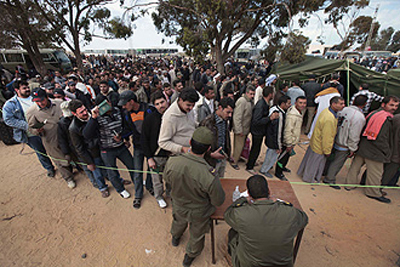
 DEHIBA: At Dehiba on Tunisia's border with Libya, rebels fighting Moamer Qadhafi's regime are regular visitors, coming from the battle front and the western mountains to visit their families.
Despite the conflict that has raged in Libya since February, the atmosphere is calm at the dusty Dehiba border post, because the constant flow of heavily loaded vehicles has stopped.
The situation is different at Ras Jedir, the main crossing point between Libya and Tunisia 200 kilometres further north, more than 12,000 refugees have crossed since Monday as NATO stepped up air raids on Tripoli.
"More than 90 percent of the women and children of Yefren and the mountains are already installed in Tunisia," in the Dehiba and Tatatouine region, said Sebtimouss Twawa, a Libyan accountant in his 30s. He left Yefren three hours earlier to see his family.
He is just one of hundreds of people who make the return trip.
At the Dehiba border post on Monday and Tuesday, 900 Libyans entered Tunisia and 351 went the other way according to figures kept by the insurgents, who since the end of April have controlled the frontier post.
Twawa arrived by driving down the road alongside the mountains connecting Yefren with Chakchouk. A strategic segment he said had been "liberated on Saturday" by the rebels, who are less than 80 kilometres from Tripoli.
After a 60-day siege, Yefren has fallen to complete rebel control, Twawa said, though "a pocket of resistance remains east of Galaa, in the eastern suburbs."
Qadhafi's forces, about 10 kilometres distant, continue to attack the border post, but nobody makes much of it. People say there is no more heavy shelling, just missiles that fall. They counted 16 on Monday; 10 on Wednesday.
On the Libyan side, people wishing to enter Tunisia continue to queue, their green passports in their hands. In his prefab hut, Ali Chalbek records the comings and goings on a dust-covered computer.
"It's software he made himself," says Chalbek's friend Said, proud of his friend. The interface consists of 4 entries for identity purposes and two buttons for arriving or departing.
Chalbek sees his software as the basis of a mechanism for all the borders of "the new Libya", according to his friends who consider him "an expert in new technologies". The idea is to link up his network with the border post between Libya and Egypt and with the rebel headquarters in Benghazi.
Copyright AFP (Agence France-Presse), 2011

















Comments
Comments are closed for this article.