



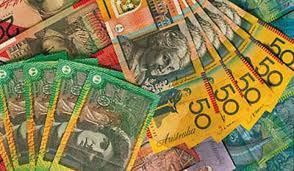
 SYDNEY/WELLINGTON: The Australian and New Zealand dollars ground higher on Monday, extending their recovery from recent lows as a sharp bounce in gold and bank interest-rate reforms in China underpinned demand.
The Aussie nudged up to $0.9214 from $0.9174 on Friday in Sydney, to be sitting well above a three-year trough of $0.8998 plumbed earlier this month.
It was helped by a 1 percent jump in precious metals including gold, which reached a one-month peak.
Rising prices of iron ore <.IO62-CNI=SI>, Australia's top export earner, lent further support. The bulk commodity topped $130 a tonne for the first time since May.
The Antipodean currencies were also buoyed by news of more market-oriented reforms in the banking sector of China, a key export market.
China's central bank has removed controls on bank lending rates, which could lower credit financial costs for companies and help support the softening economy.
Traders put resistance at $0.9235/45, citing decent selling interest there.
The key risk events this week for the Aussie are domestic inflation data and the HSBC flash PMI for China , both due on Wednesday.
Swap markets see a two-in-three chance of an interest rate cut by the Reserve Bank of Australia in August, while interbank futures <0#YIB:> have a 25 basis point easing to a record low of 2.5 percent fully priced in by October.
Annette Beacher, head of Asia-Pacific Research at TD Securities in Singapore, sees room for the Aussie to fall below 90 cents should inflation show a soft reading that leaves room for rate cuts.
The New Zealand dollar was quoted at $0.7930, recovering from an early slide to a session low of $0.7891 in reaction to a strong earthquake in Wellington on Sunday.
"The kiwi slipped half a cent, but as people have been assessing the situation, they're thinking that maybe the damage is not as bad," said Tim Kelleher, head of institutional FX sales at ASB.
New Zealand's capital city suffered limited damage from the quake, but trading desks in Wellington, including those at ANZ and Bank of New Zealand, and most businesses in the central city were closed as buildings were inspected for structural damage.
Kelleher said the risks for the kiwi this week looked to the downside given uncertainty about the quake, and with the central bank's rate review on Thursday.
Near-term support for the kiwi was seen at $0.7910 and then $0.7890, with Friday's high of $.7990 seen capping gains.
NZ government bond prices were flat.
Australian government bond futures were firmer, with the three-year bond futures 0.04 points higher at 97.350. The 10-year contract added 0.01 points to 96.335, having touched a one-month peak of 96.350.


























Comments
Comments are closed for this article.