



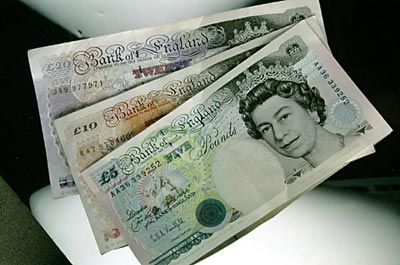
 LONDON: Sterling hit two-and-a-half month highs against the dollar and a trade-weighted basket of currencies on Monday as investors cut bets on more monetary easing by the Bank of England in the near term.
Better-than-expected British economic growth contrasted with below-forecast first-quarter gross domestic product in the United States and put the dollar under broad pressure.
The pound could get a further boost if British purchasing managers' surveys (PMIs) on Wednesday, Thursday and Friday show economic activity continued to improve in April.
"Both internal and external factors are pointing the compass north for sterling. If we get expansion in services PMI on Friday and we get a disappointing US payrolls figure then we could see sterling close to $1.57," said Nawaz Ali, market analyst at Western Union Business Solutions.
Figures last week showed Britain avoiding recession by growing 0.3 percent in the first quarter, much more than the 0.1 percent rise expected. That led some speculators to trim bets on further easing by the BoE and cut bearish bets against the pound.
The pound rose to hit $1.5547, its strongest since mid-February, before easing slightly to trade at $1.5515, up 0.2 percent on the day. Offers were cited around $1.5550, where an options barrier was reported and could limit its rise.
Against a trade-weighted basket of currencies the pound rose to 81.3, its strongest since Feb. 8, Bank of England (BoE) data showed.
More gains against the dollar could come when the US Federal Reserve makes an announcement on monetary policy on Wednesday. Below-forecast US GDP data and recent weak jobs data are likely to make policymakers wary of announcing any tapering of its asset-buying programme just yet.
In the medium term, though, some investors are cautious about buying the pound given the risk that Britain's recovery could falter. That would keep alive the possibility that incoming BoE governor Mark Carney may advocate aggressive monetary easing when he takes over in July.
"A significant depreciation of the currency is still likely in order to revive long-term growth in the economy. We thus maintain our forecast of $1.41 by year end," said Mansoor Mohiuddin, chief currency strategist at UBS.
BoE policymaker Ian McCafferty was reported on Monday as saying he was "cautiously optimistic" about Britain's economy but that he expected its recovery to be slow and difficult.




















Comments
Comments are closed for this article.