


NetSol Technologies Limited (PSX: NetSol) one of Pakistan's most prominent software companies. The Lahore-based firm has been engaged in providing a variety of information technology services and custom software offerings. NetSol's forte lies in technology outsourcing, systems integration, application development, business intelligence, and information security. From the start, NetSol has targeted a variety of industries, which include lease finance, manufacturing, banking, healthcare, education, information technology, insurance, e-government and defence. Over the years, the financial services industry emerged as NetSol's main clientele, most of which reside overseas in the Asia Pacific region.
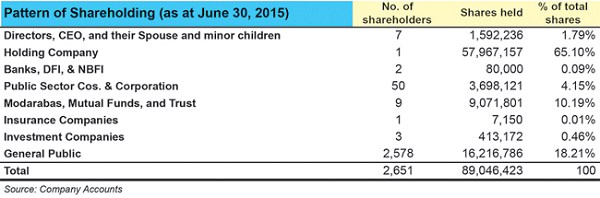
NetSol draws bulk of its revenues from abroad. Available information suggests that the firm has provided services to more than thirty bluechip global clients, including Fortune 500 manufacturers, global automakers, and financial institutions. Domestic sales have been low (1.4% in 9MFY16) but recently there has been a pickup in domestic revenues from software services and maintenance. Given low domestic demand on account of a variety of reasons, it makes sense for NetSol to keep its focus towards overseas markets to better monetise its human resource capabilities.
NetSol has offices in Pakistan, USA, UK, China, Australia and Thailand. NetSol Pakistan is listed on all three stock exchanges of Pakistan: Islamabad, Karachi and Lahore. Latest financial performance is analysed below:
Financial performance
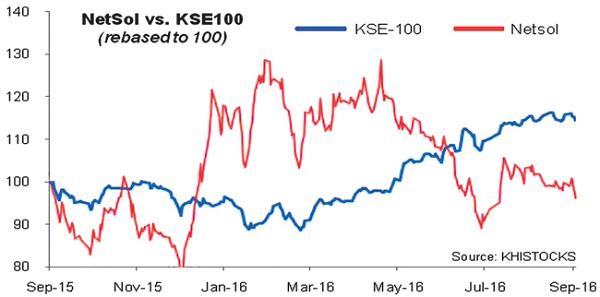
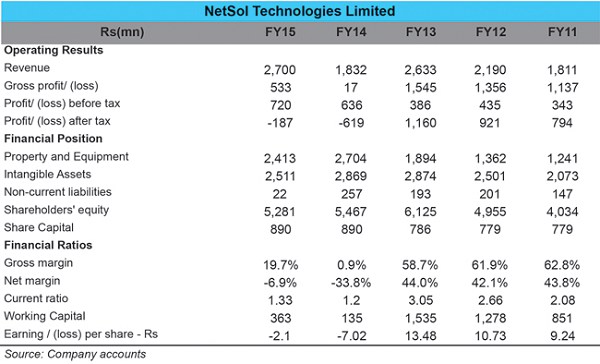
NetSol, for many years, delivered healthy double-digit margins for its shareholders, thanks to its overwhelming reliance on foreign markets where its lease finance software has created a market for itself. Between FY08 and FY13, the firm's average net margin stood at 44 percent - an impressive figure. But it's a markedly different story from FY14 and onwards until this fiscal year. NetSol's profitability was wiped out in FY14 and FY15. Will FY16 be any different than the previous two years? Well, investors will find out that on Friday, when the company will publish its financials for the year ending June 30, 2016. For now, let's take a look at how the firm performed in 9MFY16.
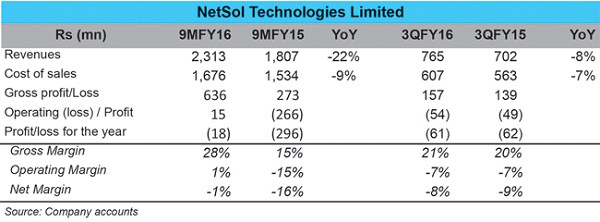
Based on most recent results, it appears that NetSol is closing out its losses and heading back towards profits. Thanks to strong revenue growth in earlier quarters of FY16, the firm scored a solid 28 percent top line gain on a year-on-year basis in 9MFY16. The slower revenue growth in the third quarter is a bit concerning, given that it is the final two quarters when the revenue growth usually picks up for NetSol.
NetSol's revenue dynamics need to be understood. The firm provides, broadly, three kinds of products: 1) licenses to its proprietary lease-finance and other ancillary software; 2) plain-vanilla software and business consulting services; and 3) IT maintenance contracts. When some software is licensed to a new client, it can be like a foot in the door for more business, in services and maintenance areas. It can work the other way as well: start from the low-end 'maintenance' contracts, build a relationship, and gradually position towards the top where software licensing deals are marketed.
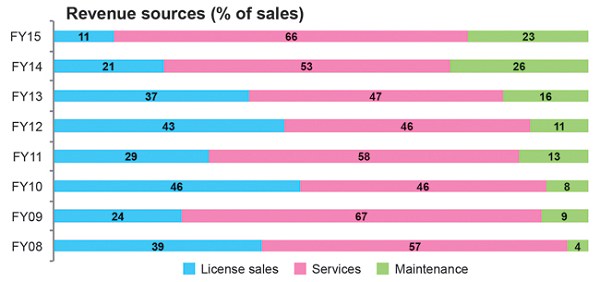
Over the past few years, NetSol's revenues have come to be dominated by the "services" segment (see the illustration), whereas "licensing" segment has been contributing an increasingly shrinking chunk to the revenue pie, even as maintenance revenues have also picked up. Concentration of licensing revenues may improve in the future, something that is essential for an IT firm to have a sustainable footing, as NetSol is in the midst of marketing and implementing its recent flagship lease-finance software product, NFS Ascent. The firm reportedly won a $100 million contract last year to implement Ascent in 12 countries for one of its major clients. As per the management, implementation got already underway earlier this year in four countries: Australia, China, South Africa, and South Korea.
Despite the new Ascent implementations, in 3QFY16, licensing revenues declined on a year-on-year basis. The management insists that revenues would grow as Ascent implementations gain traction via the "twelve country NFS Ascent deal". NetSol, the management, says, has started recognizing revenues from that deal from 4QFY16. One reckons that licensing revenues may indeed get a boost in the final quarter and in the subsequent quarters.
On the cost front, NetSol underwent savings in its core costs in 9MFY16. During those nine months, the firm spent 72 percent of its net revenues on cost of sales, about 12.4 percentage points lower than what those costs exhausted back in 9MFY15. There were valuable savings on the operating expenditure avenue as well. During the nine months under review, NetSol spent 6.8 percent of its net sales on selling expenses (about 2.5 percentage points below the level seen in 9MFY15) and 20.9 percent of its net sales on administrative expenses (about 3.5 percentage points below that in 9MFY15).
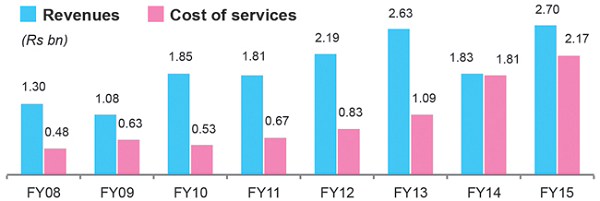
Those operating savings helped NetSol return an operating profit in 9MFY16 as opposed to an operating loss a year ago. Yet the measly Rs 15 million accumulated thereof was consumed by more than Rs 16 million incurred on account of finance costs. An Rs 16 million tax bill meant that the firm closed the nine month period with a net loss of Rs 17.5 million, which is about 94 percent lower than the loss incurred in the same period the previous year.
Future outlook
Thanks to an improving top line and operational savings, the firm has been cutting its losses in recent quarters. As NetSol gears up implementation of NFS Ascent, revenues are expected to pick up and support the profit margins. Whether or not FY16 ends on a profitable note, one will find out in a few days.
But the bigger picture for years to come is for NetSol to not only increase the clientele for its Ascent software but also ensure seamless execution of the already-secured Ascent deals.
As one understands, NetSol won't be expending too much money on new product development, as it is time to market and mainstream NFS Ascent in the firm's core market, the Asia Pacific region. But, as with all software firms, it would pay to keep an eye on changing market dynamics and spend on R&D accordingly.






















Comments
Comments are closed for this article.