


Development for whom? Rethinking Pakistan’s development priorities
- Govts build projects for political visibility, but true development means ensuring these assets deliver real, long-term benefits and improve citizens' lives effectively
Pakistan's development prioritizes visible projects over actual outcomes, leading to inefficient spending and a disconnect from citizen needs. True development requires focusing on public value, not just completed infrastructure.
- Distinction between project-centered and outcome-centered development.
- Political preference for visible projects over long-term benefits.
- Gap between development laws and their actual implementation.
- Power sector's failure to deliver affordable, reliable electricity.
- Improving public investment efficiency as a fiscal necessity.
Development is one of the most frequently used words in Pakistan’s political vocabulary. Governments point to roads, power projects, hospitals, schools, transport systems and other public schemes as evidence of progress. Many of these investments are indeed necessary. Yet one question receives far less attention: does the way government measures development match the way people experience it?
For citizens, development is not just an allocation in a budget or a completed project. It is whether electricity is affordable, children receive a meaningful education, healthcare is accessible, clean water is available, and public infrastructure that specifically improves everyday life. In other words, the issue is not infrastructure versus human development. Pakistan needs both. The more important distinction is between project-centred and outcome-centred development.
Governments naturally monitor what can be recorded: money allocated, schemes approved, kilometres constructed, megawatts installed and facilities completed. These are useful measures of activity, but they are not necessarily measures of development and herein lies the problem. Explaining the issue, we see that a completed school is an output. Whether children learn is an outcome. A hospital building is an output. Effective healthcare is the outcome. A road is an output. Improved mobility and economic activity are among its intended outcomes.
The question that arises is why governments fail to understand that the development being normally undertaken in Pakistan is perfunctory and may be just a tool allowing them to be seen to be doing something. Further, we see that visible projects do have political advantages. They can be inaugurated and associated with a particular government during its tenure. Improvements in teaching, regulation, maintenance and institutional performance are harder to display and may take years to produce results. This alone can create a political preference for what can be built and displayed over improvements whose benefits emerge gradually or on a longer period of time.
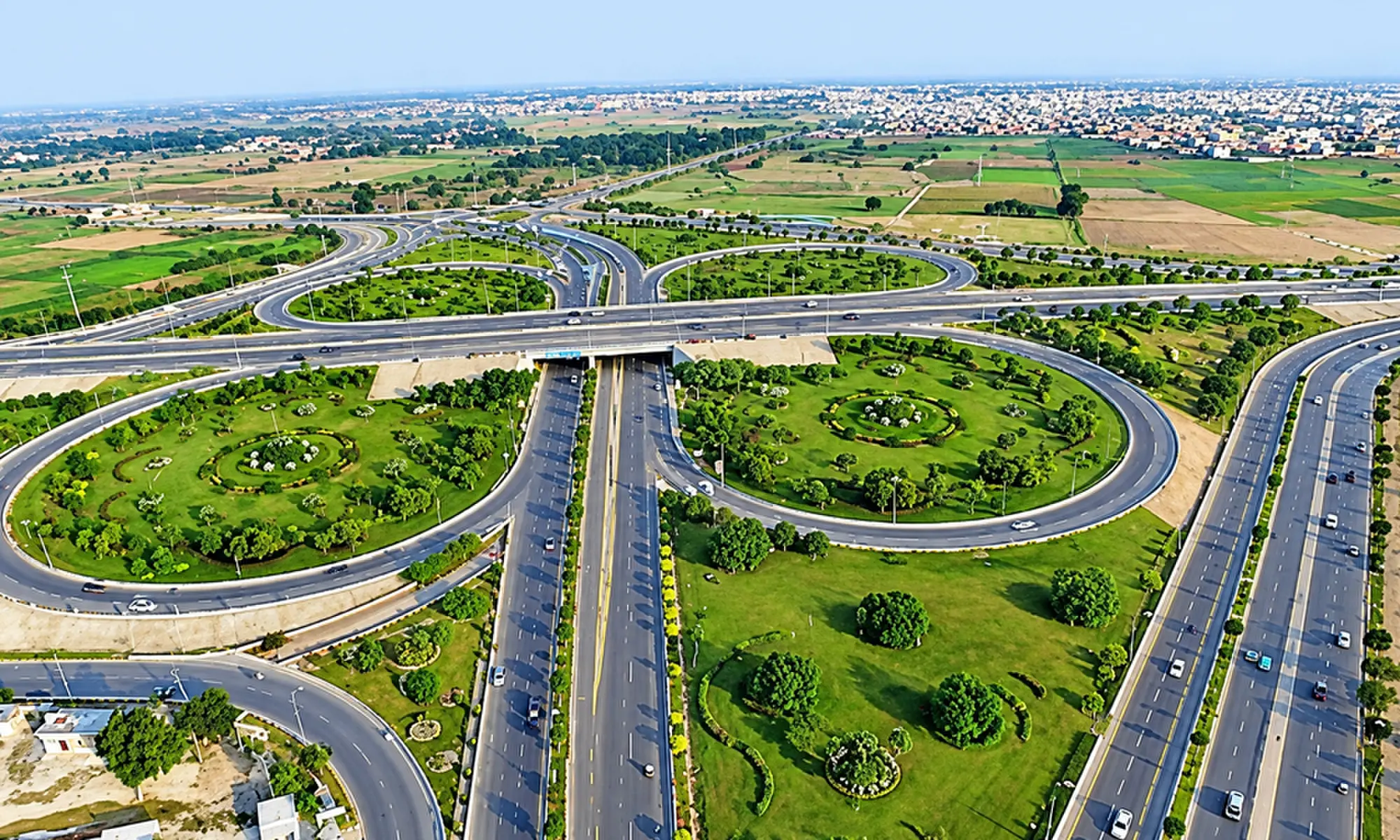
An apt example and aberration could be Pakistan’s resplendent motorways that only cater for a minuscule of the population but have used-up hefty amounts of the national wealth. Statistics tell us that only about 10% to 17% of Pakistani households or urban residents own or have access to a private car, which is the primary vehicle class permitted and practical for high-speed motorway travel. Conversely, while high-capacity motorways and national highways make up a small fraction of the total road network (around 3.6% to 7% of infrastructure), they carry a massive share of heavy intercity freight and long-distance passenger traffic – but which all could easily be catered through well maintained highways etc. and if the same had not been relegated. It is also a fact that specifically long-distance passenger traffic is at an additional cost – sometimes double of what could be catered through the provincial roadways. Additionally, it is seen that again the facility gets usurped by the same category which does not make up the majority.
That, these motorways do not let the provincial roads and links to improve is another facet that begs an answer. India, as a measure, does not rely on motorways to do the trick. They have kept away from such expenditures as a rule. We also see Sindh showcasing a policy with provincial roads making-up a cornerstone of its people-centric development. However, KP has broken-down altogether due to extremely less attention to maintaining their roadways to a great extent.
All the above aberrations do not make infrastructure unnecessary. The problem begins when completing an asset is treated as sufficient evidence that its development objective has been achieved. Interestingly, Pakistan’s formal development framework already recognises this distinction, but it remains hidden in the books alone. We see that the Public Finance Management Act, 2019 requires development projects to be monitored during implementation and evaluated on completion. For projects exceeding the threshold prescribed by the Planning Commission, it also requires independent impact assessment within five years of completion. The law further provides for operation and maintenance of public infrastructure and effective use of public assets.
The Planning Commission’s project cycle provides the administrative framework. PC-IV records project completion, while PC-V examines performance after completion. Under the current framework, relevant agencies are required to submit PC-V reports annually for five years, examining matters including actual economic and social benefits, operational performance and maintenance. The weakness, therefore, is not principally an absence of law or procedure. The question is how consistently these arrangements translate into evaluation and subsequent decisions.
There is evidence of a serious gap. The IMF’s 2023 Public Investment Management Assessment (PIMA) found that Pakistan had a well-structured monitoring system and formal arrangements for ex-post review. Yet few projects undertook ex-post reporting, and reviews of major capital projects were infrequent. The assessment also identified a weak connection between national development goals and the individual public investment projects that had been undertaken as special dispensations – probably, on pure political grounds. These findings thus highlighted a gap between the formal framework and its implementation at the time.
We thus see that monitoring construction and evaluating development are different exercises. Expenditure, procurement and physical progress tell government whether an asset is being delivered. They do not necessarily establish whether it produced the economic or social benefit that justified the investment.
Pakistan’s power sector illustrates further as to why this matters. Power plants, transmission lines, substations and distribution networks require substantial investment and engineering capability. Without this infrastructure, electricity cannot be generated and delivered. But when does electricity infrastructure become a development? This is a very important question.
Indeed, installed generation capacity is important. Yet additional capacity has limited developmental value unless electricity can be transmitted, distributed and delivered reliably. Even reliable supply produces diminished economic benefits if households cannot afford it or industry cannot use it competitively. All this is of great anguish – specially, in the context of the IPPs fiasco and the subsequent colossal failure of the policy to adopt the same methodology for public projects etc. and the ensuing backbreaking tariff addedupon by the inordinate capacity charges. The most recent mothballing of the proposed 4,500 MW power generation part of the upcoming Diamer-Basha Dam is a case in point. Unlike such earlier power generation systems accompanying Tarbela and the Mangla Dams (primarily water storage projects), the one for the DB Dam was to be built on the pure IPP model and which would on completion spew extremely expensive power. That hydel power of such magnitude on the other hand would have addedon positively to the presently beleaguered National Grid had the DB power plant been planned to be funded through the national budget. This leads us to another serious facet of the problem – as to which development would qualify for such outlays, and which could be commercially underwritten to be subsequently paid-for by the people alone. Sadly, study reveals that governments usually relegate such projects to be paid-for by the people. This normally happens to make-way and fiscal space for political-centric spending alone.
From the above, it is seen that the physical system also operates within an institutional framework of tariffs, procurement decisions, market rules, planning, regulatory standards and accountability. This points to an important principle: physical infrastructure creates capability, while institutional infrastructure determines how effectively that capability is converted into public value.
Engineering and regulation are therefore part of the same development question. A technically sound asset may deliver less value than anticipated if the surrounding operational, financial or regulatory arrangements prevent its effective use. A serious post-completion assessment of an energy project should consequently revisit the assumptions on which it was approved. Was the projected demand realised? Could the surrounding network accommodate the asset? Did it perform as expected? How did actual costs compare with projections? What benefits reached consumers and productive users? Unfortunately, the needed introspection has been missing altogether in case of Pakistan’s power sector and where the rot sadly continues.
The same principle applies elsewhere. A school requires teachers, supervision and assessment before its building produces learning. A hospital needs personnel, equipment and reliable supplies before infrastructure becomes healthcare. A water scheme requires maintenance and quality control before expenditure becomes safe water. A digital platform creates public value when it reduces the time, cost and difficulty citizens face in dealing with government. Development planning must therefore ask not only what government intends to build, but what is expected to change because it is built – another pre-requisite that is missing altogether.
This correct approach can be reinforced through a simple citizen-outcome test. Before committing public resources, government should establish the problem being addressed, the evidence supporting the proposed intervention, the measurable benefit expected and the mechanism through which the investment will produce that benefit. The indicators will differ between sectors. For electricity, they may include reliability, affordability and productive use. For roads, reduced travel time and easy connectivity. For education, it has to lead to learning rather than buildings alone. The principle remains the same: the eventual assessment should return to the problem that originally justified the expenditure.
This matters particularly because Pakistan has limited fiscal space. The IMF’s 2023 PIMA estimated Pakistan’s hybrid public-investment efficiency gap at around 38 percent. This does not mean that 38 percent of spending is wasted. It indicates considerable scope to improve infrastructure access and quality relative to the country’s existing capital stock. Obtaining greater public value from investment is therefore not merely an administrative concern. It is also a fiscal necessity. Thus, development should not end when a project is completed. That is when we should begin asking whether development actually occurred.
Herein lies the issue; whether a signal free metropolitan corridor takes precedence over the need for a comprehensive sewerage project, taking-up rejuvenation of the decrepit schooling system or instead building ionic columned buildings reeking of the erstwhile communist showpieces and so on. Whether Trump’s push to build the gigantic ballroom at the iconic White House to counter the PRC’s Great Hall in Beijing should act as an apt example of the needed developments. Should wide boulevards manifest development or the conversion of shanty towns (KachiAbadis in our lingo) to liveable areas? Probably, disregard of the answer to these questions is the reason why nearly all of Pakistan’s development is largely elite centric and about monies that have been blatantly spent. The sad part is that the elite live separately into their own make-believe world which has no connection at all with the realities or the miseries of the people – out of which 38% are said to be around the poverty level now. The question now is whether evaluation by the concerned becomes a consistent part of development administration and whether its findings influence future investment decisions or not. And can projects that do not fulfil the requirements are relegated or not?
The situation thus collates into the requirement that development is not just what the elites desire or decide. It is much more complex, and it should be taken up in the right manner. While governments necessarily see budgets, projects and assets,citizens experience services, opportunities, prices, reliability and quality of life. Both perspectives matter, but they must be connected. Pakistan will continue to need roads, electricity networks, schools, hospitals and other infrastructure. The question is not whether any of these should be built, but whether their ultimate performance is enough to establish their utility. It has to be remembered that citizens do not experience a PC-I, a budget allocation or an inauguration. They experience a service, an opportunity, a cost or its absence and all which sadly does not seem to be the basis for development in our country.
The writer is President IEEEP
The writer works on policy, legal and regulatory reforms




















Comments