


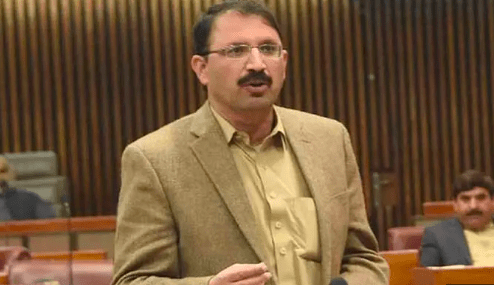
ISLAMABAD: Refusing to concede ground amid the federal takeover of Khyber Pakhtunkhwa’s administrative machinery, Pakistan Tehreek-e-Insaf (PTI) on Saturday retained Junaid Akbar as its provincial president and put in place a chain of command to keep the party functioning in his absence.
The decision underscores PTI’s determination to preserve its organisational authority in the province even as emergency and governor’s rule have dismantled the provincial government it led, transferred executive powers to the governor and intensified the confrontation between the party and the federal government.
In a statement shared by PTI chairman Barrister Gohar Ali Khan on X, the party confirmed that its existing organisational structure would remain intact.
Senator Noor-ul-Haq Qadri, the provincial senior vice-president, will preside over provincial cabinet meetings in Akbar’s absence, while provincial general secretary Ali Asghar Khan will assume that responsibility if both men are unavailable.
Asghar has also been authorised to convene and chair meetings at other levels of the provincial organisation and supervise administration, coordination and the implementation of party policies and decisions across its various tiers and wings.
The arrangements effectively establish a succession mechanism without displacing Akbar, signalling that the party intends to maintain continuity rather than allow the disruption surrounding its provincial leadership to create a vacuum.
Akbar’s whereabouts have remained unknown since the imposition of emergency and governor’s rule on October 11.
PTI maintains that he was arrested along with other party leaders, but the authorities have not publicly confirmed his whereabouts. The Peshawar High Court (PHC) has sought responses from the relevant authorities on petitions seeking his recovery.
His continued absence lends added significance to Saturday’s notification, which keeps him at the helm while delegating the operational responsibilities required to sustain the provincial organisation.
The party’s latest move comes against the backdrop of an increasingly bitter political confrontation. In September, as PTI prepared for its planned march towards Islamabad, Akbar warned the government against using force against protesters.
“We will turn Islamabad into Somnath,” he said at a gathering in Peshawar on September 20, invoking a combative historical reference as tensions mounted ahead of the planned mobilisation.
The confrontation has since moved beyond threats of street protests to a fundamental dispute over the constitutional and political order in KP.
On October 11, President Asif Ali Zardari approved the imposition of an emergency under Article 232 of the Constitution and governor’s rule under Article 234, following a recommendation from the federal cabinet.
The Centre justified the measures by citing the deteriorating security situation and what it described as inadequate cooperation from the PTI-led provincial government on counterterrorism.
Former chief minister Sohail Afridi, his cabinet and advisers ceased to hold office, with executive authority shifting to KP Governor Faisal Karim Kundi.
PTI rejected the federal government’s justification, challenged the measures in court and disputed the premise that the province’s security crisis could be addressed through a change in its political administration.
Before the takeover, Afridi had argued that providing additional resources to the police would not, by itself, defeat militancy without a change in counterterrorism policy.
The federal government proceeded with a new administrative framework, establishing an 11-member advisory council and a separate structure for 12 districts affected by terrorism.
Parliament subsequently endorsed the measures. The National Assembly and Senate approved them on October 14, followed a day later by a joint sitting that passed the resolution by 214 votes to 56 amid protests from the opposition.
On October 17, the federal government appointed 48 members to a Regional Representative and Development Council covering the 12 designated districts, following consultations with jirgas.
Against this shifting institutional landscape, PTI’s decision to retain its provincial leadership reflects a parallel effort to prevent the federal intervention from translating into organisational retreat.
While the government has reconfigured the province’s administrative chain of command, the party has reaffirmed its own hierarchy and assigned senior office-bearers the authority to keep its machinery operational.
Copyright Business Recorder, 2026


















Comments