


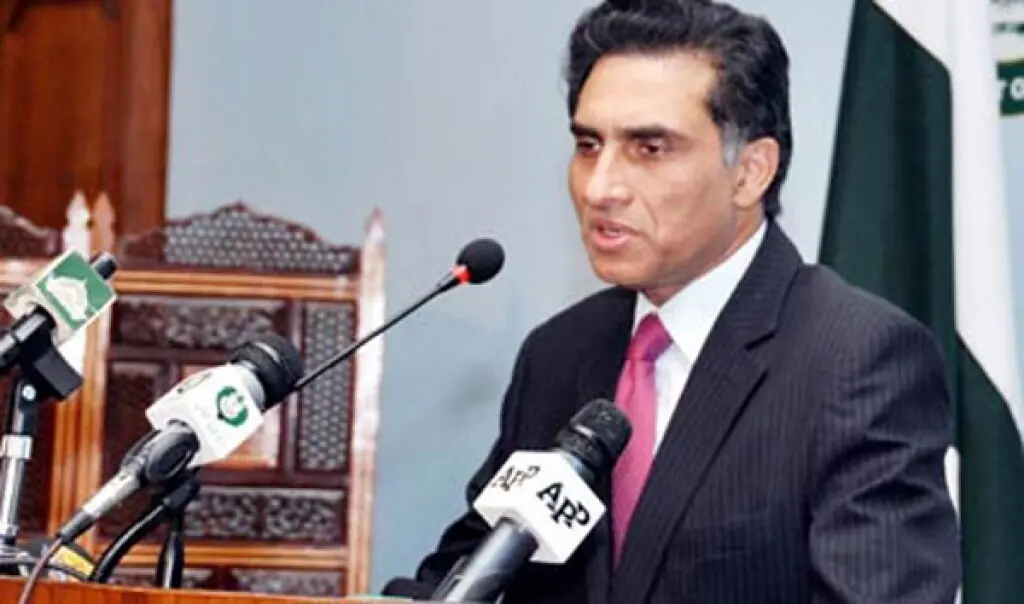
ISLAMABAD: Pakistan’s former foreign secretary Aizaz Ahmad Chaudhry stated that India had resorted to waging a proxy war against Pakistan through Afghanistan after it failed to achieve its objective of defeating Pakistan militarily or isolating it diplomatically.
Ambassador Chaudhry noted that the relevant committees of the UN Security Council had documented the presence of 20 terrorist groups on Afghan soil.
He was addressing a roundtable titled “India as a Factor in Deteriorating Pakistan-Afghanistan Relations”, which was organized by the Institute of Regional Studies (IRS), Islamabad, here on Thursday.
Chaudhry added that although there were reports of al-Qaeda providing training to TTP militants in Afghanistan, it remained challenging for Pakistan to generate international support for combating the global threat of terrorism emanating from Afghanistan.
The primary reason, he argued, was the prevailing international political environment, characterized by uncertainty and crisis.
Ambassador Chaudhry called for reviving and reinvigorating people-to-people interactions between Pakistan and Afghanistan and adopting regional and multilateral approaches to addressing the presence of terrorist groups on Afghan soil.
Referring to longstanding historical and cultural affinities as well as Pakistan’s hosting of a large population of Afghan refugees for over four decades, Pakistan’s former ambassador to the US, Ashraf Jehangir Qazi, urged Islamabad to revive friendly relations with Afghanistan.
He called on the government of Pakistan to distinguish between policies affecting the Taliban regime in Afghanistan and those affecting its people.
While acknowledging the rationale behind kinetic operations inside Afghanistan, Ambassador Qazi urged Pakistani decision-makers to recognize their limitations. He also concurred that India was taking full advantage of the deteriorating relations between Pakistan and Afghanistan.
Chairman of the Pakistan Institute for Peace and Conflict Studies (PICSS), Maj. Gen. Muhammad Saad Khattak, was of the view that India was treating the deteriorating relations between Pakistan and the Taliban regime in Afghanistan as an opportunity to use Afghan soil against Pakistan.
He added that the Taliban’s reluctance to act against the TTP and BLA was indicative of Indian influence on Kabul’s foreign policy, as the groups that it intended to act against had all been subdued. He urged both Kabul and Islamabad to give diplomacy a fair chance and resolve all outstanding issues, including cross-border terrorism, through mutual consultation and dialogue.
Experts at a roundtable discussion agreed that while India was not the sole cause of deteriorating relations between Pakistan and Afghanistan, it was taking full advantage of the rift between the two countries to achieve its long-term strategic aims against Pakistan.
Other experts who spoke at the event included Pakistan’s former ambassador to Afghanistan, Arif Ayub; former ambassador to Germany, Saeed Khalid; IRS Research Fellow Dr. Usman W. Chohan; and Head of the Afghanistan Program at IRS, Aarish U. Khan.
Copyright Business Recorder, 2026






















Comments