


Pakistan’s ten electricity distribution companies, known as DISCOs, have asked the National Electric Power Regulatory Authority (NEPRA) to approve their tariffs for 2027. Inside those requests are Prior Year Adjustments, which are old claims for money the companies say they could not recover earlier.
Together these claims come to about Rs 415 billion. If the annual margins the companies want are added, and the cost of buying power is left out, the total ask is roughly Rs 949 billion.
If NEPRA approves these amounts as filed, the money does not stay in the companies’ books. It is added to tariffs, and tariffs are paid by households, shops and factories.
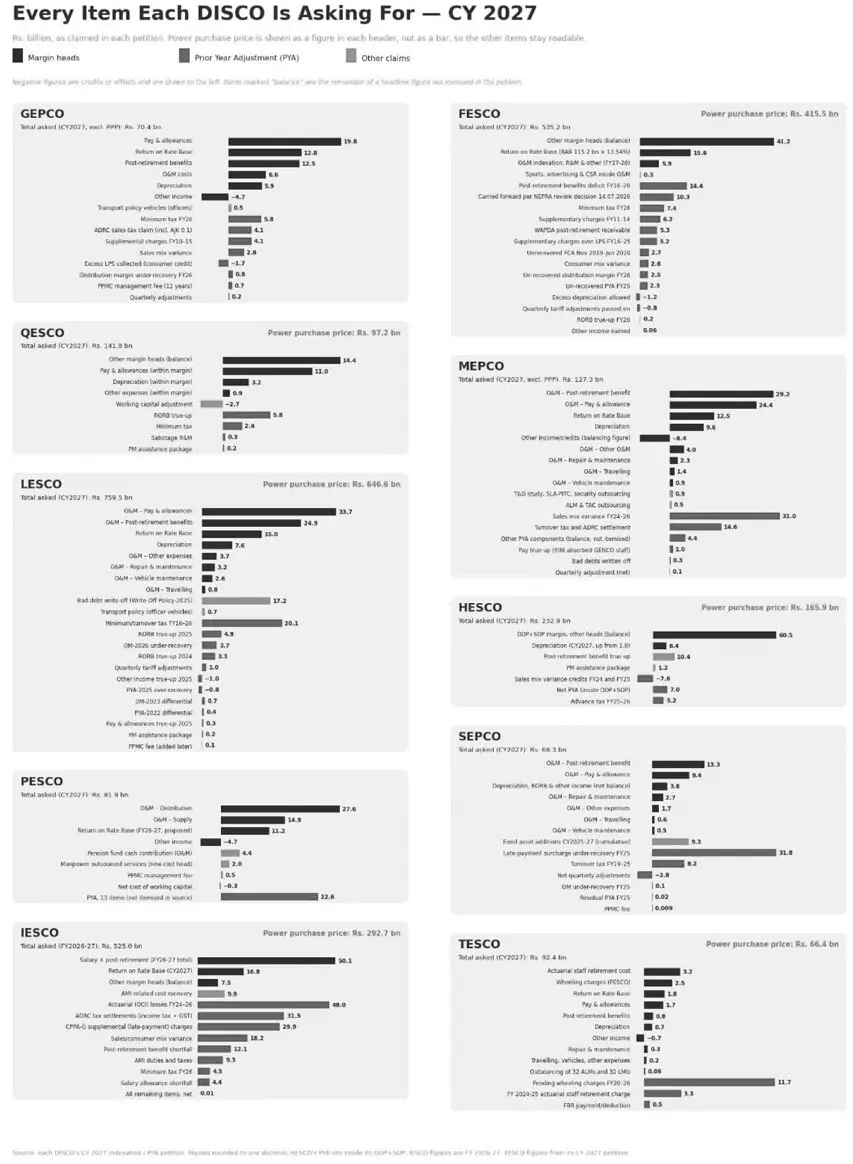
Some of the claims are very large compared with the companies’ own margins. IESCO is asking for Rs 157.9 billion in prior year adjustments, which is about twice its proposed margin for the year. SEPCO is asking for Rs 36.3 billion against a margin of Rs 32.0 billion. FESCO’s claim is about nine tenths of its margin. A simple calculation shows that if one of these were recovered in a single year, the extra cost would be around Rs 13 per unit for IESCO and SEPCO. Spreading recovery over several years would lower the cost per unit, but the total would stay the same.
Looking through the petitions, a few kinds of claim appear again and again.
Some are accounting entries, not money paid out. IESCO includes Rs 48.0 billion of actuarial losses, which are estimates of future pension obligations. FESCO wants Rs 14.4 billion to catch up on eleven years of pension costs. SEPCO’s pension cost doubled in one year, from Rs. 6.5 billion to Rs 13.3 billion. TESCO appears to have claimed about Rs 6.5 billion of actuarial cost twice in the same petition, once in its margin and once in its prior year adjustment.
Some are taxes that the companies pay themselves. LESCO is asking for Rs 20.1 billion of minimum and turnover tax going back to 2016. MEPCO wants Rs 14.6 billion for turnover tax and a settlement. PESCO claims Rs 32.6 billion of input tax over seven years, which is more than its whole prior year adjustment. Whether a company’s own tax bill should be passed on to consumers is a fair question, and the regulator is the right place to answer it.
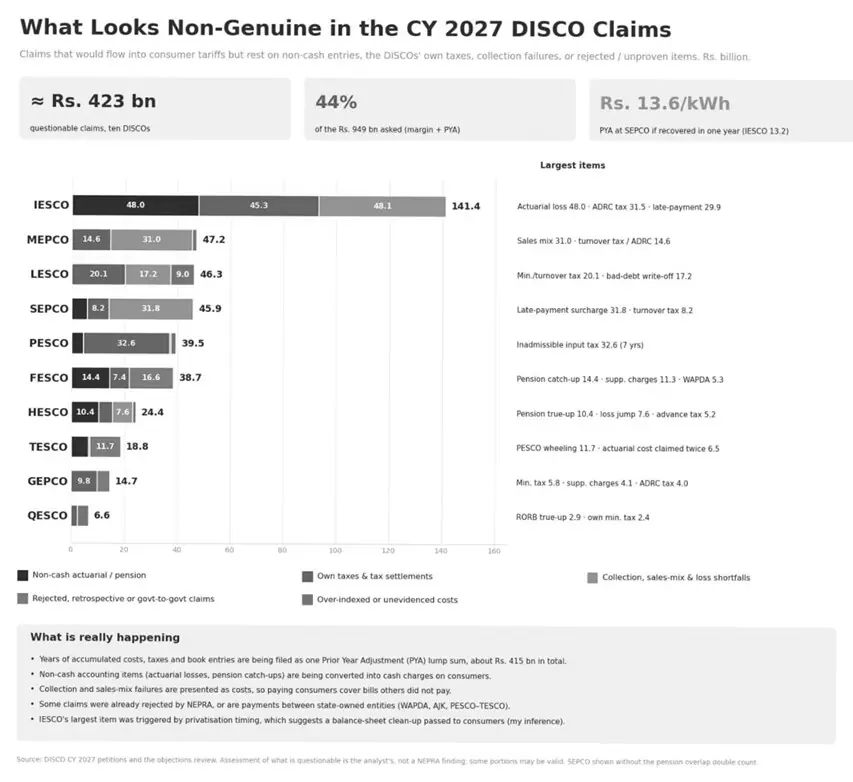
Some come from bills that were not collected, or sales that turned out differently from the plan. SEPCO’s shortfall on late payment surcharge is Rs 31.8 billion, close to 88 percent of its entire adjustment, and as filed it rests on a single advice from the power purchaser.
MEPCO claims Rs 31.0 billion for a sales mix variance over three years, and LESCO asks for Rs 17.2 billion to write off bad debts. Consumers who pay on time can fairly ask why they should cover those who did not.
Some have already been looked at by NEPRA, or are between entities owned by the state. FESCO includes Rs 6.2 billion of supplementary charges that the Authority disallowed earlier. TESCO wants Rs 11.7 billion of wheeling charges going back several years, owed to PESCO, which is also a public company. FESCO has Rs 5.3 billion for a WAPDA receivable, which is again a matter between state bodies.
Adding these up, a review of the petitions finds that about Rs 423 billion across all heads looks questionable. This is an analyst’s assessment and not a ruling. Some of these amounts may prove valid once the documents are produced.
The petitions also share some habits. Claims come as one large lump, so strong and weak items travel together. Supporting papers are thin, with missing annexures, undisclosed actuarial assumptions and no year by year workings. Several companies place a whole claim in one business segment, such as supply, without explaining why. In IESCO’s case, the review notes that the largest component was triggered by correspondence linked to the privatisation timetable. That says nothing about anyone’s intentions, and nothing here suggests that anyone has acted improperly. It is still the kind of background a regulator would want to understand before approving a large clearing of old balances.
The companies must be treated fairly too. They have every right to file, and real costs deserve to be recovered. Many of these claims may be sound in whole or in part. NEPRA decides, and its hearings exist so that claims can be tested in the open. The concern is only that the filings leave too many questions unanswered for a lump sum approval.
Objections deserve answers
Stakeholders who study a filing and file objections do so at their own cost, often with years of practical experience behind them. Yet in the final order their points usually appear as a short summary and a brief response, present on the page but rarely read, like the questions and answers on a warranty card.
NEPRA has the knowledge and standing to do better. Each serious objection should receive a reasoned reply that says what was examined, what was found, and why the point was or was not accepted. This is not about agreeing with every objector. It is about showing that every objection was weighed, so that consumers see their effort count, companies know what evidence is expected, and the Authority’s decisions carry more weight.
What would help is simple. Each component should be examined on its own evidence. Actuarial reports, tax assessments, invoices and reconciliations should be made public.
Losses, collections and cost increases should be checked against the Authority’s own benchmarks, and anything counted twice or already disallowed should be removed. Every serious objection from stakeholders should receive a reasoned reply in the final order, not only a summary. Whatever is finally verified should be recovered slowly, with the effect on the per unit tariff stated clearly.
A regulator earns its place by testing claims before they turn into bills. If Rs 415 billion is approved without that testing, the cost will appear in the monthly bill of every household and factory, long after the hearing room has emptied. The questions are on the record now. The answers, and the papers behind them, should be there too.
Copyright Business Recorder, 2026
The writer is an avid power sector expert and a leading industrialist from Karachi. He can be reached at [email protected]






















Comments