


The gold standard: dead or alive?
Central banks are increasingly turning to gold as a reserve asset, driven by geopolitical shifts, de-dollarization trends, and economic uncertainties, challenging the dollar's long-standing dominance.
- Central banks' increasing gold accumulation.
- Geopolitical factors driving de-dollarization.
- Potential re-emergence of the gold standard.
- Countries repatriating gold reserves.
- Pakistan's gold reserves and private holdings.

Today gold accounts for roughly 27 percent of global reserve assets, surpassing US Treasuries at around 22 percent. The US however retains its primacy with the largest gold reserves in the world – at 8133.5 tons followed by Italy at 2450 tons, France at 2435 tons, Germany at 2,350 tons, China at 2346 tons, and Russia at 2300 tons.
There has been an increased interest in gold by central banks around the world partly due to geopolitical constraints – the outcome of rapidly changing international order, ongoing de-dollarization, hastened by the continued weaponization of tariffs and sanctions by the Trump administration, and the ongoing Middle East conflict that has undermined the petro-dollar framework in place since 1974 that had led Gulf countries to invest their large surpluses in US bonds, thereby providing US administrations with cheap credit.
Saudi Arabia has already indicated that it would accept non-dollar payment for any oil that leaves the Strait of Hormuz though its ability to export petroleum and products has been further compromised due to its conflict with the Houthis who have effectively closed access to the Red Sea.
The US bond market at present is facing a major sell-off which has pushed long-term US government borrowing cost to its highest levels since 1970. With oil revenues largely suspended due to the Middle East conflict the United Arab Emirates and Saudi Arabia are facing a liquidity crisis with the US successfully opposing their bid to encash their US bonds though bailing them out by providing the required liquidity.
The question is whether the gold standard maybe re-emerging due to the (i) steady rise in the price of gold reaching a high of 500 dollars per ounce in January 2026 – the highest rise of any single item in the commodity market; (ii) the psychological factor notably that it is safer than holding any currency due to financial and security related issues due to sanctions and/or wars; and (iii) high inflation (due to the ongoing Middle East conflict as well as the Russia-Ukraine war) and high interest rates that are also influencing gold’s popularity.
At present, the dollar retains its hold on the global financial system though it has ceded some of its hegemony to other currencies, particularly the Chinese renmibi. The process of de-dollarisation may have begun but it is still a long way from completion. As per the International Monetary Fund (IMF) data, the US dollar accounts for 57.13 percent of foreign exchange reserves held globally in the first quarter of 2026, Euro at 20 percent, Chinese renmibi at only 1.99 percent.
The following table reveals the reserves in gold and currencies as compiled by the World Gold Council dated second quarter (April to June) 2026.
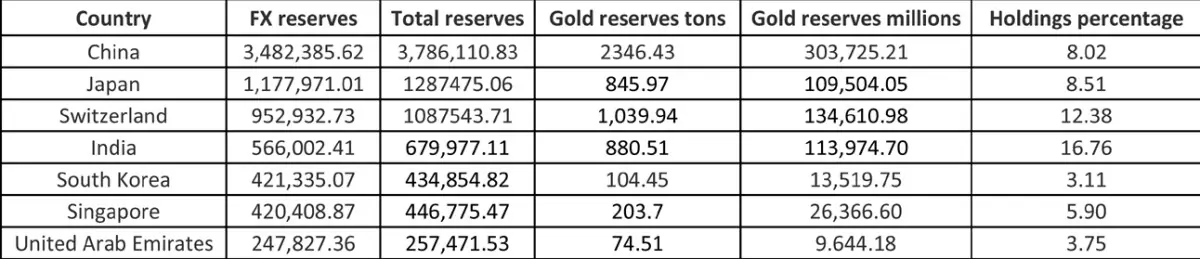
Three European countries have withdrawn their gold reserves that were parked in the US: (i) Germany transferred more than 216 tons – 111 stored in New York and 105 tons stored in Paris – over a period ending in 2016; (ii) France sold 129 tons of non-standard legacy gold held in New York between January 2025 and 2026, and used the proceeds to buy equivalent high purity bullion that met the London Bullion Market Association standards and stored it in Paris; and (iii) the Netherlands recently relocated 86 tons of gold (out of a total of 313 tons) from New York and Ottawa to London between March and August 2026 lowing its US and Canadian shares from 31 to 19 and 18.5 percent each.
The reason for storing gold abroad is because domestic storage comes at a high cost – security, audit infrastructure and insurance.
The central banks of Poland and China are currently proactively accumulating gold. Poland’s stated policy is to raise gold reserves to 20 percent of its reserves, and it currently has 582 tons, while China has accumulated 2330 tons though the exact amount is not known as China is steadily, on a monthly basis, adding to its gold reserves. Uzbekistan’s gold reserves make up a healthy 87 percent of its official reserves while Turkiye and India are adding tons pf gold to reinforce their reserves.
The question is why interest in gold reserves has resurfaced, given that the gold standard was abandoned in 1971 because it fixed the currency to the gold reserves held and therefore did not allow for the use of monetary policy, adjusting the policy rate, to control inflation.
In 2025, gold surpassed US treasuries as a share of official reserve but this development as per the IMF was “driven almost entirely by gold price valuation effects not reflected in currency composition of official foreign exchange reserves dollar share, which has remained broadly stable.”
Pakistan gold reserves were 64.82 tons from 2000 t0 2026 reaching an all-time high of 65.43 tons in the fourth quarter of 2007, a record low of 64.39 tons in the first quarter of 2010 and 64.82 tons in the second quarter of 2026 as per the World Gold Council. The amount is roughly 8.39 billion dollars fluctuating with international billion market, though this is not added to the foreign exchange reserves cited by the State Bank of Pakistan (SBP). In other words, unlike other central banks State Bank of Pakistan has made, very minor, adjustments.
Private sector gold holdings in Pakistan are not quantified, operating largely in the informal sector, but are projected at 2100 tons, estimated at a price of between 35 to 40 billion dollars. Indian households collectively hold the largest privately held gold in the world (25,000 to 34,000 metric tons) followed by China (31,000 metric tons).
The reason for private gold holdings is the fact that the general public considers gold to be a hedge against inflation and currency depreciation; and in the Sub-continent is a traditional dowry item purchased by all sections of society based on their purchasing power. The Federal Board of Revenue, like tax collection agencies around the world, classifies gold and jewelry as capital assets under the Income Tax Ordinance 2001, implying that holding gold in a locker or at home is tax-free, but selling it or failing to declare it can trigger capital gains. Income tax returns require an estimated price of all jewelry though it is next to impossible for the Board to be able to verify.
What however is significant in our case is that Islam requires 2.5 percent zakat on the total value of gold assets – a tax that if implemented could provide resources for use by the Benazir Income Support Programme. Enforcement however is subject to an individual’s conscience and of course awareness of the liability.
Copyright Business Recorder, 2026























Comments