


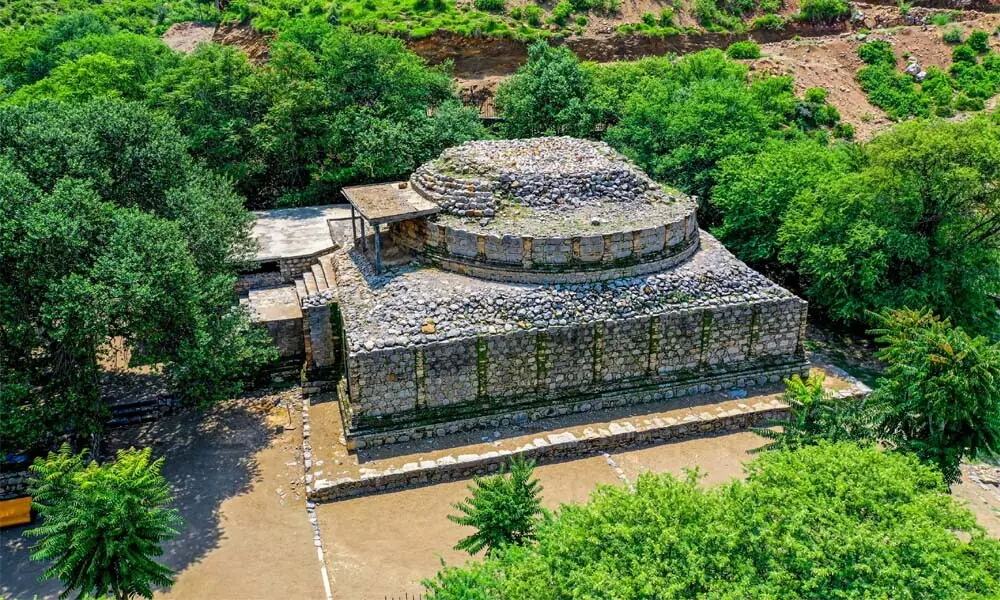
EDITORIAL: The controversy surrounding recent interventions at Mohra Moradu and Sirkap, two archaeological sites within the Taxila World Heritage complex, is escalating.
Unesco has reportedly asked the government to reverse what it considers “reconstructions” that have undermined the authenticity and integrity of these monuments, warning that failure to do so could see Taxila placed on its ‘danger list’ and, ultimately, delisted as a World Heritage Site.
At the heart of the dispute are allegations that original masonry has been replaced with new material and that surviving ancient walls have been raised in height in the name of conservation.
Photographs published in the media appear to show a clear distinction between the ancient stonework and the newer additions.
Unesco’s concerns merit serious attention. International conservation practice does not seek to make archaeological ruins appear complete or aesthetically pleasing; rather, it prioritises preserving a monument’s original fabric through the principle of minimum intervention, ensuring that conservation neither obscures nor replaces authentic historical evidence.
The Punjab archaeology department, however, disputes the characterisation of the work as “reconstruction”, maintaining that the interventions are intended to stabilise vulnerable structures and prevent further deterioration. It also says the work was explained during a recent technical visit by national and international experts. This explanation deserves consideration.
Conservation often involves difficult technical judgments. However, when concerns are raised by the very organisation entrusted with safeguarding the world’s cultural heritage, technical assurances alone do not suffice.
The most appropriate response, therefore, is complete transparency. Unesco has asked for conservation plans, heritage impact assessments, laboratory test reports on the materials used, compatibility studies, archaeological documentation and photographic records before and after the interventions. These should be shared without delay and subjected to independent professional review.
Such openness is essential not only to address Unesco’s concerns but also to strengthen public confidence in the management of Pakistan’s archaeological heritage.
The issue should be approached not as a contest between competing bureaucracies but as an opportunity to ensure that conservation practices conform to the highest professional standards.
The episode also underscores the need for stronger institutional safeguards. Conservation decisions affecting nationally and internationally significant sites should be guided by multidisciplinary expert committees operating under clear protocols aligned with Unesco conventions. Pakistan has witnessed similar controversies before.
The proposed construction of a stadium near Bhir Mound in 1998 threatened another component of the Taxila complex before public opposition forced its abandonment. That episode, like the present one, illustrates how decisions affecting irreplaceable heritage require rigorous scrutiny before, rather than after, they are implemented.
Taxila is more than an archaeological site; it is one of the region’s foremost repositories of human civilisation. Its significance lies not in how complete or visually impressive it appears, but in the authenticity of what has endured through the centuries.
The government’s engagement with Unesco should therefore be guided by one overriding principle: where the integrity of an irreplaceable heritage site is at stake, transparency, scientific conservation and adherence to internationally accepted standards must take precedence over all other considerations.
Copyright Business Recorder, 2026



















Comments