


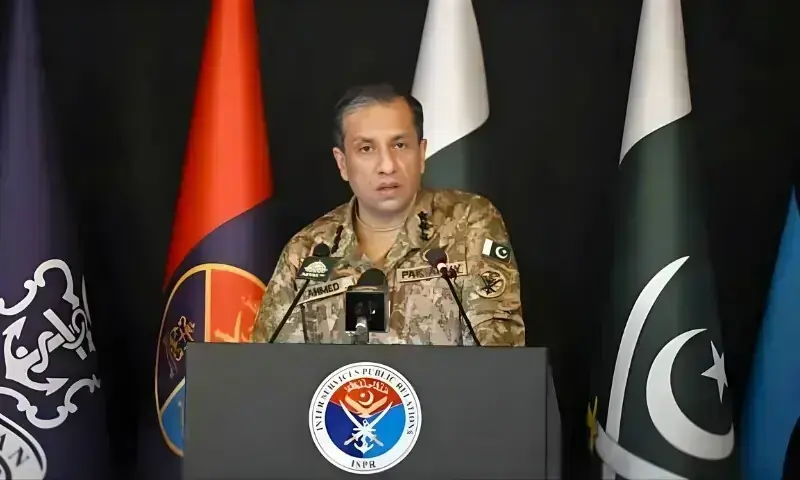

ISLAMABAD: Director General, Inter-Services Public Relations (DG ISPR) Lieutenant General Ahmed Sharif Chaudhry on Friday said that the security situation could not be addressed through kinetic operations alone, stressing that good governance was “quintessential” for Pakistan’s security and stability.
Addressing a wide-ranging press conference on the country’s security situation, he said that the security forces had conducted more than 40,000 intelligence-based operations (IBOs) this year, including over 31,000 in Balochistan alone, while nearly doubling anti-smuggling recoveries to Rs24.4 billion.
He outlined a whole-of-state strategy combining security operations, border management, economic enforcement and governance to counter terrorism.
The DG ISPR said 40,348 IBOs had been conducted so far in 2026 by the armed forces, intelligence agencies, police and civil armed forces.
According to figures shared during the briefing, 31,080 operations were conducted in Balochistan, 7,177 in Khyber Pakhtunkhwa and 2,091 in the rest of the country. The military spokesperson said the counterterrorism campaign was continuing around the clock, with security forces undertaking close to 200 operations daily when all operational and intelligence-led actions were taken into account.
Lt Gen Chaudhry said Pakistan had recorded 3,145 terrorist incidents this year, including 1,971 in Khyber Pakhtunkhwa, 1,148 in Balochistan and 26 in other parts of the country.
A total of 2,084 confirmed terrorists had been killed during the year, equivalent to an average of around 10 per day, which he described as the highest such ratio recorded. He said the casualty ratio had shifted in the state’s favour, with approximately 2.5 terrorists now being eliminated for every Pakistani martyred in terrorist violence.
However, he said 819 Pakistanis had embraced martyrdom during the same period, including 303 army personnel, 194 members of the police and civil armed forces, and 322 civilians.
The country had also witnessed 28 suicide bombings during 2026, he said, alleging that most of the attackers were Afghan nationals or individuals linked to Afghan security institutions.
Explaining why terrorist incidents remained high despite the scale of operations, the DG ISPR said proactive counterterrorism action inevitably led to more engagements. He maintained that terrorist groups and their sponsors had also intensified violence after their other strategies failed to achieve the desired results.
He ruled out appeasement or negotiations with terrorist organisations, saying they would either submit to the Constitution and the law or face continued action by the state.
He said the National Action Plan comprised 14 broad points, of which only one related directly to kinetic counterterrorism operations, while the remaining elements concerned governance, policing, judicial and administrative reforms, counter-extremism and institutional capacity.
Without improvements in governance, he argued, Pakistan’s security and socioeconomic problems could not be resolved. Any administrative restructuring needed to improve governance must, however, be undertaken through constitutional, legal and political processes reflecting the will of the people, he added.
Presenting the economic-security component of the state’s response, the briefing showed that recoveries under the anti-smuggling campaign had increased to approximately Rs24.4 billion in 2026, compared with Rs13.6 billion in 2025.
The figures reflected a rise of nearly 80 percent, indicating substantially expanded enforcement against illegal cross-border trade, particularly along Pakistan’s western frontier and within Balochistan.
The DG ISPR linked unchecked smuggling with entrenched political and economic interests in the province, saying certain influential groups portrayed illicit cross-border movement as legitimate business and resisted the state’s attempts to regulate it.
He alleged that some groups accustomed to benefiting from permits, informal trade and local patronage networks reacted to enforcement measures by supporting instability and promoting the impression that Balochistan was slipping out of state control.
The military spokesperson said the state would no longer appease individuals seeking personal or familial benefits under the guise of representing the province. Engagement, he added, would take place directly with the people of Balochistan rather than individuals who sought to preserve the status quo.
Figures displayed during the briefing also showed anti-narcotics recoveries rising from around Rs15.8 billion in 2025 to Rs17.4 billion in 2026.
Action against human trafficking and illegal border crossings had similarly intensified, with enforcement figures increasing from 1,527 cases or apprehensions in 2025 to approximately 4,595 during 2026, according to the presentation.
The state also highlighted what it described as a substantial decline in the movement of smuggled fuel since the launch of coordinated enforcement measures in October 2023.
According to briefing data, the estimated volume of smuggled fuel entering the country had fallen from around 20.5 million litres per day in 2023 to approximately 1.19 million litres per day in 2026.
The campaign was being supported by 25 joint operations, including five inter-provincial and 20 intra-provincial posts, aimed at restricting the movement of smuggled fuel, narcotics and other illicit goods beyond border districts.
The measures were presented as part of a broader attempt to shift commercial activity from informal and undocumented channels into the regulated economy, protect state revenue and deny organised criminal networks freedom of movement.
The DG ISPR said the government was also strengthening border management through the one-document regime, improved controls at formal crossing points and institutional reforms involving the Pakistan Land Port Authority.
He said approximately 2.6 million Afghans had been repatriated from Pakistan, including around 600,000 during the current year. The repatriation programme formed part of the government’s attempt to document cross-border movement and prevent the use of unregulated routes by terrorists, traffickers and smugglers.
The briefing presented kinetic operations, the repatriation programme, the anti-smuggling drive and border-control reforms as connected elements of the state’s security policy rather than separate administrative campaigns.
Turning to Balochistan, Lt Gen Chaudhry said the province’s security challenges were compounded by its vast geography, low population density, long international borders and limited response capacity in remote districts.
Balochistan covers 347,190 square kilometres, accounting for around 44 percent of Pakistan’s territory. Its dispersed settlements and extensive borders with Afghanistan and Iran made the rapid deployment of security personnel difficult, he said.
Police and Levies personnel were generally the first responders, followed by the Frontier Corps and, when required, the army. Terrorists frequently sought to exploit long distances and difficult terrain by carrying out hit-and-run attacks before reinforcements could arrive.
According to the DG ISPR, terrorists had killed 178 civilians in Balochistan during the year and kidnapped another 55. They had damaged roads and bridges at 24 locations, set property on fire in 60 incidents and carried out 47 incidents of looting.
Police and Levies personnel had been targeted in 105 incidents. The DG ISPR said attacks on labourers, roads, bridges, hospitals and other civilian infrastructure contradicted the claim that the groups involved were fighting for the province’s development.
He said the ongoing security response included Operation Shaban, subsequently expanded into Operation Al-Azm, with most operations being conducted jointly by the army, Frontier Corps and police.
Lt Gen Chaudhry said work was under way to enhance the capacity of civilian law-enforcement institutions in Balochistan rather than leaving the entire counterterrorism burden to the military.
Measures included the establishment of FC West in Chagai, which would also help secure the province’s emerging mineral corridor, the induction of newly recruited assistant superintendents of police, provision of bulletproof vehicles and improvement of police intelligence and operational capabilities.
The notes presented during the briefing also referred to the creation of specialised monitoring and evaluation mechanisms, stronger cyber and intelligence capabilities, improved information assessment and the greater induction of women into policing and associated institutions.
The DG ISPR criticised those who, he said, had historically treated the Levies as a force subordinate to tribal or political interests and resisted efforts to transform it into a professional law-enforcement institution.
Rejecting the narrative that Balochistan had been deliberately excluded from development, the DG ISPR said the province received the highest per-capita budgetary allocation in Pakistan, at more than Rs75,000 per person.
He said narratives of deprivation were being promoted while terrorist organisations themselves attacked labourers and infrastructure projects designed to improve connectivity and public services.
The briefing highlighted public investment in road networks, water infrastructure, education, healthcare, information technology, agriculture and human-resource development.
It referred to major schemes including the Pat Feeder Canal, Mangi Dam and extension of the Kachhi Canal, alongside district-level development initiatives and the Green Balochistan programme.
The DG ISPR said Rs70 billion had been allocated for socioeconomic projects in Balochistan, while another Rs24 billion had been earmarked for the Balochistan Special Development Initiative. Projects involving road connectivity, IT training and skills development were also being implemented.
He said the state’s policy was to engage directly with ordinary people, improve grassroots governance and combine development with stronger policing and enforcement.
Quoting Field Marshal Syed Asim Munir, he said Balochistan had the potential to become Pakistan’s richest province within five to 10 years because of its minerals, agriculture, coastline, blue economy and strategic location.
On missing persons, the DG ISPR said the relevant commission had received 10,901 applications since its establishment in the early 2010s, of which 9,372 had been disposed of.
He said 4,896 missing persons had returned home, around 1,030 had been traced to prisons, 308 had been found dead and approximately 2,400 cases had been classified as misreported.
Of the total applications, 2,933 were related to Balochistan, with 2,767 cases disposed of, according to the figures shared. He added that some individuals reported missing were subsequently identified among terrorists killed during operations.
The DG ISPR also accused terrorist organisations and hostile foreign networks of running a coordinated information campaign built around deprivation, lack of representation and missing persons.
He alleged that more than 300 Indian-linked websites and over 1,000 social-media accounts were being used to support terrorism-related propaganda concerning Balochistan.
Describing the information ecosystem, he said claims were initially “seeded” through closed or encrypted networks, framed by initiators, spread by online amplifiers and subsequently carried by Indian mainstream media before being picked up by international outlets.
He also alleged that terrorist networks were exploiting and blackmailing women, including through kidnapping and abuse, to force them into terrorist activities.
Lt Gen Chaudhry said Pakistan needed to become a “hard state”, clarifying that the term did not mean a military-dominated system.
A hard state, he explained, was one in which the Constitution and law applied equally to everyone, institutions performed their responsibilities and neither political influence nor tribal status placed anyone above the legal order.
Referring to Article 5 of the Constitution, he said loyalty to the state and obedience to the Constitution and law were fundamental duties of every citizen. Rights and genuine grievances could be discussed, but citizens must also recognise their constitutional obligations, he maintained.
He identified elitism, the tribal status quo, the expectation of appeasement, external interference and contiguous support bases in Afghanistan as major drivers of instability in Balochistan.
The DG ISPR alleged that India and the Afghan Taliban regime were supporting separate terrorist groups that differed ideologically but increasingly operated in coordination against Pakistan.
The state’s response, he said, would therefore continue to combine counterterrorism operations with anti-smuggling enforcement, regulated borders, police reform, socioeconomic development and direct political engagement with the people of Balochistan.
Copyright Business Recorder, 2026

















Comments