


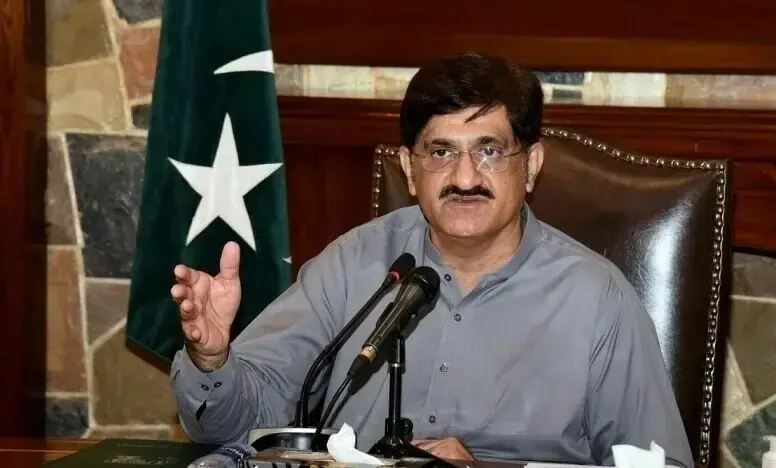

KARACHI: Sindh Chief Minister Syed Murad Ali Shah and Gilgit-Baltistan Chief Minister Advocate Amjad Hussain held a high-level virtual meeting on Saturday to strengthen inter-provincial cooperation and share Sindh’s successful experiences in revenue mobilisation, public-private partnerships (PPP), and post-disaster housing reconstruction.
The meeting focused on providing strategic guidance to the Government of Gilgit-Baltistan (GB) on enhancing own-source revenue collection through the establishment of a modern revenue authority, accelerating infrastructure and public service delivery through PPP projects, and exploring the replication of Sindh’s globally recognised flood-resilient housing programme.
He said Gilgit-Baltistan possesses enormous potential in tourism, hydropower and services. Through institutional reforms, digital governance and innovative financing models, this potential can be transformed into sustainable economic growth and improved public services.
He said Sindh is ready to provide strategic support in policy design, digital architecture, institutional development, human resource management and operational frameworks to help GB establish a modern and efficient tax administration.
He explained that the success of SRB was built on five core pillars: autonomous administration, fully digital workflows, automated tax tools, data-driven audits and taxpayer facilitation. “The future of revenue administration lies in digital governance, transparency and taxpayer trust. The Sindh Revenue Board has demonstrated that technology-driven reforms can significantly enhance revenue collection while making compliance easier for taxpayers.”
The meeting was informed that Sindh’s model includes mandatory e-registration, e-filing, online tax payments, automated withholding systems, business intelligence tools, point-of-sale integration and risk-based audit mechanisms.
Murad Shah highlighted several sectors where GB could substantially increase revenues, including telecommunications and internet services, hospitality and tourism, construction and engineering, banking and financial services, insurance and logistics operations linked to Sost Dry Port.
He directed SRB officials to provide technical assistance in drafting tax laws and rules, establishing IT infrastructure, training officers and developing a dedicated cadre of professional tax administrators.
Chairman SRB Wasif Memon briefed the participants on Sindh’s experience in modernising service tax administration and strengthening voluntary compliance through digital platforms and taxpayer facilitation mechanisms.
Murad Ali Shah also shared the experience of the Sindh Peoples Housing for Flood Affectees (SPHF), describing it as one of the largest post-disaster housing reconstruction programmes in the world. “On the instructions of PPP Chairman Bilawal Bhutto Zardari, our government launched a historic initiative to rebuild the lives of flood-affected families,” he said. “Out of 2.1 million houses planned, more than one million houses have already been completed, and around 1.6 million are at different stages of construction.”
The meeting was informed that the programme is supported by an international financing package exceeding USD2.2 billion, contributed by the Government of Sindh, the World Bank, Asian Development Bank, Islamic Development Bank, Federal Government, European Investment Bank and the European Union.
The Sindh team also presented a proposed reconstruction model for 196 flood-damaged houses in Gilgit-Baltistan, designed to withstand floods and seismic events. The model includes elevated foundations, reinforced concrete structures and essential sanitation facilities, with an estimated project cost of Rs360.6 million.
A comprehensive presentation was also given on Sindh’s Public-Private Partnership framework, which has emerged as one of the most successful PPP models in the country.
Murad Shah said Sindh began establishing its PPP framework in 2008 with technical support from the Asian Development Bank, followed by the enactment of the Sindh PPP Act in 2010.
He said dedicated financing instruments such as the Viability Gap Fund and Project Development Facility had played a crucial role in attracting private investment into public infrastructure projects. “Public-private partnerships enable governments to deliver quality infrastructure and services while leveraging private-sector innovation, expertise and investment,” he said.
The Sindh PPP Unit offered to assist Gilgit-Baltistan in developing its own PPP framework, including legal and regulatory reforms, institutional arrangements, project preparation mechanisms, funding structures and capacity-building initiatives.
Sindh CM particularly encouraged GB to explore PPP opportunities in hydropower, tourism infrastructure, roads, hospitality facilities and public services.
GB CM appreciates Sindh’s support
The Chief Minister of Gilgit-Baltistan, Advocate Amjad Hussain, thanked the Sindh government for sharing its experiences and expertise and appreciated the proactive support being extended under the guidance of PPP Chairman Bilawal Bhutto Zardari.
He said Gilgit-Baltistan was keen to learn from Sindh’s successful reforms and development initiatives, particularly in revenue generation, climate-resilient housing and public-private partnerships.




















Comments