


FDI recovery remains elusive
Pakistan's foreign direct investment (FDI) significantly declined by 34% in FY26 to $1.64 billion, with increased outflows and reduced inflows, showing no signs of recovery.
- The 34% decline in net FDI in FY26.
- Decreased foreign investment inflows and rising capital outflows.
- Declining investment from key countries like China and UAE.
- Significant net outflows from the United States and Norway.
- Factors needed to attract foreign investors beyond stability.

Foreign direct investment in Pakistan weakened further in FY26, with little to suggest that a recovery is around the corner. Despite greater macroeconomic stability and some easing of external account pressures, foreign investors remain cautious. According to provisional SBP data, net FDI fell to $1.64 billion in FY26, down 34 percent from $2.48 billion in the previous year.
The weakness was visible on both sides of the equation. Gross inflows declined by 16.4 percent to $3.57 billion from $4.27 billion, while outflows increased by 7.8 percent to $1.93 billion from $1.79 billion.
In simple terms, Pakistan attracted less fresh foreign investment while more capital was withdrawn through divestments and other FDI-related transactions. This is not the trend expected from an economy hoping to revive investment, exports, and growth.
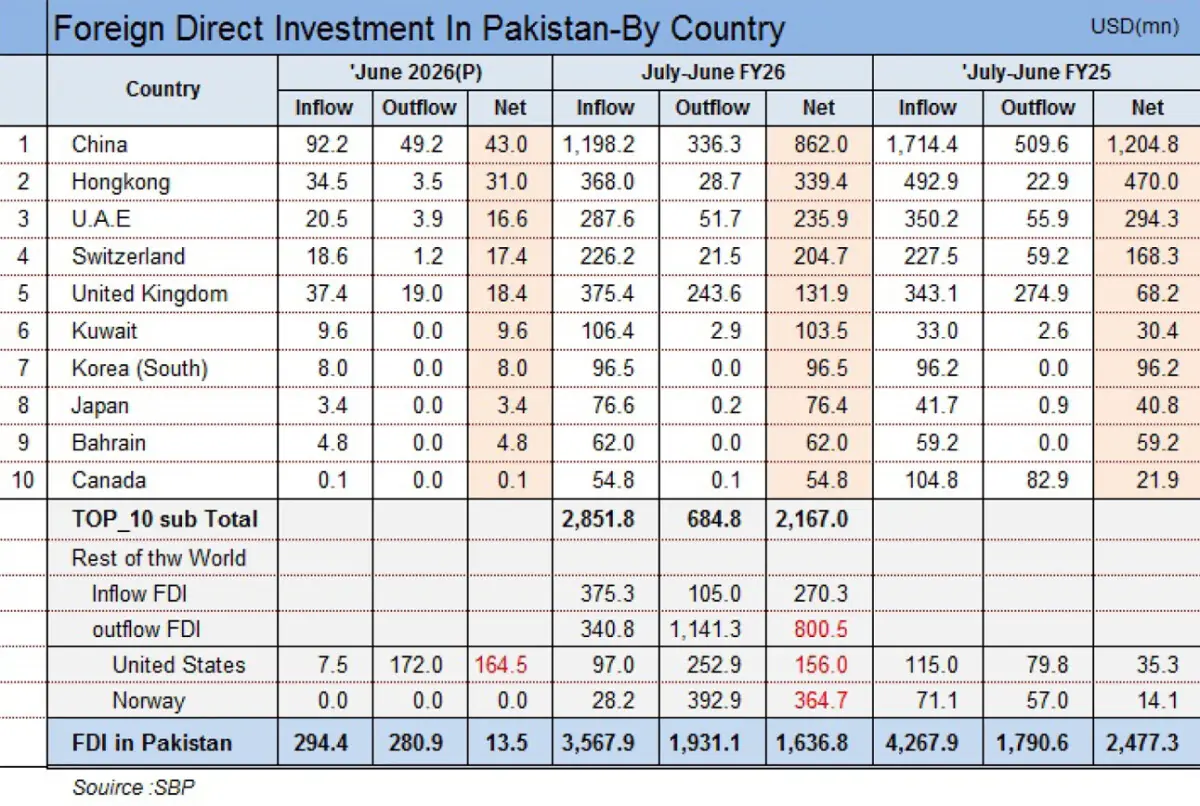
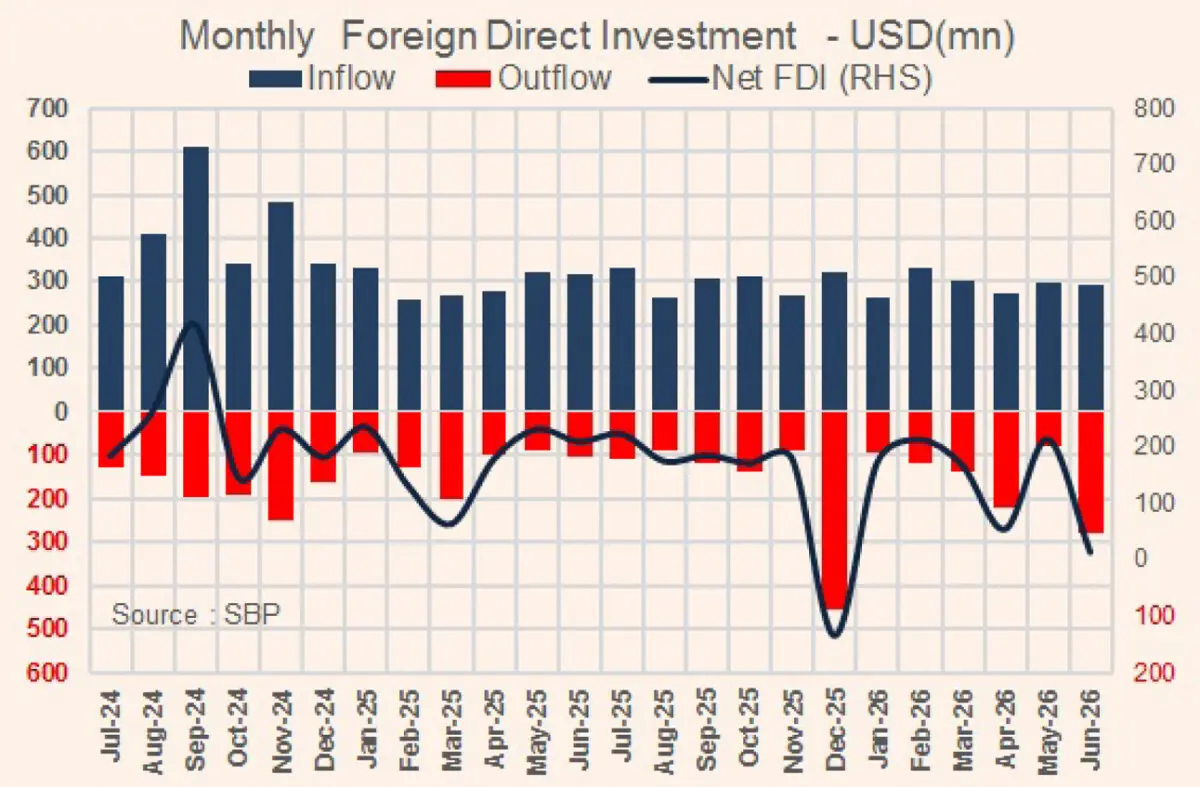
June ended the year on an equally disappointing note. Net FDI stood at just $13.5 million, as inflows of $294.4 million were almost completely offset by outflows of $280.9 million.
Monthly investment numbers can be volatile, but the broader trend has remained weak for some time. Positive inflows are regularly offset by large withdrawals, leaving little sustained momentum.
China remained Pakistan’s largest source of FDI in FY26, but Chinese investment also lost momentum.
Net investment from China declined to $862 million from $1.20 billion in FY25. Investment from Hong Kong fell to $339.4 million from $470 million, while net flows from the UAE declined to $235.9 million from $294.3 million.
Together, China, Hong Kong and the UAE accounted for nearly 88 percent of Pakistan’s net FDI in FY26. This highlights a long-standing concern: foreign investment remains heavily concentrated in a small number of countries.
There were improvements in net investment from Switzerland, the United Kingdom, Kuwait, and Japan, but these increases were not enough to offset weaker flows from major investors and sizeable withdrawals elsewhere.
Net outflows from the United States and Norway also weighed heavily on the overall numbers. The United States recorded a net outflow of $156 million during FY26, while Norway posted a much larger net outflow of $364.7 million. In June alone, the United States recorded a net outflow of $164.5 million, more than offsetting the combined $90.6 million received from China, Hong Kong, and the UAE.
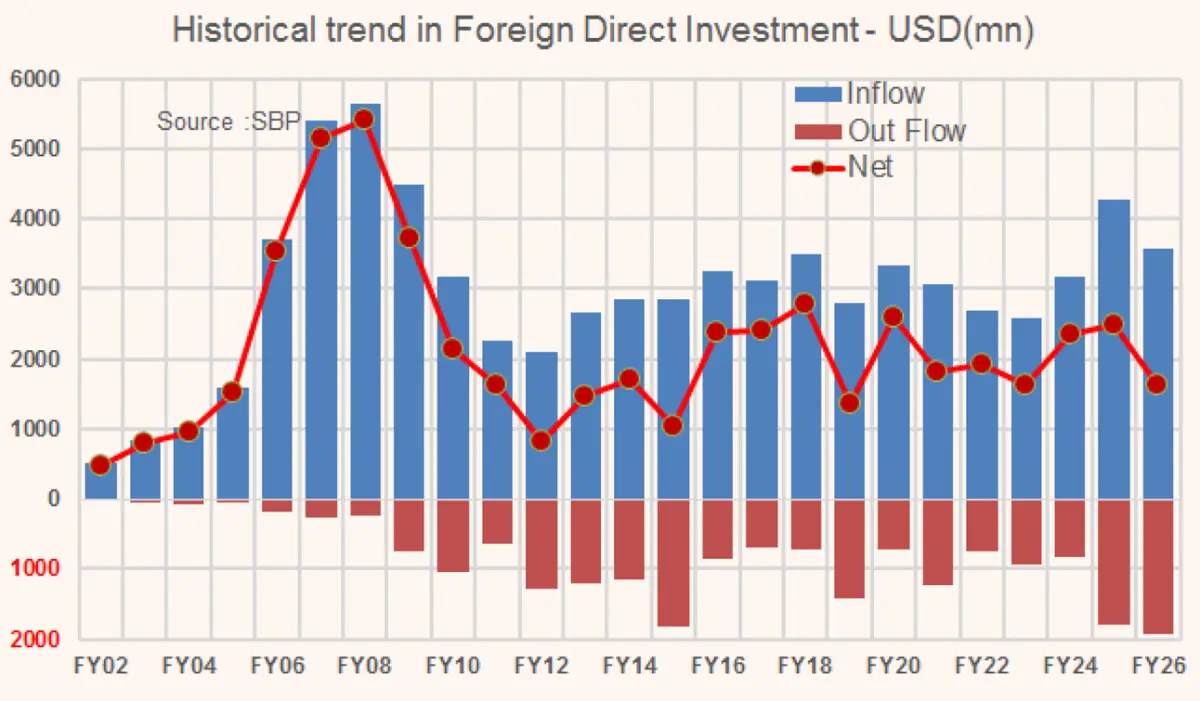
The longer-term trend is even less encouraging. Pakistan’s annual net FDI remains far below the levels seen around FY07 and FY08, when it exceeded $5 billion. Today, net FDI of around $1.6 billion is simply not enough to meaningfully expand productive capacity, exports, and employment.
Macroeconomic stability may have reduced the fear of an immediate crisis, but stability alone does not bring investment. Investors also need policy consistency, predictable taxation, reliable energy, smooth profit repatriation, contract enforcement, and a clear long-term economic direction. Pakistan continues to struggle on many of these fronts.
FY26 was therefore another weak year for foreign investment. With inflows falling, outflows rising and June ending almost flat, there are still no convincing signs of a turnaround.





















Comments